
Why Indian Hospitals Struggle to Move Beyond AI Pilots
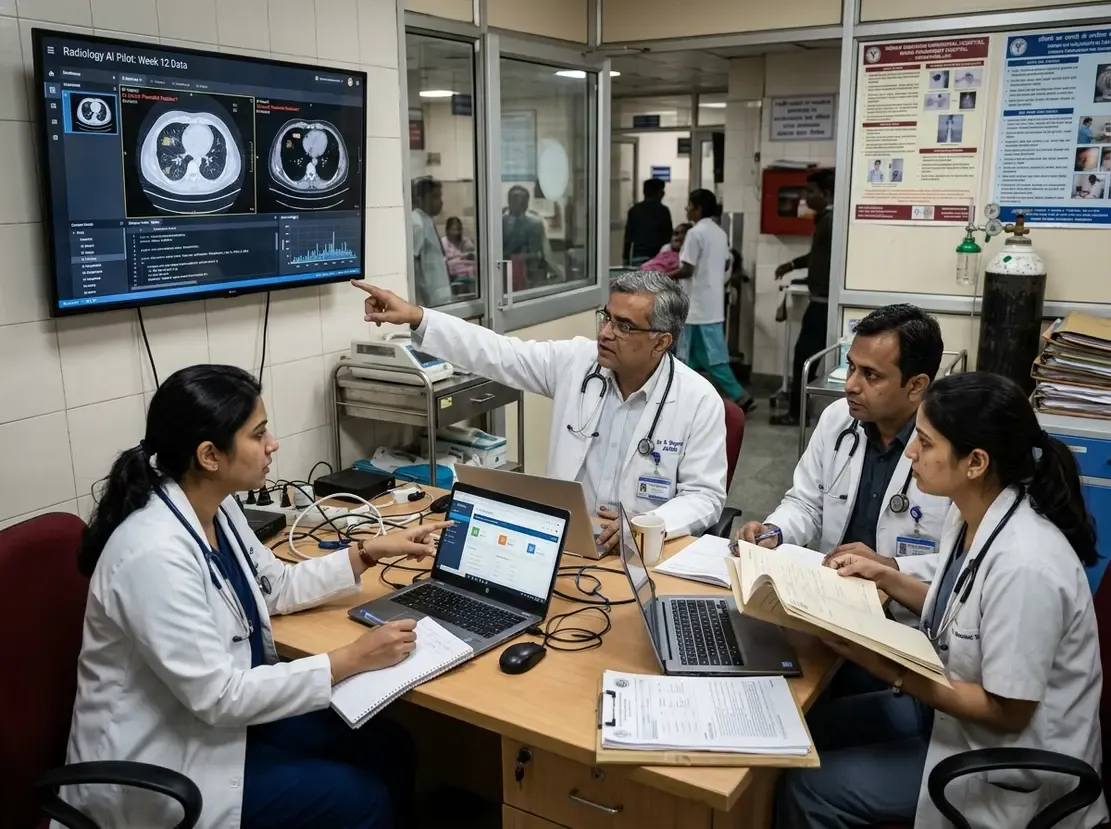
Indian healthcare institutions currently evaluate dozens of digital health applications. However, sustainable deployment of AI in hospitals remains an uphill battle across India. Leaders at the ETHealthcare Leaders Summit noted that pilot projects rarely transition into mainstream clinical practice. Consequently, institutions often treat intelligent software as an additional expense rather than an operational efficiency driver. Healthcare providers must therefore address structural integration barriers before meaningful adoption can occur.
The Pilot Trap for AI in Hospitals
Around 95 percent of health technology pilots disappear into an operational valley of death. Furthermore, developers frequently build algorithms in technical silos without analyzing hospital realities. As a result, software that delivers promising experimental numbers often fails in busy public wards. Small facilities frequently adopt newer algorithmic models faster than tertiary hospitals because their administrative hierarchies are simpler. Therefore, executives must stop launching isolated pilot experiments. Instead, healthcare organizations need unified, well-orchestrated technological architectures.
Screening Alone Cannot Substitute for Clinical Care
Artificial intelligence systems can efficiently flag pulmonary lesions or diabetic retinopathy. However, algorithms do not deliver patient treatment on their own. Healthcare delivery requires beds, clinicians, medications, and reliable follow-up protocols. For example, a village screening camp creates minimal value if local clinics cannot manage newly confirmed diagnoses. Consequently, diagnostic tools must link directly with existing clinical care pathways. Clinicians should ensure that every automated alert connects to actionable clinical interventions.
Algorithmic Bias and Indian Population Diversity
High test accuracy on a small cohort often creates dangerous false confidence. Specifically, models trained on homogeneous demographic datasets carry significant risks of bias. India presents immense regional, socioeconomic, genetic, and cultural heterogeneity. Therefore, algorithms trained in Western populations or single urban centers frequently fail across rural cohorts. The Indian Council of Medical Research emphasizes rigorous local validation across varied ethnic demographics. Thus, hospitals must demand multi-center clinical validation data before purchasing diagnostic applications.
Software Versus Labour: A Deflationary Shift
Conventional enterprise software typically inflates operational budgets. For instance, hospitals must purchase perpetual licenses, hire administrative managers, and train staff on intricate interfaces. In contrast, clinical intelligence systems act as deflationary medical labour. An automated tool functions like a tireless resident, reducing repetitive clicks and drafting preliminary case summaries. At leading oncology centres, automated clinical documentation already reduces administrative task time from several minutes to sixty seconds. Moreover, advanced machine learning now transitions from simple screening to comprehensive radiological diagnosis.
Practical Strategies for Hospital Leadership
Hospital administrators should avoid evaluating AI tools as isolated line items. Instead, leadership teams must calculate holistic labor savings and clinical turnaround improvements. Furthermore, departments should prioritize tools that integrate directly into existing electronic medical record systems. Clinicians are eager to adopt technology that removes administrative burdens without interrupting clinical workflows. Consequently, institutional leadership must focus on end-to-end integration, robust data governance, and clinician-led evaluation.
Frequently Asked Questions
Q1: Why do most healthcare AI pilots fail to reach full deployment in India?
Most pilots fail because developers create them in isolated technical silos without accounting for real-world hospital workflows. Additionally, many projects lack sustainable reimbursement models and clear pathways linking early detection to clinical treatment.
Q2: How does clinical AI differ from standard hospital enterprise software?
Standard enterprise software often inflates administrative overhead by requiring continuous user data entry. In contrast, clinical intelligence functions as a deflationary operational assistant, automating repetitive radiological analysis and document processing.
Q3: How can Indian hospitals prevent algorithmic bias in automated diagnostics?
Hospitals must mandate clinical validation across representative, multi-center cohorts that mirror India's demographic and ethnic diversity. Furthermore, ethics committees should follow the Indian Council of Medical Research guidelines on data equity and model transparency.
References
- Integration is the real barrier to AI in hospitals: Experts - ETHealthworld
- Ethical Guidelines for Application of Artificial Intelligence in Biomedical Research and Healthcare - Indian Council of Medical Research (ICMR)
- AI in Indian Healthcare Delivery - Bain & Company


