Ayush Sector Boom: What Doctors Must Know About Growth
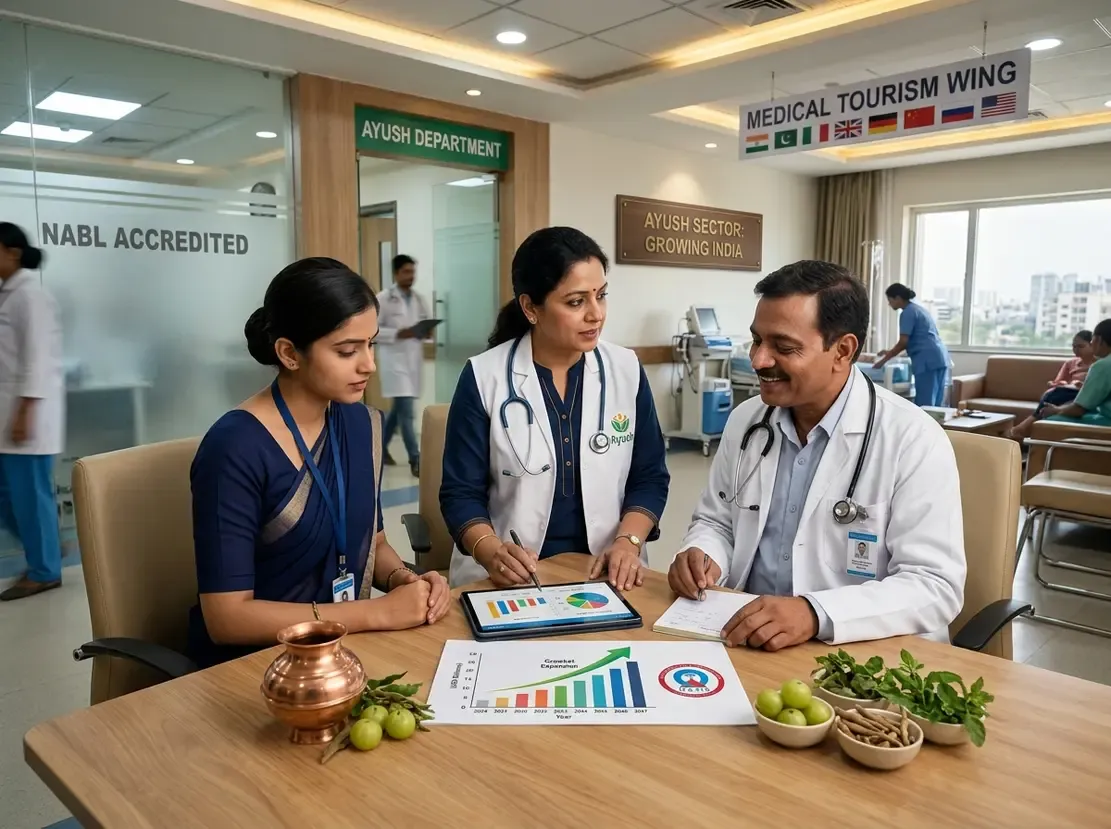
The Ayush services sector has established itself as one of the fastest-growing components in Indian healthcare. A nationwide survey by the Research and Information System for Developing Countries reveals significant economic expansion. Specifically, the sector generated 36.92 billion dollars in 2024-25. Furthermore, researchers project that revenue could reach 318 billion dollars by 2047. Consequently, mainstream clinicians must understand how this rapid growth impacts primary care delivery and cross-referral pathways.
Economic Scale of the Ayush Services Sector
The comprehensive study evaluated 15,914 healthcare establishments across all six traditional Indian medicine systems. Notably, the sector expanded at an impressive compound annual growth rate of 16.91 percent since 2022-23. In addition, traditional facilities directly support roughly 1.76 million livelihoods throughout the country. Ayurveda represents the largest individual discipline, contributing nearly 48 percent of total service revenue. Meanwhile, wellness facilities and yoga centers registered remarkable gains exceeding 70 percent over two years. Therefore, traditional systems have shifted from informal practice to an organized economic engine.
Key Growth Drivers Across Healthcare Facilities
Primary care clinics and day-care centers generated more than 71 percent of total revenue. Specifically, standalone clinics contributed over 16 billion dollars, anchoring community-level patient outreach. Moreover, outpatient clinics sustain more than one million jobs across urban and semi-urban communities. Women comprise 43 percent of the total workforce, showing even higher representation in organized wellness units. Consequently, these facilities play an essential role in expanding localized access to preventive healthcare.
Accreditation and Medical Value Travel Opportunities
Medical Value Travel represents another high-yield segment for traditional Indian healthcare providers. International patients generated approximately 1.77 billion dollars in revenue during 2024-25. Furthermore, foreign medical tourists contributed up to 25 percent of hospital revenues despite lower overall volume. Notably, clinical programs like Panchakarma require longer stays, averaging between five and eleven days. Formal accreditation through NABH or ISO doubled the odds of attracting international medical travelers. In addition, digital adoption and functional websites tripled patient acquisition for participating centers. Therefore, standardized clinical records and quality audits remain vital for future cross-border integration.
Frequently Asked Questions
Q1: What is driving the rapid expansion of the Ayush services sector?
Rising consumer preference for preventive health, expanding wellness tourism, and increased clinic infrastructure fuel this sustained growth.
Q2: How does quality accreditation affect Ayush healthcare facilities?
Accreditation through NABH or ISO doubles the odds of attracting foreign medical travelers by establishing formal quality benchmarks.
Q3: What role do standalone clinics play in Ayush service delivery?
Standalone clinics generate the majority of sector revenue and provide more than one million jobs across local communities.
References
- Ayush services sector growing fast; projected to hit up to USD 318 billion by2047: Study - ETHealthworld
- Research and Information System for Developing Countries (RIS). Ayush Services Sector Report: Mapping Growth, Employment, and Medical Value Travel. 2026.
- Ministry of Ayush, Government of India. Ayush Vision 2030 and Global Healthcare Framework. 2026.