
Innovative Stepwise Removal of Genital Foreign Bodies
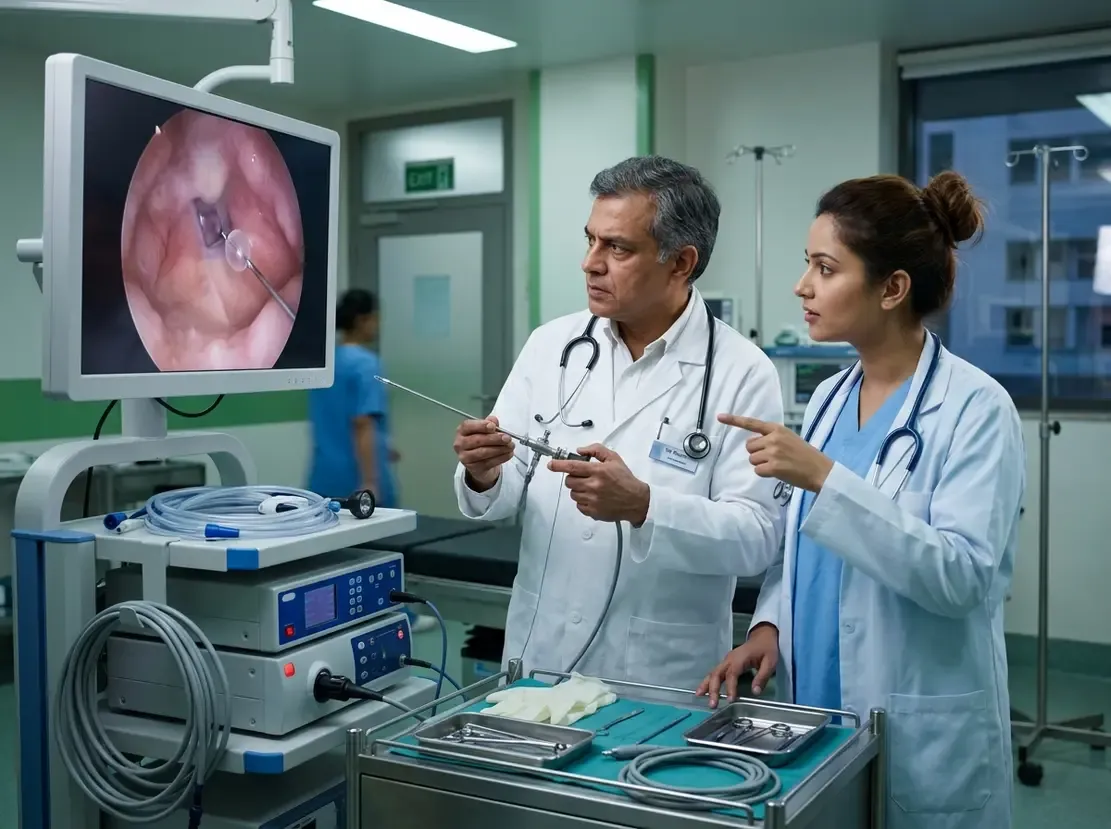
Clinicians occasionally encounter retained objects within the reproductive tract that present unusual diagnostic challenges. Although uncommon, retrograde migration into the endocervix or uterine cavity can cause chronic pain, foul-smelling discharge, or recurrent infection. In such complex cases, hysteroscopic foreign body removal offers an accurate and tissue-sparing solution. Surgeons can avoid aggressive blind extraction by utilizing direct endoscopic visualization.
Consequently, this approach preserves structural integrity in nulliparous adolescents and adult women.
Clinical Presentation of Retrograde Migration
Foreign objects inside the female genital tract often originate from accidental retention, hygiene products, or self-insertion. However, persistent muscular contractions and local inflammatory reactions can gradually displace these objects upward. Over time, surrounding tissues develop dense fibrous encapsulation around the foreign material. Therefore, standard grasping forceps often fail to dislodge the retained object during initial office examinations.
Additionally, forceful extraction without proper visualization carries significant risks. Patients may experience severe cervical lacerations, vaginal tears, or even uterine perforation. For instance, pediatric and adolescent patients face heightened vulnerability due to delicate anatomical structures. Thus, gynaecologists require gentle, stepwise interventions to release entrapped objects safely.
Technique for Hysteroscopic Foreign Body Removal
To overcome fibrotic entrapment, surgeons developed a refined two-step technique. First, the surgeon performs hysteroscopic foreign body removal using direct visualization with continuous fluid distension. The operator identifies the surrounding fibrous ring near the cervix or uterine cavity. Subsequently, the surgeon makes controlled radial incisions into the fibrotic tissue using a 5-Fr bipolar needle-tip electrode. This precise electrosurgical incision releases the mechanical constriction without damaging adjacent normal structures.
Next, the operative team introduces a Foley catheter into the cervical canal. The surgeon inflates the catheter balloon with approximately 30 mL of sterile saline. The inflated balloon remains in place overnight to achieve gentle, mechanical tissue dilation. As a result, the expanded canal facilitates effortless removal of the foreign object on the following day without additional surgical trauma.
Clinical Outcomes and Practical Advantages
This hybrid protocol has demonstrated excellent success across diverse clinical scenarios. For example, clinicians successfully extracted a retained cosmetic spray cap in a 12-year-old girl and an entrapped douche cap in an adult woman. Both patients achieved uneventful recoveries without structural complications or infection.
Moreover, the method eliminates the need for aggressive mechanical cervical dilators. This advantage is especially beneficial in patients with severe cervical stenosis or nulliparous anatomy. Furthermore, the overnight catheter placement softens fibrous tissue gradually. Consequently, surgical teams can achieve complete object retrieval while minimizing patient distress and procedural morbidity.
Frequently Asked Questions
Q1: Why do foreign bodies migrate in a retrograde direction?
Negative intragenital pressure, pelvic floor contractions, and chronic inflammatory tissue changes can slowly draw retained objects upward toward the cervix and uterine cavity.
Q2: What is the main benefit of overnight balloon dilation?
The balloon provides gradual, atraumatic dilation of the fibrous cervical tissue, which prevents severe lacerations and permits smooth object extraction.
Q3: When should clinicians consider this hysteroscopic approach?
Surgeons should utilize this method when foreign objects are firmly entrapped by fibrotic rings or when standard office forceps cannot safely achieve retrieval.
References
- Di Spiezio Sardo A et al. The Retrograde Migration of Foreign Bodies inside the Female Genital Tract: A Step-by-Step Hysteroscopic Approach. Am J Obstet Gynecol. 2026 Oct 07. doi: undefined. PMID: 42843582.
- Al-Hussaini TK, Abdellah MS, Zakherah MS. Hysteroscopic management of retained intrauterine foreign bodies. Int J Gynaecol Obstet. 2008;102(3):284-287.
- Stamatellos I, Apostolides D, Stamatopoulos P. Hysteroscopic removal of retained foreign bodies from the uterine cavity: a case series. Case Rep Obstet Gynecol. 2013;2013:461585.


