
Over 10,000 PG Medical Seats Blocked: Float Rule Review
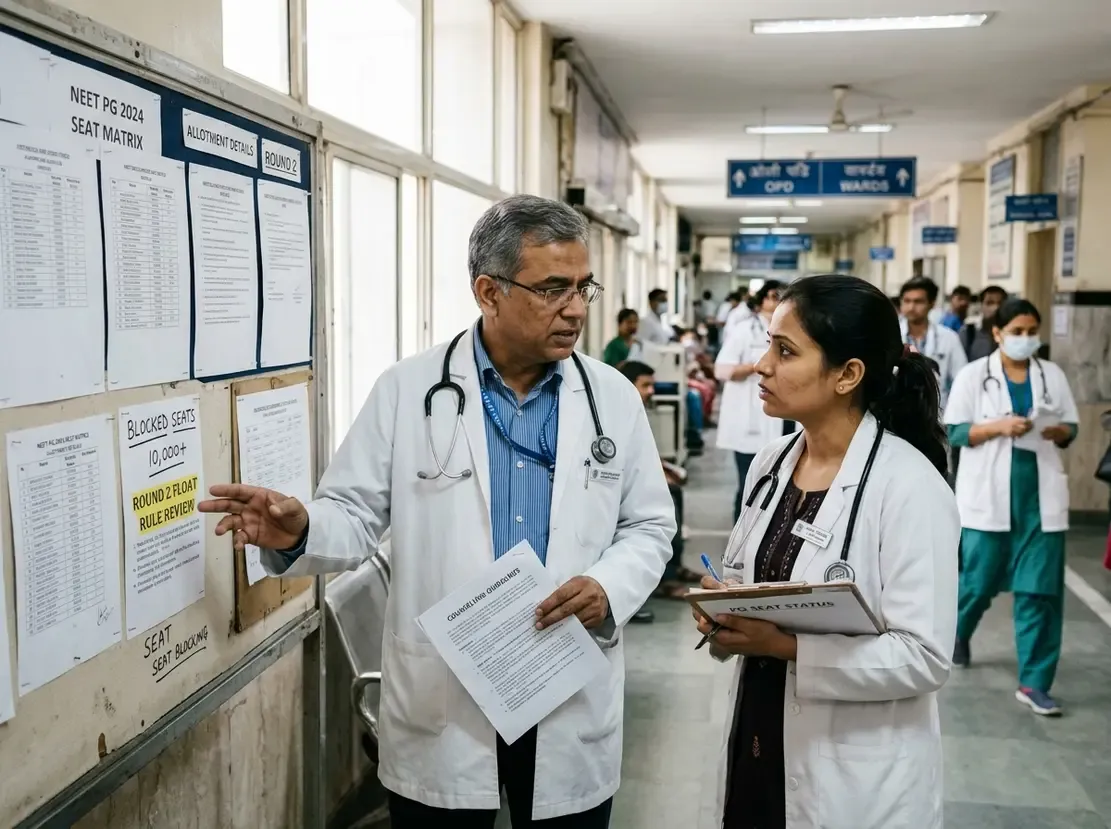
Recently, admission data revealed widespread NEET PG seat blocking after the completion of Round 2 counselling. Specifically, more than 10,000 postgraduate medical seats appeared under the blocked category. Many candidates retained one seat through All India quota counselling and another through state counselling simultaneously. Consequently, the Union Health Ministry is now reviewing the newly launched float system. This unexpected bottleneck has caused significant distress among thousands of aspiring postgraduate resident doctors across India.
Scale and Speciality-Wise Impact of the Blockade
According to data on the SARTHA platform, candidates blocked exactly 10,105 medical seats. Furthermore, the platform filtered this data directly from Medical Counselling Committee All India allotments. Medical activists quickly highlighted these numbers on social media to alert health authorities. Notably, MD General Medicine recorded the highest number of blocked seats at 1,026 positions. In addition, MS Obstetrics and Gynaecology followed closely with 861 blocked seats. MS General Surgery also registered 786 seats held under dual status. Therefore, top clinical specialities experienced the severe brunt of this holding phenomenon.
Factors Contributing to NEET PG Seat Blocking
Officials noted that the newly introduced float option directly facilitated this parallel seat retention. Under this facility, candidates can retain an allotted seat while seeking an upgrade in subsequent rounds. However, All India Quota and state counselling authorities operate on completely disconnected online portals. Because these platforms do not sync data, a single candidate can select float on both systems. Thus, candidates effectively hold two separate seats without immediate physical joining penalties. Although authorities designed the float option for candidate convenience, lack of unified oversight created severe loopholes. Moreover, differences in state reservation policies continue to prevent the creation of a single admission portal.
Proposed Government Reforms and Future Outlook
In response to mounting concerns, the government is considering major revisions to counselling protocols. Specifically, administrators may restrict the float facility strictly to the first round. Candidates would then face mandatory physical reporting and document deposition from Round 2 onward. Meanwhile, the Federation of All India Medical Association demanded immediate corrective action for affected aspirants. The association requested a 24-hour deferment of Round 2 results alongside a seat surrender window. Consequently, this window would allow candidates to vacate either their state or national quota allotment. Officials plan to review all counselling data thoroughly before finalising policies for upcoming cycles.
Frequently Asked Questions
Q1: What caused the large number of blocked seats in NEET PG 2026?
The primary cause stems from the float facility running across separate All India and state portals. As a result, candidates could hold seats in both counselling processes simultaneously without reporting physically.
Q2: Which clinical branches experienced the highest seat blocking?
MD General Medicine witnessed the highest blockade with 1,026 seats. In comparison, MS Obstetrics and Gynaecology followed with 861 seats, while MS General Surgery recorded 786.
Q3: What changes is the government planning for future counselling cycles?
Officials may restrict the float option to Round 1 only. Additionally, authorities may mandate physical reporting and certificate submission starting from Round 2.
References
- Over 10k postgraduate medical seats in blocked category; govt may review floatsystem - ETHealthworld
- NEET PG 2026: 10,105 Medical Seats Flagged as Blocked, Government May Examine Float Counselling Policy - Jagran Josh
- NEET PG Candidates Flag Counselling Gaps As 10,105 Seats Show Up Under Blocked Category - Times Now


