Novel Recombinant Antivenom Shields Against Cobra Bites
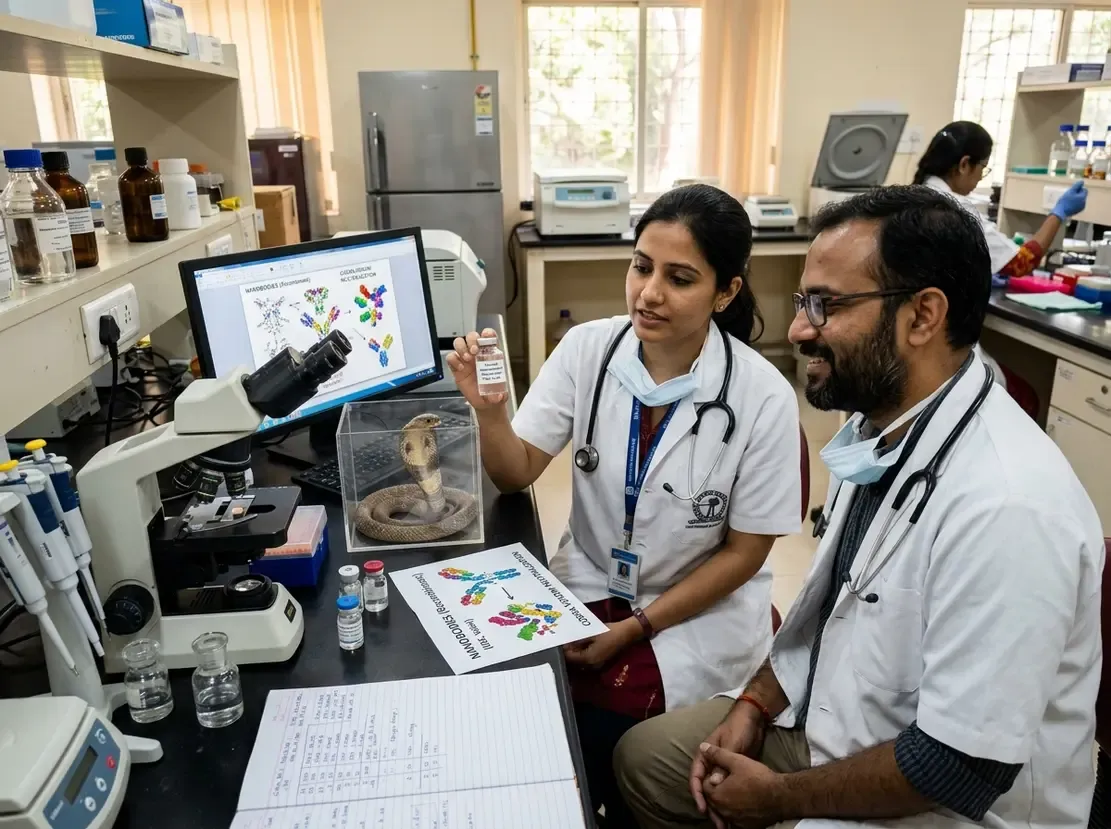
Snakebite envenomation remains a severe neglected medical emergency across India. Consequently, a team from the Indian Institute of Science and the Technical University of Denmark has designed a novel recombinant antivenom. This modern biologic offers broad protection against spectacled cobras, monocled cobras, and Indian king cobras. Moreover, the lab-produced solution avoids the limitations of traditional equine serum.
Limitations of Conventional Equine Antivenoms
For over a century, clinicians have relied on horse-derived immunoglobulins to treat envenomation. However, conventional antivenom manufacturing depends on immunising animals with raw snake venom. As a result, these legacy therapies suffer from high batch-to-batch variability. In addition, equine products frequently trigger severe adverse reactions, including anaphylaxis and serum sickness. Animal immunisation also yields relatively low concentrations of active neutralizing antibodies. Therefore, Indian emergency physicians urgently require modern, consistent alternatives.
How the Recombinant Antivenom Neutralizes Venoms
To overcome these obstacles, scientists engineered synthetic antibody fragments called nanobodies. Specifically, these nanobodies originate from camelid heavy-chain antibodies. The research team combined five distinct nanobodies into a unified therapeutic cocktail. Furthermore, this cocktail targets shared toxin motifs across diverse geographic populations. Consequently, the synthetic molecules block venom proteins from attaching to cellular receptors. In laboratory tests, this formulation rescued mice even when researchers administered treatment thirty minutes after venom injection. In fact, paralysed mice recovered completely without displaying residual neurotoxicity.
Clinical Implications for Snakebite Care in India
India reports approximately 50,000 snakebite fatalities every year. Spectacled cobras alone cause the largest share of these fatal injuries. Therefore, a broad-spectrum therapy marks a pivotal breakthrough for rural healthcare centres. Furthermore, biotech expression platforms enable rapid, animal-free antibody manufacturing. Health systems can scale production without relying on horse farms or venom milking. However, this specific cocktail does not yet neutralize viper or krait toxins. Thus, researchers plan to incorporate additional binders to develop an all-inclusive pan-Indian antivenom.
Frequently Asked Questions
Q1: What is a recombinant antivenom?
A recombinant antivenom is a laboratory-engineered biologic produced via microbial or cell culture expression systems. Consequently, it eliminates the need to harvest plasma from venom-injected animals like horses.
Q2: Why are nanobodies advantageous for snakebite treatment?
Nanobodies are tiny antibody fragments that penetrate deep tissues rapidly. Furthermore, their synthetic design reduces immunogenic side effects and offers consistent neutralization across diverse cobra venoms.
Q3: Does this new antivenom cover all Indian venomous snakes?
No, this initial formulation targets cobras and king cobras specifically. However, researchers are adding more antibodies to ensure coverage against kraits and vipers in future iterations.
References
- Researchers develop lab-produced antivenom offering broad protection fromdiverse Indian cobras - ETHealthworld
- Indian Institute of Science (IISc). Engineered antibodies offer broad protection against deadly cobra toxins. Science Translational Medicine, September 2026.
- The Times of India. New hope for snakebite victims: IISc develops first recombinant antivenom. Published September 10, 2026.