
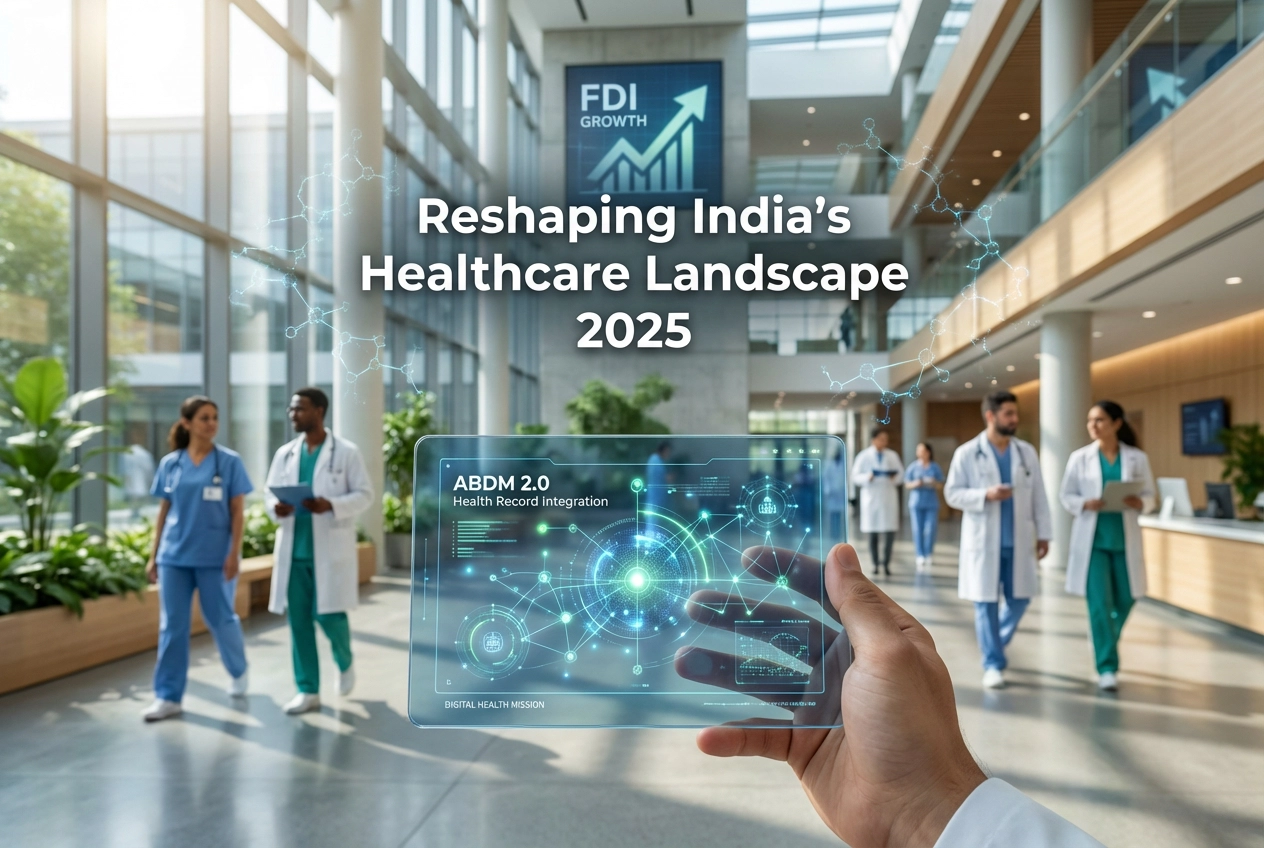
India’s health sector experienced transformative shifts in 2025, driven by ambitious digital public infrastructure. The national healthcare burden has notably shifted toward age-related multimorbidity, demanding new care models as a result of hard-won gains against infectious diseases and increased life expectancy. The launch of ABDM 2.0, a major evolution in the Ayushman Bharat Digital Mission, is among the most tectonic changes in the sector. This new iteration moves beyond digital identities to build a person-centric system, thereby enabling individuals to better manage their own health.
The Tectonic Shift of ABDM 2.0
The original Ayushman Bharat Digital Mission (ABDM) concentrated on digital identities and facility registries. However, ABDM 2.0 elevated the national conversation to focus on longitudinal personal health records (PHRs), interoperability, and patient-controlled data flows. Consequently, this shift proves transformative for chronic disease management, which remains the main problem in India’s health transition. Conditions like diabetes, hypertension, and cardiovascular risk require continuous monitoring and proactive intervention, not just episodic consultations. Therefore, ABDM 2.0 represents the first national infrastructure capable of supporting scaled, continuous chronic care in India. Crucially, the private sector has responded swiftly, demonstrating how citizen-facing health technology can automate lab report ingestion, provide medication reminders, and enable seamless record-sharing across providers through a single consent mechanism. Collectively, these features mark a fundamental pivot from provider-centric to person-centred care, generating AI-ready data streams that will shape the next decade of health innovation.
Policy and Finance: Catalyzing the Post-Hospital Era
Bold policy decisions reinforced this digital shift. For example, the passage of the Sabka Bima Sabki Raksha (Amendment of Insurance Laws) Bill, 2025, merits significant mention. This landmark legislation, which included enabling 100% Foreign Direct Investment (FDI) in insurance, will likely lead to a structural reconfiguration of healthcare financing in India. Allowing 100% FDI is expected to attract more global capital, expertise, and competitive pressure, ultimately stimulating product innovation. Furthermore, this change provides insurers with both the incentive and the digital capability to reward disease control rather than costly hospitalization. This shift is already visible in expanded insurance coverage for users who meet good health targets via digital self-care platforms. Meanwhile, progress was not limited to digital systems.
Modern Therapeutics and the Future of Metabolic Care
The year 2025 also marked the widespread accessibility of modern GLP-1 therapies in India. Previously seen as expensive Western molecules, these drugs are now locally available for diabetes and high-risk obesity. In addition, the WHO’s recent endorsement of GLP-1 therapies as essential medicines for high-risk diabetes further highlights their importance. With domestic manufacturing poised to expand as patents expire, India could emerge as a global hub for affordable GLP-1 drug production. This will alter access not only domestically but also worldwide, ushering in a new era of metabolic care.
For professionals looking to advance their expertise in this rapidly evolving area, dedicated training is key. Understanding the pharmacology and application of these novel agents is vital for optimizing treatment in both diabetes management and weight control, particularly given the long-term nature of these conditions.
Precision Preventive Care: The AI & PHR Convergence
Taken together, these developments signal the entry into a post-hospital era of health where care moves upstream, closer to the individual. Self-care is on the verge of becoming a serious, data-driven pillar of public health. Therefore, intelligent prompts tied to ABHA-linked records, AI-assisted dose adjustments, risk-prediction models, and personalised nudges will empower individuals to manage chronic disease trajectories with unprecedented precision. India is uniquely positioned to lead this transformation. No other country combines a population-scale digital infrastructure, a vibrant health-tech ecosystem, increasingly permissive financing, and a massive Non-Communicable Disease (NCD) burden that demands new care models. Consequently, layering AI onto ABDM 2.0 and citizen-controlled PHRs can reduce hospital load, improve health equity, and flatten the NCD curve, ultimately laying the foundation for a new health ecosystem. The nation is preparing to release its National AI Strategy for Health, a fitting and important first among developing nations.
Frequently Asked Questions
Q1: What is the main difference between the original ABDM and ABDM 2.0?
The original ABDM focused on establishing digital identities and registries. Conversely, ABDM 2.0 focuses on the higher-order goals of longitudinal personal health records (PHRs), system-wide interoperability, and patient-controlled data flows to better manage chronic diseases.
Q2: How does the Sabka Bima Sabki Raksha Bill impact the health sector?
The Bill’s key provision is allowing 100% FDI in the insurance sector. Therefore, this change is expected to inject greater capital and global expertise, which will stimulate product innovation, especially in outpatient and chronic disease management, and encourage risk-stratified premiums that reward healthy behaviours.
Q3: What makes 2025 a turning point for metabolic therapeutics in India?
The year 2025 saw the widespread accessibility of modern GLP-1 therapies for diabetes and high-risk obesity, moving from aspirational to available. This, combined with the WHO’s essential medicine listing and the prospect of domestic generic manufacturing, sets the stage for India to become a global hub for affordable GLP-1 drug production. Professionals interested in mastering the long-term strategy for NCD management can benefit from specialized Diabetes and Endocrinology training.
References
- Key breakthroughs and shifts that defined India’s health sector in 2025 – ETHealthworld.
- Insurance Amendment Bill 2025: Sabka Bima Sabki Raksha Bill Clears 100% FDI; How Will It Benefit Policyholders – Goodreturns.
- The Sabka Bima Sabki Raksha (Amendment of Insurance Laws) Bill, 2025 – PRS India.
- Parliament passes bill to raise FDI to 100% in insurance sector – The Economic Times.
- After WHO nod, Indian Patient Groups urge GLP-1 inclusion in NLEM – ET Pharma.
- GLP‑1 Therapies: Transforming Obesity Treatment in India 2025 | Aranca.
- Transforming Healthcare: Unlocking the Benefits of Ayushman Bharat Digital Mission (ABDM) through ABHA – ClinAlly mPower Health.
- The Ayushman Bharat Digital Mission (ABDM): making of India’s Digital Health Story – PMC.
Disclaimer: This article was automatically generated from publicly available sources and is provided for informational and educational purposes only. OC Academy does not exercise editorial control or claim authorship over this content. It is not a substitute for professional medical advice, diagnosis, or treatment. Always consult a qualified healthcare provider and refer to current local and national clinical guidelines.