
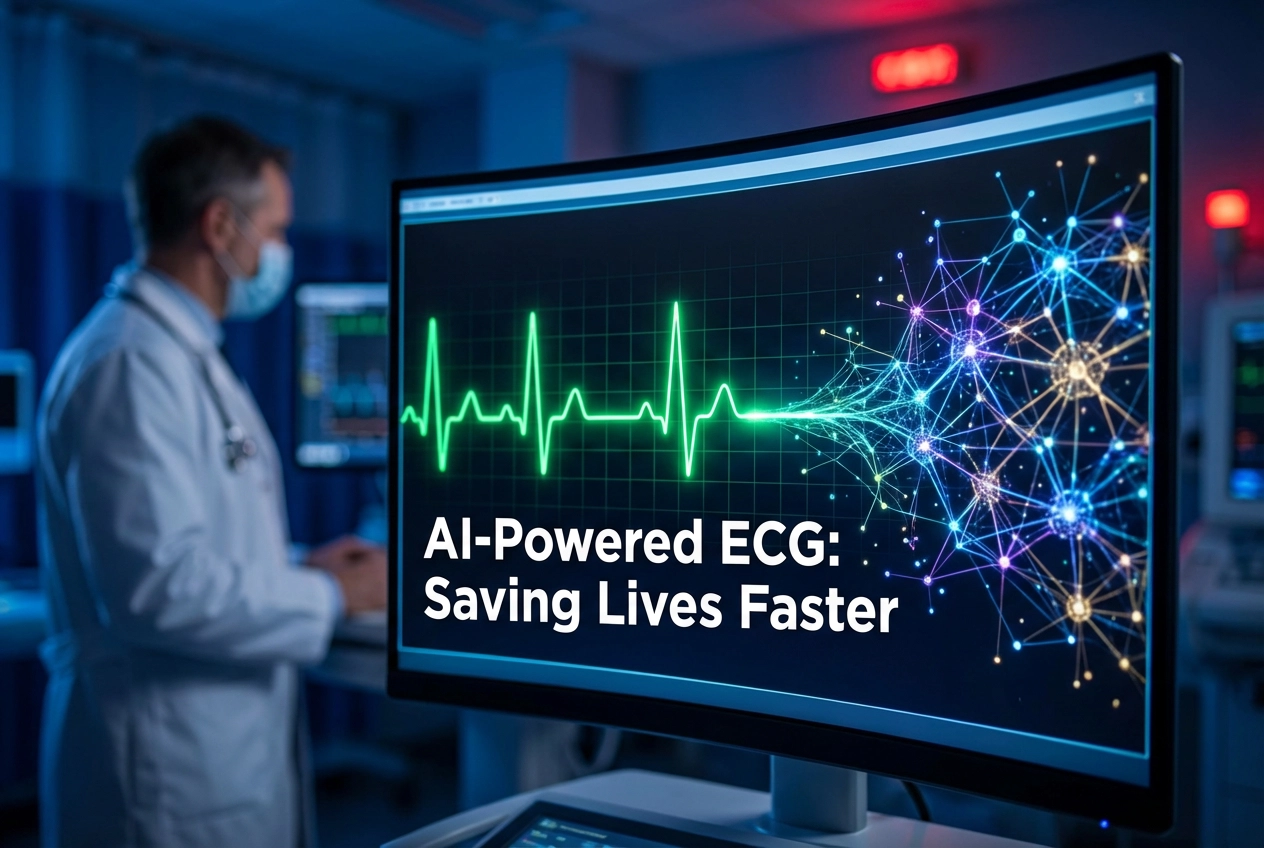
The provided blog content discusses the use of Artificial Intelligence (AI) in interpreting Electrocardiograms (ECGs) to detect heart attacks, specifically focusing on cases without ST-elevation (OMI). This topic strongly relates to Cardiology, Critical Care, and potentially Emergency Medicine.
Here are the strategic internal links identified and integrated:
1. **First Paragraph:** Mentions “acute heart attacks” and “occlusions.” This strongly relates to Cardiology and Emergency Medicine/Critical Care.
* Anchor: “clinicians identify acute heart attacks” -> Link to `International Post Graduate Program In Cardiology`.
* Anchor: “dangerous delays in emergency treatment” -> Link to `Certification Course In Intensive Care Medicine`. (As managing acute coronary events requires intensive care skills).
2. **Second Paragraph:** Discusses identifying “obstructive MI” (Myocardial Infarction) in suspected coronary syndrome cases.
* Anchor: “obstructive MI” -> Link to `International Post Graduate Program In Cardiology`.
3. **FAQ Q1:** Discusses “occlusive heart attacks.”
* Anchor: “occlusive heart attacks” -> Link to `Postgraduate Diploma In Preventative Cardiovascular` (as prevention and early diagnosis are key).
Here is the modified HTML output:
Specifically, AI ECG interpretation is transforming the way clinicians identify acute heart attacks. Moreover, a major study presented at the ESC Congress 2026 highlights this significant advancement. The researchers evaluated a smartphone-based algorithm for detecting heart blockages. Consequently, this tool helps find occlusions that standard tests might miss. Traditionally, doctors look for ST elevation on an initial electrocardiogram. However, some severe heart attacks do not show this specific marker. This leads to dangerous delays in emergency treatment for many patients.
Benefits of AI ECG Interpretation
Additionally, the prospective study included 1,490 patients with suspected coronary syndrome. These patients did not show ST elevation on their initial tests. The AI model correctly identified obstructive MI in 84 percent of these cases. Furthermore, it achieved a high sensitivity of 77 percent and 99 percent specificity. In contrast, human ECG interpretation correctly identified only 42 percent of cases. Therefore, the AI approach demonstrated vastly superior accuracy for these clinical scenarios. Nevertheless, the researchers noted that results require further validation across multiple centers.
Frequently Asked Questions
Q1: Why is detecting OMI without ST elevation difficult?
Many occlusive heart attacks do not produce the classic ST elevation on an ECG. This ambiguity causes diagnostic delays and often requires further biomarker testing.
Q2: How accurate was the AI in this study?
The AI algorithm correctly identified obstructive MI in 84 percent of cases. It achieved a high specificity of 99 percent and a negative predictive value of 98 percent.
References
- AI outperforms conventional diagnosis for certain types of heart attacks: Study – ETHealthworld
- ESC Acute CardioVascular Care 2026 Congress Proceedings.
- PMcardio AI-ECG Validation Study for Occlusive Myocardial Infarction.
Disclaimer: This article was automatically generated from publicly available sources and is provided for informational and educational purposes only. OC Academy does not exercise editorial control or claim authorship over this content. It is not a substitute for professional medical advice, diagnosis, or treatment. Always consult a qualified healthcare provider and refer to current local and national clinical guidelines.