
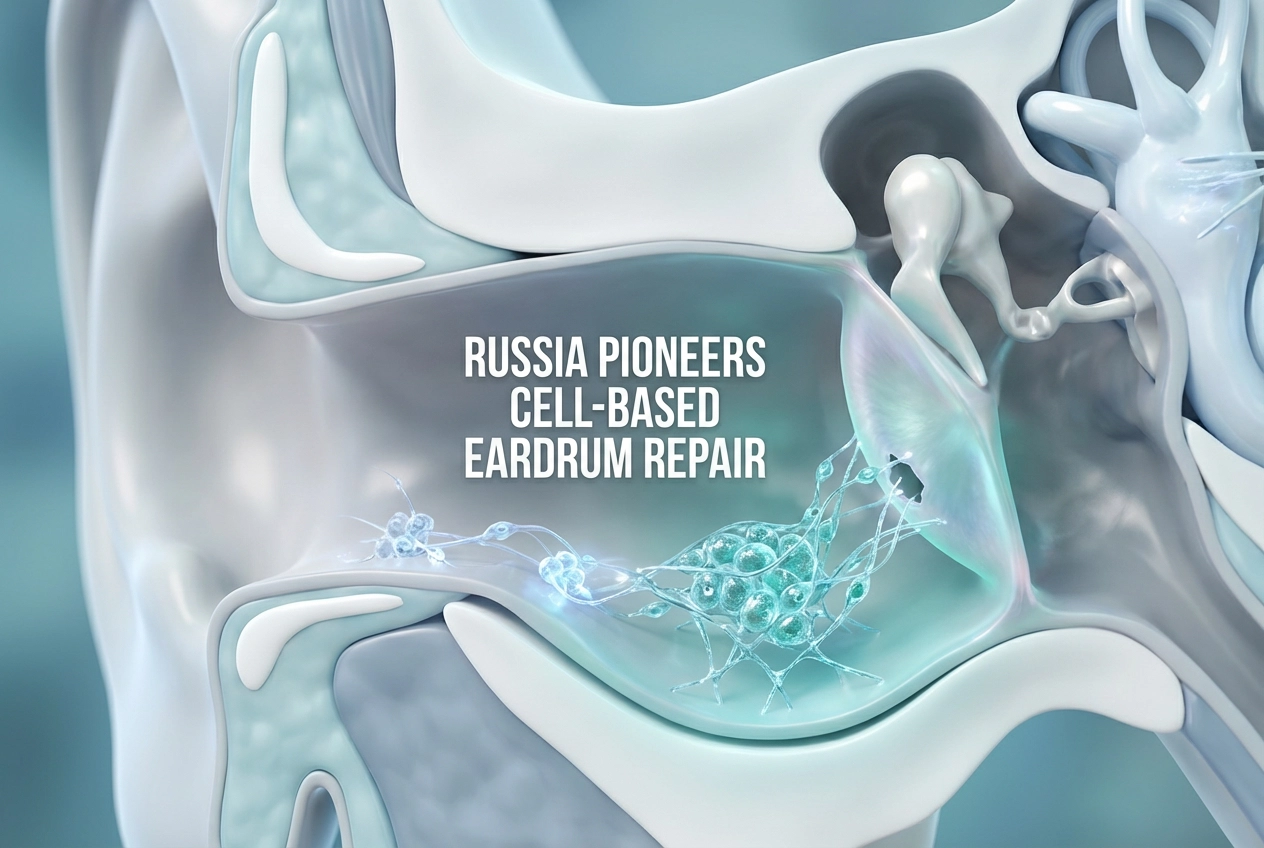
Russia has achieved a major milestone in otolaryngology. Sechenov University initiated the world’s first reported clinical application of cell-based technology for eardrum repair. This innovative procedure, using a cell-based medicinal product (CBMP) derived from the patient’s own cells, marks a significant global advancement in regenerative medicine.
The Clinical Need for Regenerative Otology
Tympanic membrane perforation is a pervasive global health issue, typically affecting four to five people per 1,000. It often results from infections, physical trauma, or sudden pressure changes. Traditional surgical methods, known as conventional tympanoplasty, are complex and invasive. Furthermore, these techniques carry graft failure rates commonly ranging between 10 and 20 per cent. Doctors and researchers, therefore, sought new methods to achieve stable, durable anatomical and functional outcomes.
How the Cell-based Eardrum Repair Works
The Sechenov University procedure leverages the body’s natural healing mechanisms. Specifically, the process involves extracting cells from a patient’s adipose tissue. Researchers then form these cells into cell spheroids. These spheroids are then carefully implanted, along with a resorbable membrane, at the site of the damaged eardrum. Over time, the membrane dissolves completely and the patient’s own regenerated tissue replaces it. Consequently, the new tissue closely matches the structure and function of a natural eardrum. Clinical data shows promising early results, with the first patients experiencing favourable post-operative recovery and no reported complications.
Clinical Advantages and Translational Potential
The new cell-based repair procedure offers distinct advantages over traditional surgery. For instance, the operation takes approximately 40 minutes, making it significantly faster than conventional tympanoplasty. Sechenov University Rector Petr Glybochko emphasised that the institution successfully completed the entire translational pathway. This cycle moves from fundamental research to certified production of the cell product and its subsequent clinical use within the facility. Moreover, researchers believe this platform technology holds potential for adaptation to regenerate other organs and tissues, thus significantly expanding the future applications of cell-based therapies. Advancements in regenerative medicine and tissue engineering are key areas for many medical specialities, including Surgery Speciality Courses.
Frequently Asked Questions
Q1: What is the primary source of cells used in the new procedure?
The procedure uses the patient’s own cells, which are extracted from adipose (fat) tissue and formed into cell spheroids.
Q2: How does the new cell-based technique compare in duration to traditional surgery?
The cell-based repair procedure takes approximately 40 minutes, making it significantly faster than conventional tympanoplasty, which can take 60 minutes to over two hours.
Q3: What are the main limitations of conventional tympanoplasty that the new method addresses?
Conventional tympanoplasty is often complex, invasive, and has reported graft failure rates ranging from 10 to 20 per cent. The new method seeks to overcome these limitations by promoting the patient’s own natural tissue regeneration. For specialized surgical training, consider our Clinical Fellowship in Surgery with MRCS Training.
References
- Russia begins clinical use of cell-based technology for eardrum repair – ETHealthworld
- Russia starts clinical use of cell-based technology to repair damaged eardrums.
- Determinants of Failure in the Reconstruction of the Tympanic Membrane: A Case-Control Study.
- Tissue engineering and regenerative medicine strategies for the repair of tympanic membrane perforations.
Disclaimer: This article was automatically generated from publicly available sources and is provided for informational and educational purposes only. OC Academy does not exercise editorial control or claim authorship over this content. It is not a substitute for professional medical advice, diagnosis, or treatment. Always consult a qualified healthcare provider and refer to current local and national clinical guidelines.