Why Clear Vision Demands Much More Than 20/20 Acuity
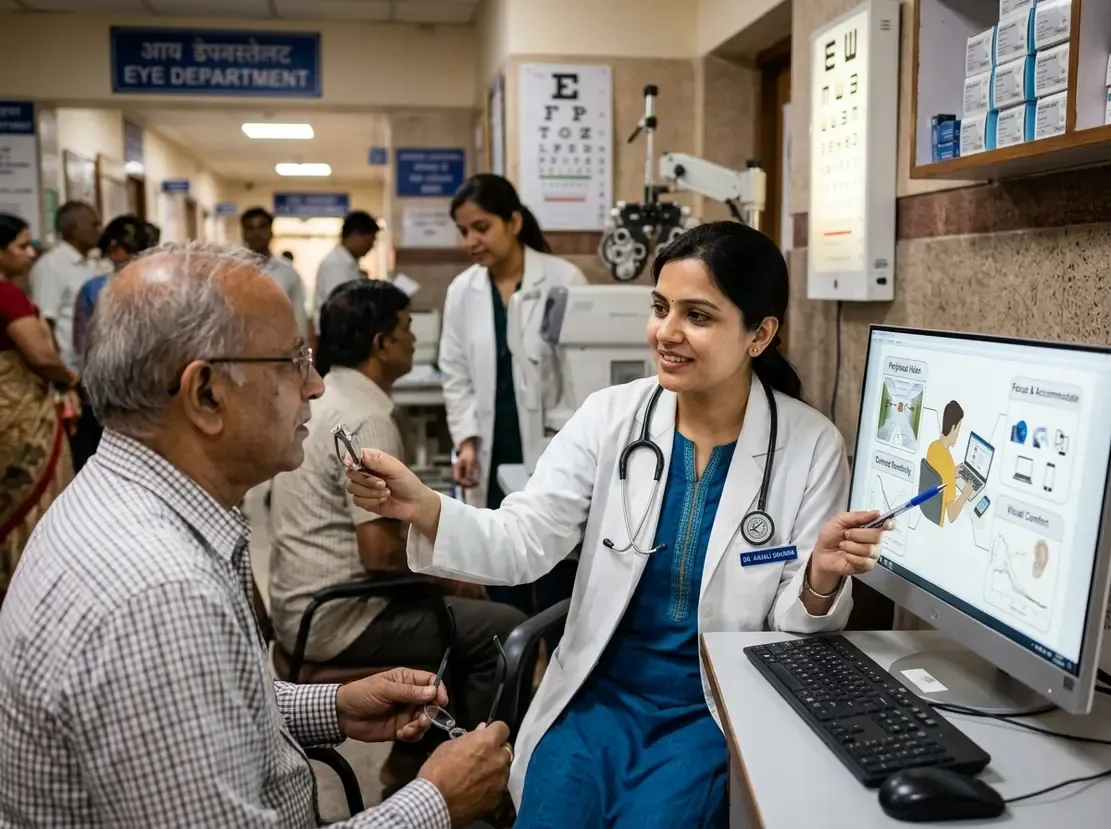
Many patients assume that clear sight depends solely on achieving standard 20/20 acuity on a Snellen eye chart. However, true ocular comfort involves much more than simply identifying static letters. Daily activities require individuals to process information smoothly without generating continuous visual effort. When small refractive errors or optical distortions disrupt focus, everyday tasks rapidly demand heightened cognitive and ocular energy. Consequently, subtle blur forces people to squint, lean forward, or re-read sentences repeatedly. Over a full workday, these repeated micro-adjustments create persistent discomfort and cognitive fatigue. Therefore, eye care professionals must evaluate how optical clarity directly influences overall visual comfort.
Understanding the Mechanism of Visual Effort
Clearly, the focusing system of the human eye relies on continuous coordination between accommodation and vergence. When visual clarity drops, the ciliary muscles contract more intensely to sharpen the retinal image. Furthermore, the brain must allocate extra cognitive resources to interpret low-contrast or degraded shapes. This combined muscular and neurological exertion is what clinicians define as visual effort. For instance, reading small print on a low-contrast screen demands constant micro-fluctuations in focus. In addition, uncorrected astigmatism or minor presbyopia worsens this strain substantially. As a result, patients frequently present with tension headaches, periocular soreness, and premature fatigue. Thus, achieving crisp retinal imagery remains essential for alleviating needless muscular strain.
Dynamic Working Distances in Modern Daily Life
Today, visual tasks rarely stay confined to a single static focal plane. In fact, modern professionals continually switch between smartphones, desktop monitors, meeting displays, and distant objects. Each viewing distance introduces distinct optical demands on the accommodative apparatus. For example, handheld smartphones require sharp focus at thirty centimeters. In contrast, computer screens demand comfortable clarity at intermediate distances of sixty to eighty centimeters. Moving across these distances throughout the day requires rapid, flexible lens adaptation. However, conventional single-vision lenses often fail to accommodate these dynamic focal shifts. When lenses do not support intermediate demands, the wearer must manually compensate by craning the neck or tilting the head. Therefore, task-specific optical solutions play a pivotal role in maintaining comfortable intermediate vision.
How Lens Design Mitigates Visual Effort
Modern optical engineering now looks well beyond standard spherical correction. Indeed, researchers combine neuroscience with everyday gaze behavior to refine ophthalmic surfaces. Contemporary solutions, such as ZEISS ClearMind lenses with NeurOptix technology, incorporate real-world ocular movement patterns into their geometry. These advanced designs minimize peripheral aberrations and expand the zone of comfortable single vision. In addition, digital lens profiles provide gentle accommodative support for prolonged screen work. Wearer trials demonstrate that 96% of users experience noticeably crisp, effortless vision with tailored surfaces. Consequently, individuals spend less energy compensating for peripheral distortion and refocusing delays. By aligning lens architecture with real-world visual behavior, clinicians can dramatically improve patient satisfaction.
Frequently Asked Questions
Q1: What is the difference between visual acuity and visual effort?
Visual acuity measures how well an eye resolves fine details on a high-contrast chart at a fixed distance. In contrast, visual effort represents the muscular and cognitive energy required to maintain comfortable, clear vision during sustained activities, a core concept taught in advanced clinical training in ophthalmology.
Q2: Why do standard glasses sometimes cause eye fatigue during computer work?
Standard single-vision lenses often optimize focus exclusively for distant or near reading tasks. However, computer displays sit at an intermediate distance, forcing the ciliary muscles to work harder if the lens lacks dedicated intermediate support.
Q3: How do modern lenses reduce eye fatigue for digital users?
Advanced lens technologies incorporate ergonomic power distributions and aberration controls that match natural gaze shifts. Consequently, these designs reduce accommodative stress and widen usable clear zones across various digital devices.
References
- The Relationship Between Clear Vision and Visual Effort - ETHealthworld
- Digital Eye Strain- A Comprehensive Review - PMC - NIH
- Accommodative and Vergence Dysfunction - American Optometric Association (AOA)
- Asthenopia: Causes, Symptoms and Treatment - All About Vision