Why India's Health Financing Reforms Must Focus on Care
India is reshaping its public healthcare expenditure through comprehensive health financing reforms under the National Health Mission. For clinical administrators and doctors, available funding must translate into timely patient care. Previously, central funds moved slowly through multiple administrative tiers before reaching peripheral facilities. Consequently, implementing agencies held unspent cash balances across thousands of isolated bank accounts. In response, the Central government launched the Single Nodal Agency framework in 2021.
The Shift Under Single Nodal Agency Architecture
Under this system, states consolidated fragmented accounts into a unified nodal bank account. Furthermore, the finance ministry eliminated more than 15 lakh decentralized bank accounts nationwide. As a result, the government recovered approximately ₹11,000 crore in idle funds by 2025. In Bihar, authorities recaptured ₹675 crore from dormant accounts for public health operations. Similarly, Odisha recovered ₹270 crore into its central nodal account. Fund release timelines dropped from months to under 15 days in Odisha. Therefore, real-time expenditure tracking greatly improved transparency across state treasuries.
Operational Challenges in Health Financing Reforms
However, better fund tracking does not guarantee superior clinical care for patients. First, administrative approvals often exceed actual financial envelopes allocated to states. For instance, approved spending outpaced available resources by 153% in recent years. When budgets fell short, facilities prioritized fixed salaries over medical supplies. Second, uneven digital connectivity creates glaring disparities between rural and urban districts. Specifically, facilities with trained accounting personnel drew money much faster than remote primary centers. In addition, some healthcare teams logged advance payments as expenditures to meet administrative targets.
Transition to SNA-SPARSH and Outcome Measurement
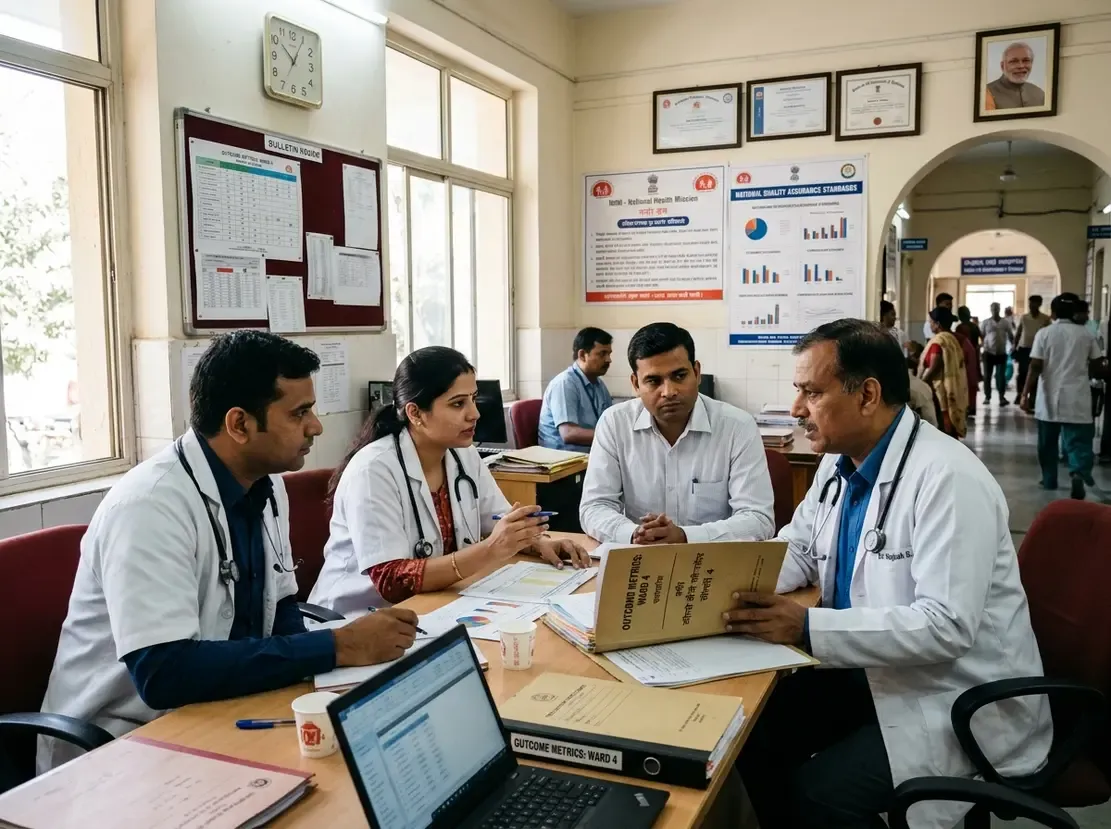
To optimize treasury liquidity, India introduced the SNA-SPARSH system across all Centrally Sponsored Schemes. Hence, treasuries disburse payments on a just-in-time basis rather than parking float in bank accounts. Nevertheless, financial systems still focus heavily on compliance metrics rather than healthcare delivery. Public health experts emphasize that financial monitoring must integrate directly with Health Management Information Systems. Thus, health authorities can evaluate patient outcomes alongside expenditure rates. Additionally, hospital superintendents require flexible contingency funds to manage sudden clinical emergencies. Ultimately, effective financial policy must empower healthcare providers to deliver quality treatment without administrative disruption.
Frequently Asked Questions
Q1: What is the primary purpose of the Single Nodal Agency system in NHM?
The system consolidates scattered accounts into one state-level account. This prevents idle funds and enables real-time expenditure tracking.
Q2: How does SNA-SPARSH change health scheme disbursements?
SNA-SPARSH enforces a just-in-time payment mechanism where treasuries release funds only when a verified transaction occurs, eliminating parked funds.
Q3: Why must health financing reforms shift toward outcome-based monitoring?
Tracking fund utilization alone overlooks clinical quality and service delivery. Linking expenditure data to health indicators ensures that public money improves measurable patient care.
References
- Beyond Fund Utilisation: What India's Health Financing Reforms Must Measure Next - ETHealthworld
- Choudhury M, Chutani N. Public Financial Management Reforms in India: Understanding State-level Experiences from the Implementation of Single Nodal Agency Reform in National Health Mission. NIPFP Working Paper No. 438, 2025.
- Choudhury M, Chutani N. Challenges to Achieving Universal Health Coverage Through Public Financial Management Reforms: Insights from the Implementation of Single Nodal Agency Reform in India. Health Systems & Reform, 2026.