
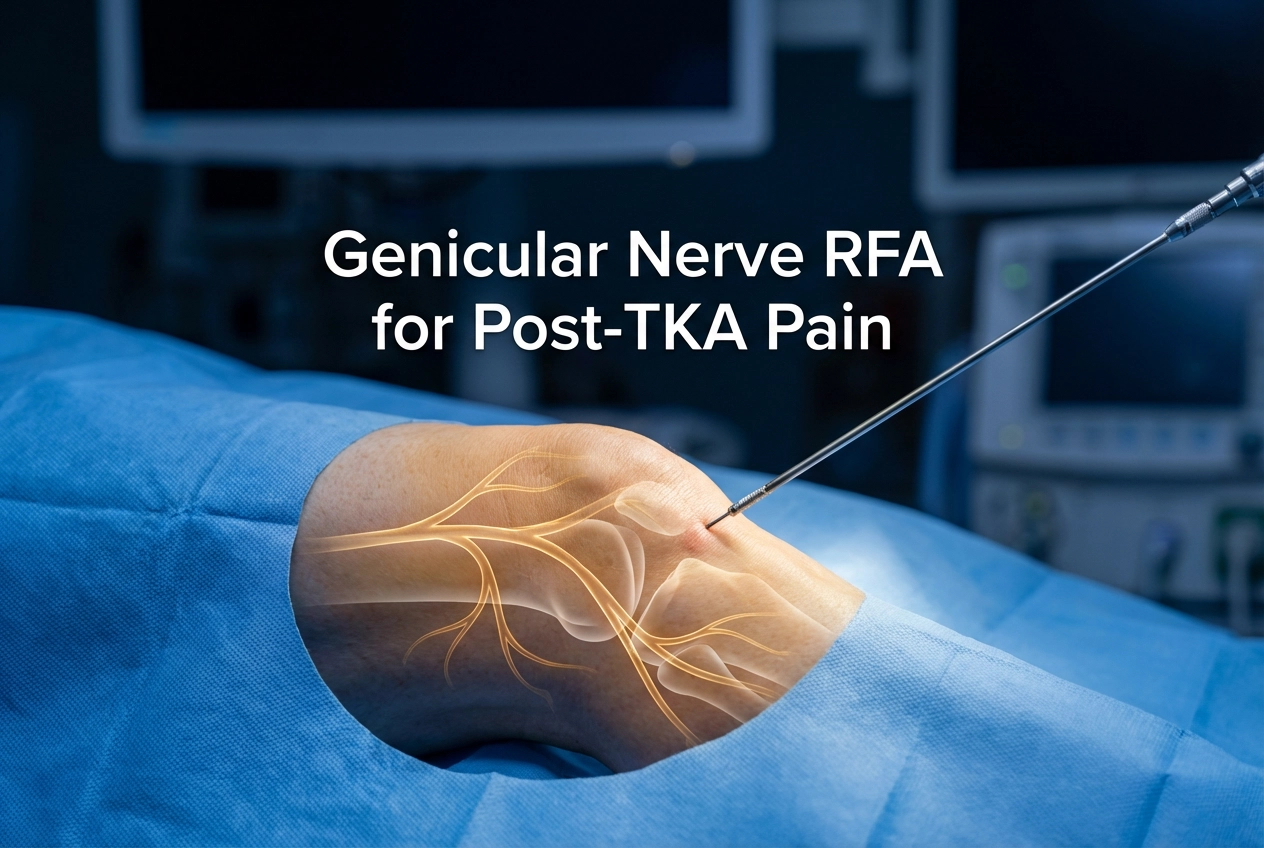
Total Knee Arthroplasty (TKA) is a common, life-changing procedure, yet up to 30% of patients experience persistent post-surgical pain (PPSP). This chronic pain often lacks an identifiable cause and can be extremely difficult to manage with conventional treatments. A promising, minimally invasive solution is emerging: Genicular Nerve Radiofrequency (GNRF). This technique targets the sensory nerves supplying the knee joint to interrupt pain signals. Therefore, it provides a safe treatment pathway.
Assessing Continuous Genicular Nerve Radiofrequency Efficacy
Researchers recently conducted a single-center retrospective study to evaluate the effectiveness of continuous ultrasound-guided GNRF for PPSP of unknown aetiology. The study included 23 patients suffering from chronic knee pain following TKA. Consequently, the team targeted the supero-medial, supero-lateral, and infero-medial genicular nerves. They used a numeric rating scale (NRS) to measure pain at baseline, 1 month, and 6 months. Furthermore, they analyzed if the outcome of a diagnostic nerve block predicted the success of the GNRF procedure.
The results showed a clear, statistically significant improvement in pain at 1 month. Specifically, the mean NRS score dropped from $8.0 \pm 1.4$ at baseline to $6.0 \pm 3.4$ (p = 0.01). Clinically significant pain reduction, defined as a $\geq 2$-point decrease, occurred in 47.8% of patients. Additionally, 34.8% of patients achieved a $\geq 50\%$ reduction in pain. However, while the mean NRS score remained lower at 6 months ($6.6 \pm 3.0$), this reduction was no longer statistically significant compared to the 1-month score or baseline. No major complications were reported during the procedure, suggesting an excellent safety profile. The study also highlighted a crucial finding: prognostic nerve blocks did not correlate with the GNRF efficacy. This result challenges the standard practice of using a diagnostic block to predict radiofrequency outcomes in this patient population.
GNRF as a Minimally Invasive Option for Post-Arthroplasty Knee Pain
This study confirms that continuous ultrasound-guided Genicular Nerve Radiofrequency offers a safe and effective treatment option for chronic post-arthroplasty knee pain. Other studies support this application, demonstrating comparable efficacy between GNRF for PPSP and for typical osteoarthritic knee pain. Although the overall quality of evidence for PPSP specifically is low, the pooled success rate across multiple studies—defined as a $\geq 50\%$ pain reduction—sits around 51% at 6 months. Consequently, GNRF is a valuable non-surgical intervention when conventional treatments fail. Specialists often reserve this procedure for patients unresponsive to pharmacologic and physical therapy interventions. It provides consistent, short-term pain relief, with some reports indicating an average effect duration of 8.3 months. Because the procedure is image-guided (ultrasound or fluoroscopy), precision targeting of the nerves is achievable, minimising the risk of adverse events.
Frequently Asked Questions
Q1: What is the primary objective of Genicular Nerve Radiofrequency (GNRF) for post-TKA pain?
The primary objective is to manage persistent chronic knee pain following total knee arthroplasty (TKA) that has no identifiable underlying cause and has been unresponsive to conventional medical treatments.
Q2: How effective is GNRF for chronic post-arthroplasty knee pain?
The procedure is effective in providing clinically significant pain relief for a subset of patients. One retrospective study showed nearly 48% of patients experienced a $\geq 2$-point reduction in pain at one month, which persisted up to six months. Other studies show a pooled success rate ($\\geq 50\%$ reduction) of around 51% at six months across different patient populations.
Q3: Do diagnostic nerve blocks predict the success of GNRF?
No. This particular study found no significant correlation between the outcomes of the anaesthetic nerve block tests and the eventual efficacy of the continuous GNRF treatment. This finding suggests that a positive diagnostic block is not necessarily required before proceeding with the radiofrequency procedure for this specific indication.
References
- El Khalfi R et al. Assessment of ultrasound-guided continuous genicular nerve radiofrequency for the management of persistent post-arthroplasty knee pain. Eur Radiol. 2025 Dec 23. doi: 10.1007/s00330-025-12140-9. PMID: 41436644.
- Lee D et al. Effectiveness comparison of genicular nerve ablation for knee osteoarthritic versus post-total knee arthroplasty pain. Penn State Research Database.
- Anselm A et al. Effectiveness of genicular nerve radiofrequency ablation in osteoarthritis and post-surgical knee pain: systematic review. Oxford Academic.
- Protzman NM et al. The therapeutic effect of genicular nerve radiofrequency for chronic knee pain after a total knee arthroplasty: A systematic review. PubMed Central.
- Alonso C et al. A retrospective study on patients with chronic knee pain treated with ultrasound\u2010guided radiofrequency of the genicular nerves (RECORGEN trial). PMC – NIH.