
IIT Bombay Unveils Low-Cost Sickle Cell Screening Tool
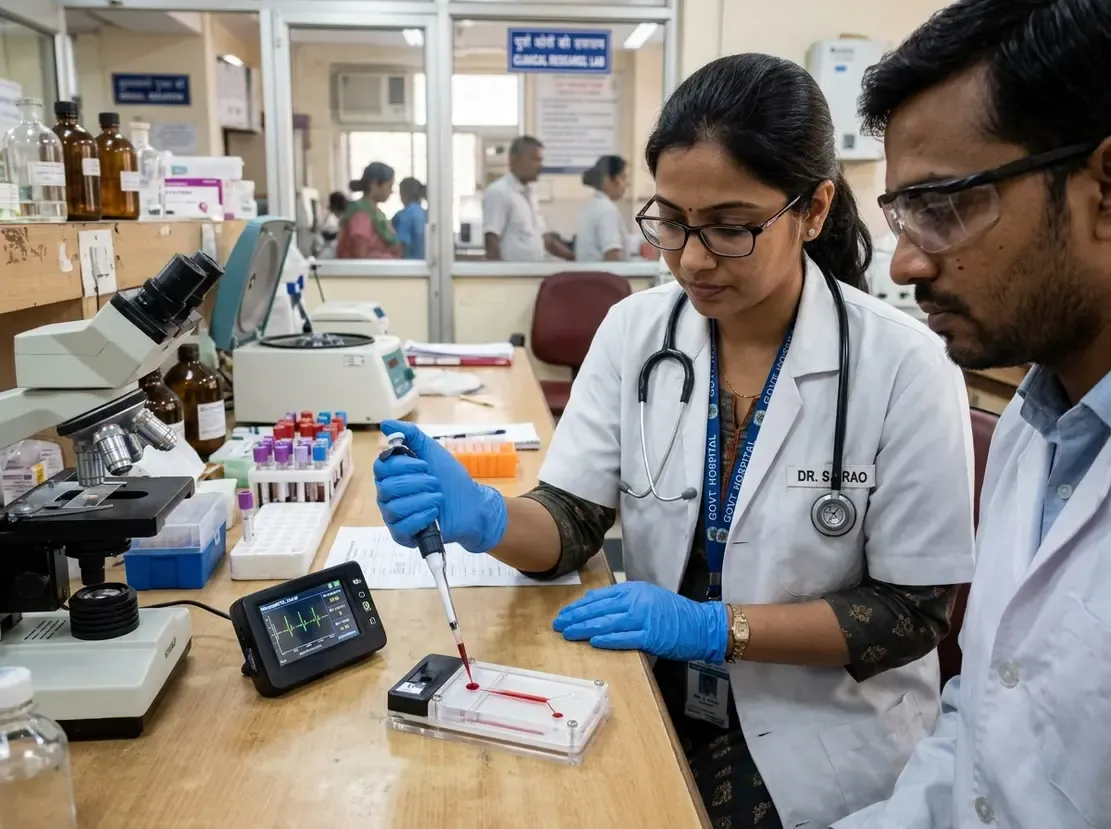
Researchers at the Indian Institute of Technology Bombay have engineered an automated, portable diagnostic device that revolutionizes sickle cell disease screening and anaemia detection. This point-of-care platform uses only a single drop of capillary blood. Furthermore, the innovative test analyzes the biophysical spreading behavior of blood on a glass slide. As a result, healthcare workers can rapidly identify hematologic disorders in remote and resource-limited primary care centers.
Physics-Driven Innovation in Sickle Cell Disease Screening
Prof Mahesh Tirumkudulu and his team from the Department of Chemical Engineering designed this patented technique based on fluid mechanics. Standard manual blood smears often suffer from inconsistent slide angles and variable push velocities. In contrast, the automated device pushes a blood drop at a strictly regulated velocity across a glass surface. Under these standardized conditions, the length of the resulting smear directly reflects dynamic blood viscosity.
More viscous blood spreads less readily, which produces a shorter and thicker smear. Conversely, blood with low viscosity travels farther across the glass slide. For instance, anaemia lowers red blood cell concentration and reduces haemoglobin, leading to longer smears. In contrast, sickle cell disease triggers cellular rigidity during deoxygenation, which spikes viscosity and shortens the smear. Consequently, measuring the smear length offers an objective surrogate measurement for hemorheology.
Clinical Utility and Operational Advantages in Resource-Limited Settings
Conventional screening methods like high-performance liquid chromatography or hemoglobin electrophoresis demand expensive laboratory infrastructure and highly trained personnel. However, rural clinics and tribal primary health centers frequently lack these specialized resources. Therefore, this novel point-of-care platform bridges a vital diagnostic gap. The complete diagnostic test requires only glass slides, a pipette, an inexpensive sickling reagent, and a standard ruler or imaging module.
Moreover, the procedure does not require advanced technical expertise. The diagnostic platform can also distinguish between sickle cell trait and sickle cell anaemia by evaluating viscosity changes after chemical sickling. Additionally, clinicians can utilize viscosity shifts to monitor patient responses to disease-modifying therapies like hydroxyurea, an area often explored in specialized hematology training.
Diagnostic Limitations and the Road to Regulatory Approval
Despite these remarkable capabilities, physicians must remain mindful of certain diagnostic confounders. Specifically, atypical conditions like hyperviscosity syndrome alter blood plasma properties and can obscure anaemia detection. Furthermore, genetic polymorphisms across diverse demographic groups can influence hemorheological baselines when blood oxygen levels plummet. Therefore, healthcare providers should interpret boundary readings with clinical discretion.
Currently, IIT Bombay startup Rheoheme Private Limited holds the technology license. Furthermore, the team collaborates with AIIMS Nagpur and NIRTH Jabalpur to secure formal regulatory clearance. Subsequently, researchers plan to adapt the platform for measuring glucose concentrations and blood coagulation intervals.
Frequently Asked Questions
Q1: How does smear length detect sickle cell disease and anaemia?
Blood smear length directly correlates with dynamic fluid viscosity. Specifically, anaemia lowers viscosity and lengthens the smear. Conversely, sickled erythrocytes increase viscosity and shorten smear length.
Q2: Can this diagnostic method differentiate between sickle cell disease and sickle cell trait?
Yes, the technique successfully differentiates between sickle cell trait and sickle cell anaemia. Specifically, it compares viscosity changes before and after treating red blood cells with a chemical sickling agent.
Q3: Which clinical conditions might produce false results with this device?
Rare clinical disorders like hyperviscosity syndrome can obscure anaemia screening by abnormally increasing plasma viscosity. Additionally, baseline viscosity variations among different demographic groups require careful clinical evaluation.
References
- IIT Bombay develops low-cost device to screen for anaemia, sickle cell disease - ETHealthworld
- Mir MA, Raicha B, Tirumkudulu MS. Fluid mechanics of thin blood films to detect anemia and sickle cell disease. Lab on a Chip. 2026.
- National Sickle Cell Anaemia Elimination Mission. Ministry of Health and Family Welfare, Government of India.


