
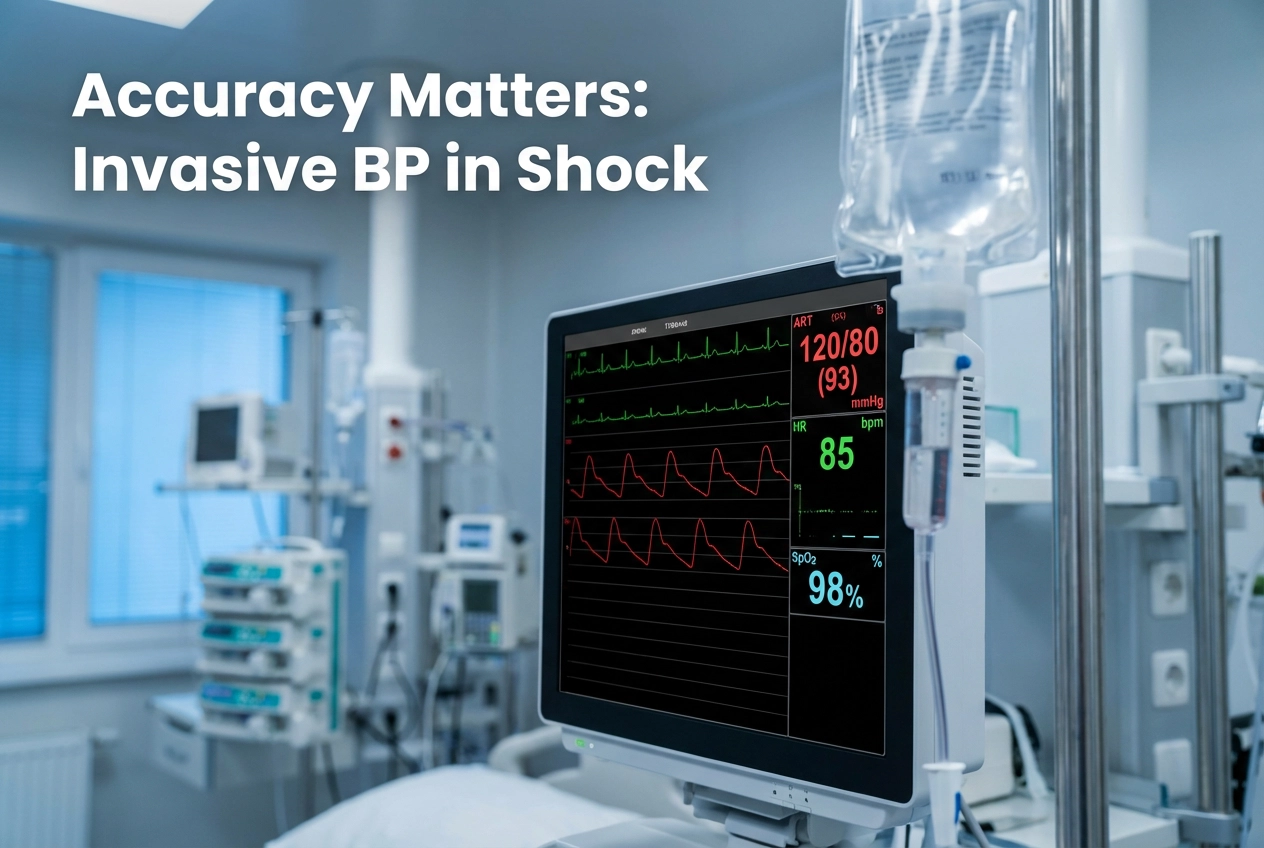
Many intensive care units traditionally rely on invasive BP monitoring for managing patients in shock. Consequently, clinicians often insert arterial catheters immediately upon admission to ensure continuous hemodynamic data. However, a recent multicenter trial has challenged this standard practice. Specifically, researchers investigated whether starting with noninvasive methods could provide equivalent safety and survival outcomes.
Findings on Invasive BP Monitoring
The EVERDAC trial compared early arterial catheterization against noninvasive monitoring using an automated brachial cuff. Interestingly, the results showed that noninvasive monitoring was non-inferior for 28-day all-cause mortality. Therefore, the risk of death did not increase when doctors deferred the invasive procedure. Furthermore, the noninvasive approach allowed 85% of patients to avoid arterial line insertion entirely.
Safety and Clinical Considerations
Invasive BP monitoring involves risks like hematoma and hemorrhage at the insertion site. Indeed, the study reported significantly higher rates of these complications in the invasive group. Nevertheless, patients in the noninvasive group experienced slightly more discomfort related to the frequent cuff inflations. Additionally, physicians should still consider individual patient factors when deciding on a monitoring strategy. Ultimately, this evidence supports a more selective use of arterial lines in early shock management.
Frequently Asked Questions
Q1: Was there a significant difference in 28-day mortality?
No, the study demonstrated that noninvasive monitoring was non-inferior to invasive monitoring regarding all-cause mortality at 28 days.
Q2: What were the main risks associated with the invasive strategy?
The invasive strategy was associated with a significantly higher risk of complications like hematoma and hemorrhage compared to the noninvasive group.
References
- Honarmand K et al. In critically ill adults with shock, early noninvasive vs. invasive BP monitoring was noninferior for all-cause mortality at 28 d. Ann Intern Med. 2026 Mar 03. doi: 10.7326/ANNALS-25-05556-JC. PMID: 41771136.
- Muller G et al. Deferring Arterial Catheterization in Critically Ill Patients with Shock. N Engl J Med. 2025;393(19):1875-1888.
- Scheer B, Perel A, Pfeiffer UJ. Clinical review: Complications and risk factors of peripheral arterial catheters used for haemodynamic monitoring. Crit Care. 2002;6(3):199-204.