
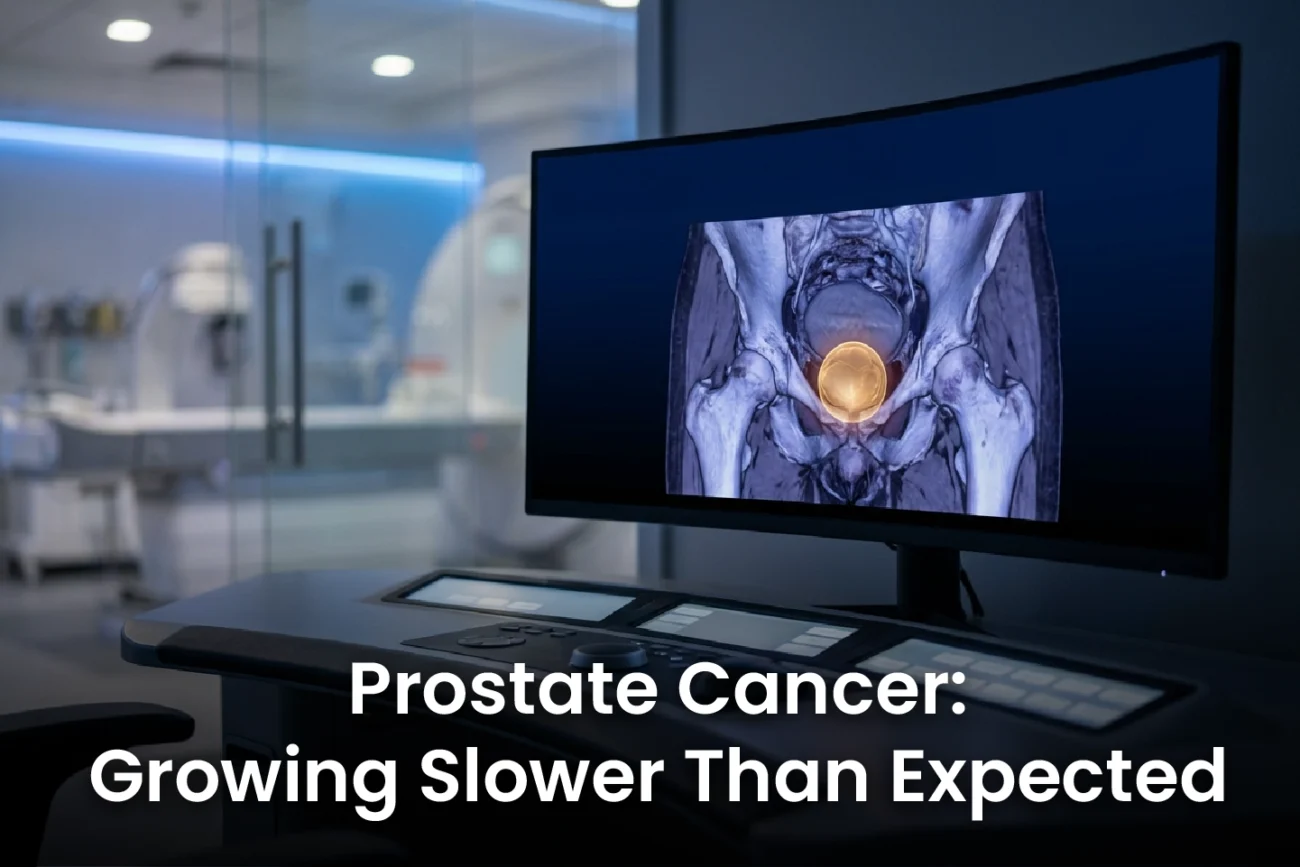
Understanding the prostate cancer growth rate is crucial for optimizing Active Surveillance (AS) protocols. Consequently, new longitudinal data from an MRI-based AS cohort provides fresh insight. Researchers modeled tumor progression in 145 patients with biopsy-confirmed prostate cancer. The study aimed to accurately estimate growth rates and account for the substantial variation between individuals. This research helps clinicians identify which low-risk lesions may safely remain under observation.
The Gompertz Model and Cancer Trajectory
Investigators compared three mixed-effects models—exponential, logistic, and Gompertz—to describe the observed lesion volume changes. While all three models fit the observed longitudinal data well, only the Gompertz model provided reasonable estimates across the entire life of the lesion. Therefore, it was selected to model the full natural trajectory of prostate cancer, from a single cell to a clinically detectable size. The Gompertz model accurately reflects the biological reality of exponential growth deceleration over time. Overall, the findings demonstrate a very slow process. On average, a lesion takes 17 years (95% CI) to grow from a single cell to an MRI-detectable size (approximately 3 mm diameter). Furthermore, it takes an additional 12 years (95% CI) to reach a clinically detectable size (approximately 1 cm diameter).
Variability in Prostate Cancer Growth Rate
Prostate cancer growth rate shows considerable variation between patients. Identifying factors that predict this variability is essential for refining AS criteria. The study found the Gompertz growth parameter (mean = 0.07, range = 0.02-0.15), which describes the exponential growth deceleration, positively correlated with several clinical characteristics. These factors include patient age, the lesion volume at the start of AS, prostate-specific antigen (PSA) level, and PSA density. In addition, the Gleason score strongly predicted the growth rate. Lesions classified as Gleason 3+4 exhibited significantly faster volume doubling times than less aggressive Gleason 3+3 lesions (mean of 3.5 years versus 5.2 years, respectively). This difference underscores the importance of accurate grading in predicting progression. Other studies also confirm that PSA velocity (the rate of PSA rise) reliably identifies aggressive disease, which is a key consideration for AS management. The slow, variable nature poses a challenge, as it increases the risk of detecting indolent lesions that may never cause harm, leading to overtreatment concerns. For example, the risk of a cancer-specific death is strongly linked to PSA growth rates.
Clinical Implications for Active Surveillance
These findings have direct implications for managing patients on Active Surveillance, especially in settings that rely on MRI monitoring, which is becoming standard practice even in Indian guidelines. The Urological Society of India recommends AS for suitable candidates with low-risk disease, often utilising pre-biopsy multiparametric MRI (mpMRI). Since the growth is so slow, small lesions that are currently undetectable on MRI may take decades to reach a clinically significant size. Therefore, the long-term risk of progression from indolent to aggressive cancer is low for many men. Consequently, this study supports less intensive monitoring schedules for many low-risk patients, especially those with small, low-grade lesions. At age 50, researchers estimate that 75% of lesions would remain undetectable by MRI. Therefore, healthcare providers must counsel patients about the extended time required for progression versus the potential side effects of immediate definitive treatment.
Frequently Asked Questions
Q1: How long does it take for prostate cancer to become clinically significant?
On average, it takes 17 years for a prostate cancer lesion to grow from a single cell to an MRI-detectable size (about 3 mm) and an additional 12 years to reach a clinically detectable size (about 1 cm).
Q2: Which factors predict a faster prostate cancer growth rate?
A faster growth rate correlates positively with a higher Gleason score (e.g., 3+4 vs. 3+3), greater lesion volume at the start of Active Surveillance, higher patient age, and elevated PSA levels or PSA density. PSA velocity also helps predict aggressive disease.
Q3: Why is slow prostate cancer growth a challenge for early detection?
Slow growth with large individual variation means that screening often detects small, indolent lesions that may never cause harm. This increases the risk of overtreatment, subjecting patients to unnecessary side effects from surgery or radiation.
References
- Smith H et al. Variation in prostate cancer growth rates in an MRI-based active surveillance cohort. Eur Radiol. 2026 Jan 16. doi: 10.1007/s00330-025-12248-y. PMID: 41543565.
- Neville TA. PSA Growth Rate May Help Identify Aggressive Prostate Cancer Early. OncLive. 2014 May 21.
- Prostate cancer growth rate: How fast does it grow? roboticoncology.com. 2025 Aug 8.
- Gompertz models with periodical treatment and applications to prostate cancer. NIH PubMed. 2024 Feb 23.
- The Urological Society of India guidelines for the evaluation and management of prostate cancer (executive summary). NIH PMC. 2022 Oct 1.