
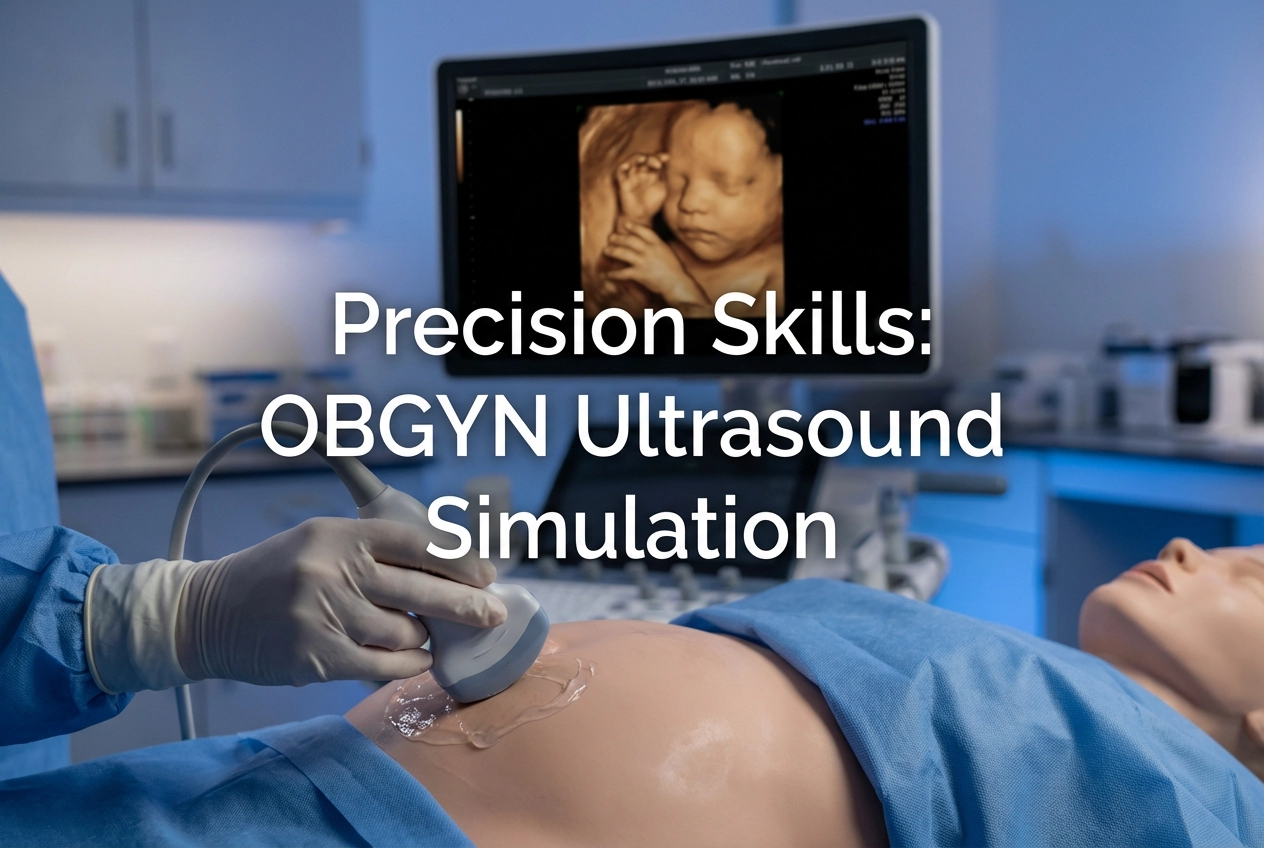
Medical educators are increasingly exploring digital solutions to bridge training gaps in reproductive healthcare. Consequently, the assessment of OBGYN ultrasound simulator skills has become a focal point for modern residency programs. For instance, a recent study evaluated how well remote examiners could judge performance compared to traditional in-person assessments. Furthermore, the research compared various simulation technologies against real-world clinical scenarios involving pregnant volunteers.
Validating OBGYN Ultrasound Simulator Skills
The study involved twelve physicians with minimal prior experience in obstetric imaging. Subsequently, these participants completed a structured training course before undergoing evaluation at four distinct stations. Specifically, one station utilized a mid-trimester pregnant volunteer for obstetric scans. In contrast, the other three stations employed different simulation tools, including a high-fidelity mannequin and an app-based interface. Researchers aimed to determine if remote observation via live video could reliably replace physical presence.
Meanwhile, during the sessions, two maternal-fetal medicine specialists performed simultaneous assessments. While one specialist stood in the room, the other observed the live feed from a remote location. They used the 20-planes approach and the Objective Structured Assessment of Ultrasound Skills scale. As a result, this dual-layered evaluation provided a robust framework for comparing assessment accuracy.
Clinical Outcomes and Technological Insights
Results indicated that remote assessment showed moderate-to-good agreement for most stations. However, the high-fidelity mannequin simulator produced lower correlation scores during remote viewing. This suggests that certain physical interactions are harder to judge through a screen. Additionally, scores on the structured scale differed significantly between the two examiner groups across all stations. Consequently, educators must refine remote scoring systems to ensure consistency and fairness for trainees.
Moreover, both trainees and examiners shared their perspectives on the simulation tools. Though participants found the simulators helpful, they acknowledged differences in tactile feedback. Therefore, these insights are vital for Indian medical institutions looking to adopt tele-education models. By integrating these technologies, schools can provide expert-level supervision to remote regions without physical travel.
Frequently Asked Questions
Q1: Can remote evaluation replace in-person assessment for ultrasound training?
The study suggests that while remote evaluation is feasible and shows good agreement for many tasks, it may yield different results on structured scales compared to in-person observation.
Q2: Which type of simulator is most effective for OBGYN skills?
While various simulators like high-fidelity mannequins and app-based tools offer unique benefits, the study found that high-fidelity mannequins may present challenges for remote assessors during complex image acquisition.
References
- Rameh G et al. Simulator-based assessment of obstetric and gynecological ultrasound skills: validity of three different simulators and feasibility of remote evaluation. Ultrasound Obstet Gynecol. 2026 Feb 25. doi: 10.1002/uog.70175. PMID: 41739883.
- Weimer J et al. Development and evaluation of a \”simulator-based\” ultrasound training program for university teaching in obstetrics and gynecology–the prospective GynSim study. Front Med (Lausanne). 2024.
- Lai T et al. Is remotely supervised ultrasound (tele-ultrasound) inferior to the traditional service model of ultrasound with an in-person imaging specialist? A systematic review. WINFOCUS. 2025.