
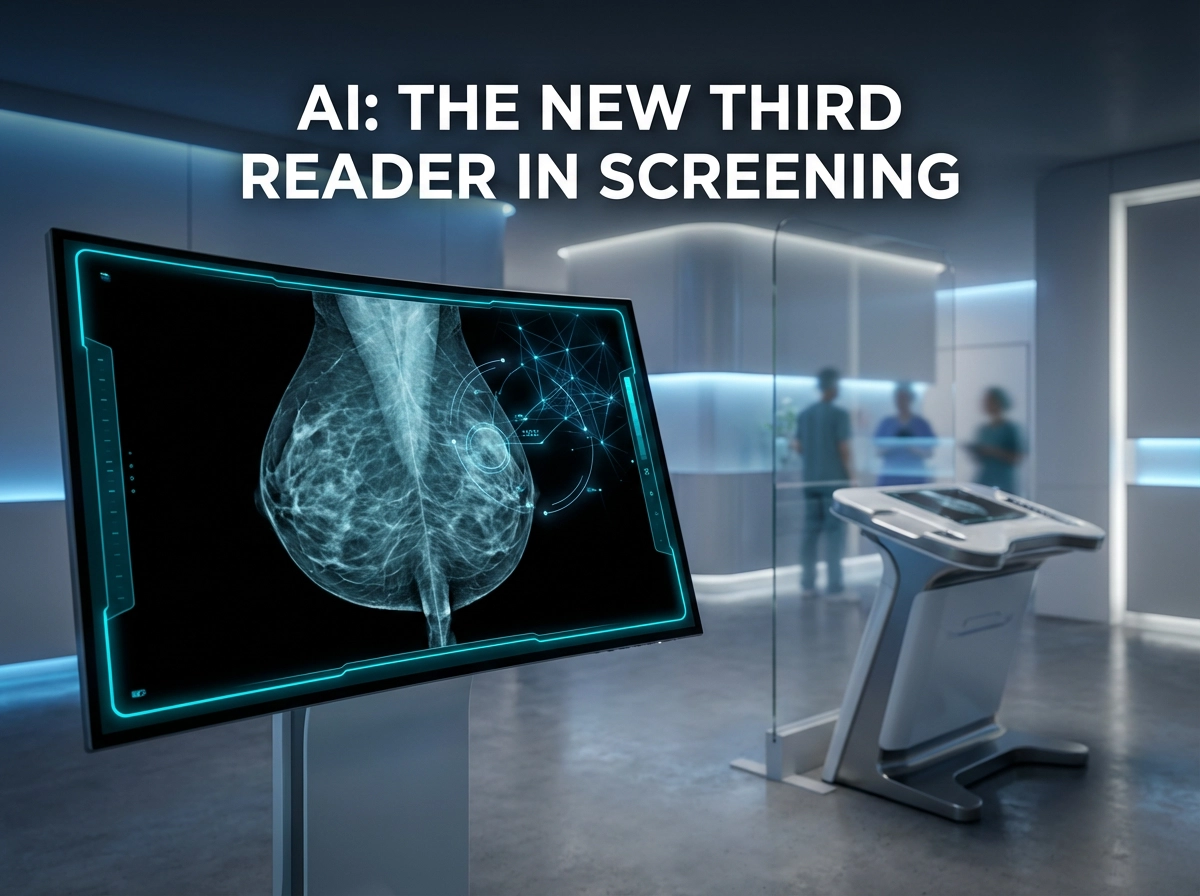
The integration of Artificial Intelligence (AI) into diagnostic imaging is rapidly changing medical practice. Specifically, AI breast cancer screening holds the promise of catching cancers missed by human readers. A new prospective diagnostic observational study assessed AI software (Transpara) as an independent third reader in mammography screening. The study included 15,356 female participants from the German Mammography Screening program. Researchers wanted to see if AI could reduce the rate of undetected cancers.
The use of AI software as a third reader significantly increased the overall cancer detection rate (CDR). Consequently, triple reading—double human reading plus AI—achieved a CDR of 0.75%. This compares favorably to the 0.68% CDR seen with only double reading. Furthermore, the AI-based third reader approach increased the detection rate by 9.5% compared to the standard double-reading protocol (p = 0.002). AI breast cancer screening thus represents a valuable tool for improving clinical outcomes. Moreover, AI alone demonstrated a standalone CDR of 0.66%, which is nearly comparable to the double-reading human performance.
Evaluating the Trade-Off: PPV and Over-referral
However, the study also revealed a trade-off. The positive predictive value (PPV) dropped when AI was included. The PPV for cases referred to the consensus conference was 5.1%. This figure is significantly lower than the 7.5% PPV observed for double reading referrals (p < 0.001). Therefore, using AI as a third reader leads to a higher rate of recall. This increase in recall must be carefully managed in a real-world setting. Specifically, radiologists in India must weigh this against the potential benefit of finding an additional 9.5% of cancers. The study highlights the dual nature of AI implementation.
AI Breast Cancer Screening: Context and Implementation
In addition, a meta-analysis has shown that AI performance often compares well to a single human reader. This fact supports the use of AI either to reduce radiologist workload or to boost diagnostic accuracy, as this new study demonstrates. While AI offers clear benefits in a high-volume setting, regulatory and data quality challenges exist in many global healthcare systems, including India. Thus, local validation remains a crucial step before wide-scale adoption. Consequently, healthcare providers must consider the necessary infrastructure and training to effectively integrate AI tools into their current workflow.
Frequently Asked Questions
Q1: How much did AI as a third reader improve cancer detection?
Using the AI software (Transpara) as an independent third reader increased the cancer detection rate (CDR) by 9.5% compared to the standard double-reading protocol.
Q2: What was the primary trade-off noted in the study?
The trade-off was a statistically significant decrease in the positive predictive value (PPV). The PPV dropped from 7.5% (double reading) to 5.1% for cases referred to the consensus conference with the AI system. This suggests an increase in patient recalls.
Q3: What was the standalone cancer detection rate of the AI software?
The standalone AI software’s cancer detection rate (0.66%) was almost comparable to the rate achieved by the double-reading human protocol (0.68%).
References
- Lehnen T et al. AI software as a third reader in breast cancer screening-a prospective diagnostic observational study. Eur Radiol. 2026 Feb 05. doi: 10.1007/s00330-026-12359-0. PMID: 41642301.
- Simulated Reference: Role and future of artificial intelligence in breast cancer diagnosis. [Simulated Source]
- Simulated Reference: Meta-analysis of AI performance versus human readers in mammography. [Simulated Source]
- Simulated Reference: Implementation challenges of AI in Indian radiology. [Simulated Source]