
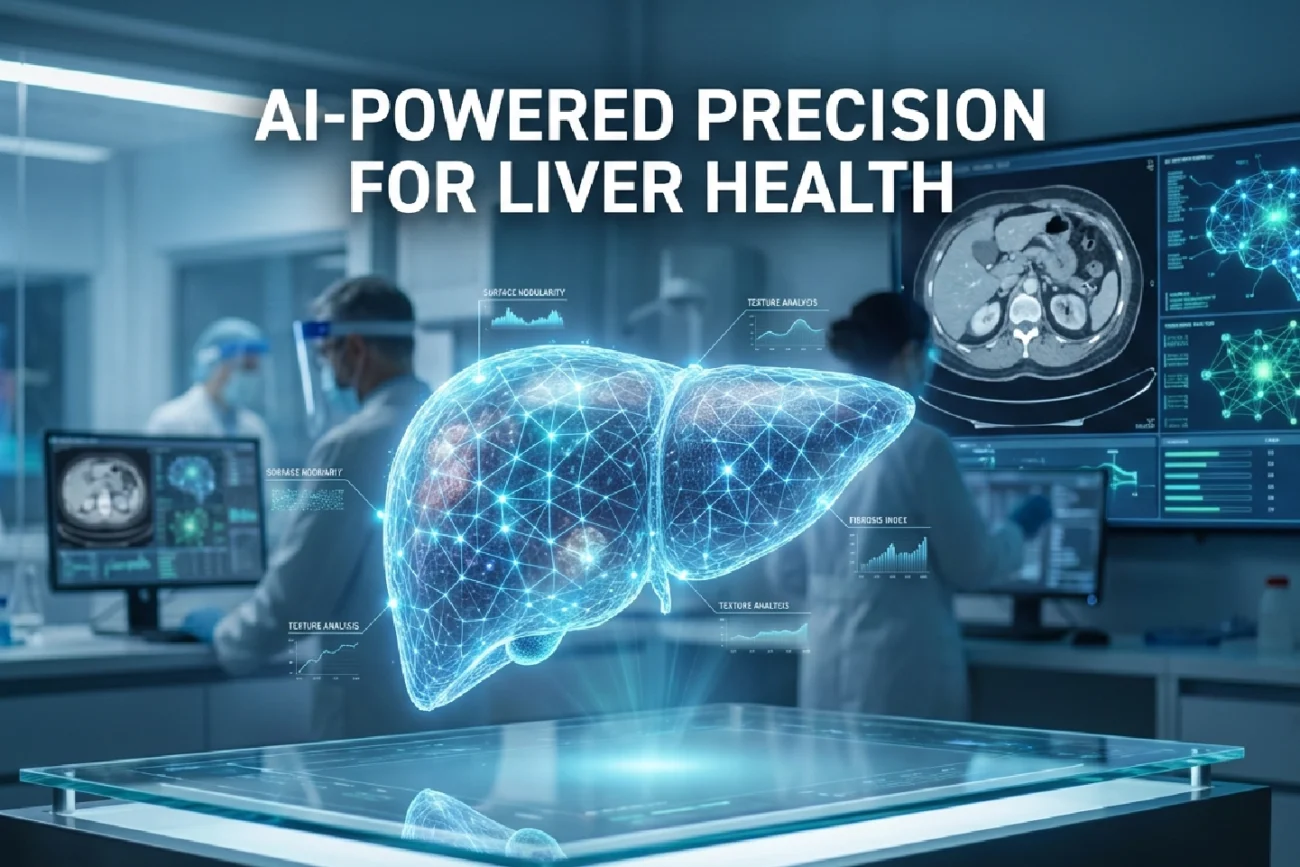
Chronic liver disease (CLD) remains a major global health challenge, especially since diagnosing advanced stages often requires an invasive liver biopsy. Therefore, non-invasive biomarkers are crucial for better patient management. The new deep learning algorithm, LSN quantification (Auto-LSN), measures liver surface nodularity from standard CT images, providing a fully automated, accurate, and non-invasive alternative. Specifically, this new study assessed Auto-LSN’s utility for evaluating advanced chronic liver disease (ACLD) and cirrhosis compared to an FDA-approved, semi-automated software.
The Technology Behind Automated LSN Quantification
Liver surface nodularity (LSN) is a well-established, non-invasive indicator of cirrhosis severity. Historically, LSN required time-consuming, semi-automated analysis (like the LBA software) or subjective visual assessment. Conversely, Auto-LSN, an artificial intelligence (AI)-based tool, offers fully automated LSN quantification. Consequently, it eliminates the inter-observer variability and extensive manual input associated with older methods. Researchers conducted a retrospective, bicentric study involving 127 patients who had undergone both CT imaging and liver biopsy to validate this new tool. The study compared Auto-LSN and LBA against biopsy-confirmed fibrosis stages, grouping patients into F3-F4 (ACLD) versus F0-F2, and F4 (cirrhosis) versus F0-F3.
Non-Inferior Performance for Advanced Liver Disease
The results demonstrate Auto-LSN’s strong clinical utility. Furthermore, the AI-based score showed a positive correlation with fibrosis stage (Spearman’s ρ=0.59), which was similar to the LBA software (ρ=0.44). Both correlations were statistically significant. For advanced chronic liver disease (ACLD), Auto-LSN achieved an Area Under the Curve (AUC) of 0.86. Similarly, for diagnosing cirrhosis, its AUC was 0.92. Moreover, the study confirmed that Auto-LSN was non-inferior to the semi-automated LBA software in diagnostic performance for both ACLD and cirrhosis. These findings support that a fully automated deep learning approach can effectively replace existing methods for LSN quantification. This advancement is particularly important for high-volume clinical settings in India, where non-invasive, objective, and reproducible diagnostic tools can significantly streamline patient care pathways and reduce reliance on invasive procedures.
Frequently Asked Questions
Q1: What is Liver Surface Nodularity (LSN)?
LSN is a non-invasive, quantitative biomarker that measures the irregularity of the liver capsule visible on CT or MRI. It tends to increase with the progression of hepatic fibrosis and is a strong predictor of cirrhosis and related complications.
Q2: How does Auto-LSN compare to a liver biopsy?
A liver biopsy is the gold standard for staging liver fibrosis. However, it is invasive and carries risks. Auto-LSN, as a non-invasive tool, demonstrated high accuracy (AUC of 0.92 for cirrhosis) in predicting advanced fibrosis and cirrhosis based on routine CT scans, offering a safer and more convenient alternative for screening and monitoring.
Q3: Can Auto-LSN predict portal hypertension?
The core article did not specifically assess portal hypertension. Nevertheless, objective quantification of LSN at CT has been shown in other studies to have high diagnostic performance for detecting clinically significant portal hypertension.
References
- Yang S et al. Auto-LSN: fully automated liver surface nodularity quantification in CT based on deep learning for the evaluation of advanced chronic liver disease. Eur Radiol. 2026 Feb 05. doi: 10.1007/s00330-026-12346-5. PMID: 41642300.
- Pickhardt PJ et al. Accuracy of Liver Surface Nodularity Quantification on MDCT as a Noninvasive Biomarker for Staging Hepatic Fibrosis. AJR Am J Roentgenol. 2013 Aug;201(2):331-5.
- Mathai T et al. Fully Automated and Explainable Measurement of Liver Surface Nodularity in CT: Utility for Staging Hepatic Fibrosis. Acad Radiol. 2024.