
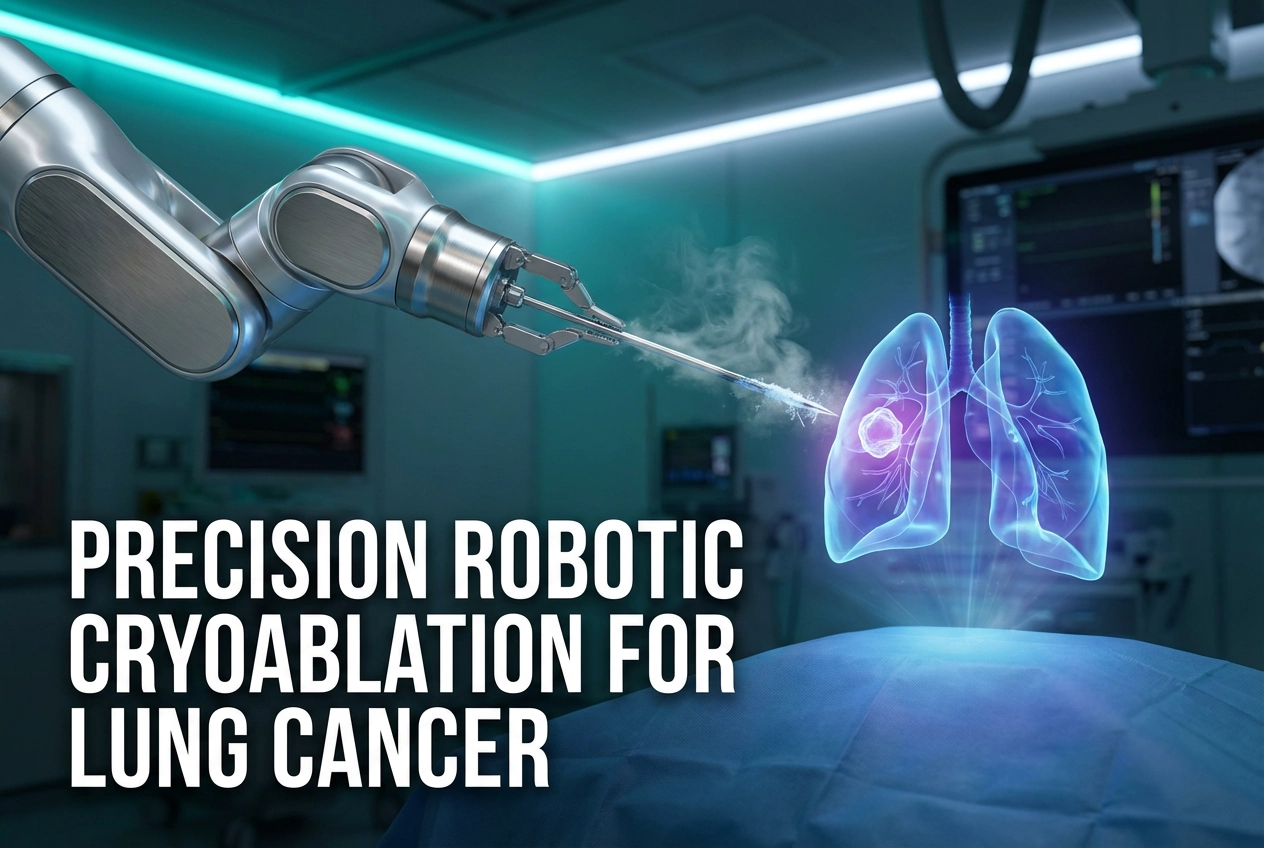
The field of interventional oncology is evolving rapidly. A recent IDEAL stage 2a prospective study highlights the efficacy of a novel technique for lung metastases. Specifically, the trial evaluated Robot-Assisted Cryoablation guided by Computed Tomography (CT). Researchers sought to determine the feasibility, safety, and technical performance of this minimally invasive approach for pulmonary metastases.
Robot-Assisted Cryoablation: A Safe and Feasible Option
The single-centre study involved 26 participants. These patients had a total of 37 lung metastases targeted over 30 procedures. Their median tumor diameter was quite small, measuring 9.8 mm (IQR 5.1–12.8). All procedures required general anesthesia with high-frequency jet ventilation. Consequently, this ensured patient stability during the intervention. The robotic guidance system successfully completed the trajectory without conversion in 95% of the tumors (35/37). This high rate demonstrates the procedure’s technical feasibility.
Furthermore, the overall complication profile was favorable. Only one major complication (3%) occurred, which was a CTCAE grade 3 pneumothorax that required four days of drainage. Other adverse events were low-grade (grade 1–2). The study also noted no observed bronchopleural fistulas. In fact, many pneumothoraces were managed by simple observation (n=7). Clinicians also utilized prophylactic intraprocedural chest drain insertion in eleven cases. Patient recovery was fast. Therefore, the median hospital stay was only one night (IQR 1–2).
Achieving High Precision with Robot-Assisted Cryoablation
Robotic navigation systems inherently offer superior navigational precision. The study confirmed this critical benefit. On the first insertion, the median Euclidean targeting error was 6.1 mm. The lateral error was 4.2 mm. These measurements confirm the robotic system’s high accuracy. Moreover, the robotic platform’s design enables complex trajectory planning, supporting the use of multiple probes. A total of 54 cryoprobes were necessary for the ablations. Nevertheless, the median number of manipulations per probe was only one. Strikingly, one-third of the probes needed no adjustment whatsoever. This minimal manipulation is a key advantage of the robotic approach.
Once integrated into the workflow, the ‘chopstick technique’ was frequently applied. This technique supports conformal ablation, which is vital for complete tumor destruction. The median total procedure time was 66.5 minutes. Most importantly, the clinical efficacy was excellent. The 12-month local tumor progression-free survival rate reached an impressive 97%.
Clinical Implications for Interventional Oncology
This study strongly supports the continued evaluation of robotic-assisted CT-guided cryoablation. The ability to perform precise probe placement is particularly advantageous for lung cryoablation. Ablation procedures, including Radiofrequency Ablation (RFA), rely heavily on operator expertise for optimal probe positioning. Consequently, suboptimal manual positioning can lead to incomplete ablation margins in up to 15–20% of cases. Robotic navigation significantly mitigates this risk.
Furthermore, procedural refinements helped manage specific risks, such as the potential for bleeding. These refinements included careful patient positioning and optimized probe selection. Clinicians also adopted the ‘chopstick configuration’ to optimize energy delivery. The capacity to efficiently plan complex multiprobe configurations makes the robotic platform a vital tool. Therefore, these findings warrant evaluation in larger, prospective comparative trials.
Frequently Asked Questions
Q1: What is the key advantage of using robotic guidance for cryoablation?
Robotic guidance provides high targeting precision, resulting in a low median targeting error (6.1 mm) on first insertion. Furthermore, it enables complex multiprobe configurations with minimal cryoprobe manipulation, which is critical for performing conformal ablation effectively.
Q2: How effective is this procedure at controlling the tumor?
The procedure demonstrated excellent clinical efficacy. The 12-month local tumor progression-free survival rate reached 97%.
Q3: What was the median hospital stay following the procedure?
Patient recovery was rapid, with a median hospital stay of only one night (IQR 1–2).
References
- Fotiadis N et al. Robot-assisted CT-guided cryoablation of pulmonary metastases: an IDEAL stage 2a prospective development study. Eur Radiol. 2026 Feb 05. doi: 10.1007/s00330-026-12335-8. PMID: 41642299.
- Jiao D et al. Robot-Guided Navigation Enhances Precision and Safety in Lung Tumor Ablation. Appl Radiol. 2026 Jan 07.
- Callstrom MR et al. Multicenter Study of Metastatic Lung Tumors Targeted by Interventional Cryoablation Evaluation (SOLSTICE). J Vasc Interv Radiol. 2022 Dec;33(12):1559-1567.e3.
- Wolf F et al. Evaluating Cryoablation of Metastatic Lung Tumors in Patients – Safety and Efficacy: The ECLIPSE trial – Interim analysis at 1-Year. ResearchGate. 2025 May 30.