
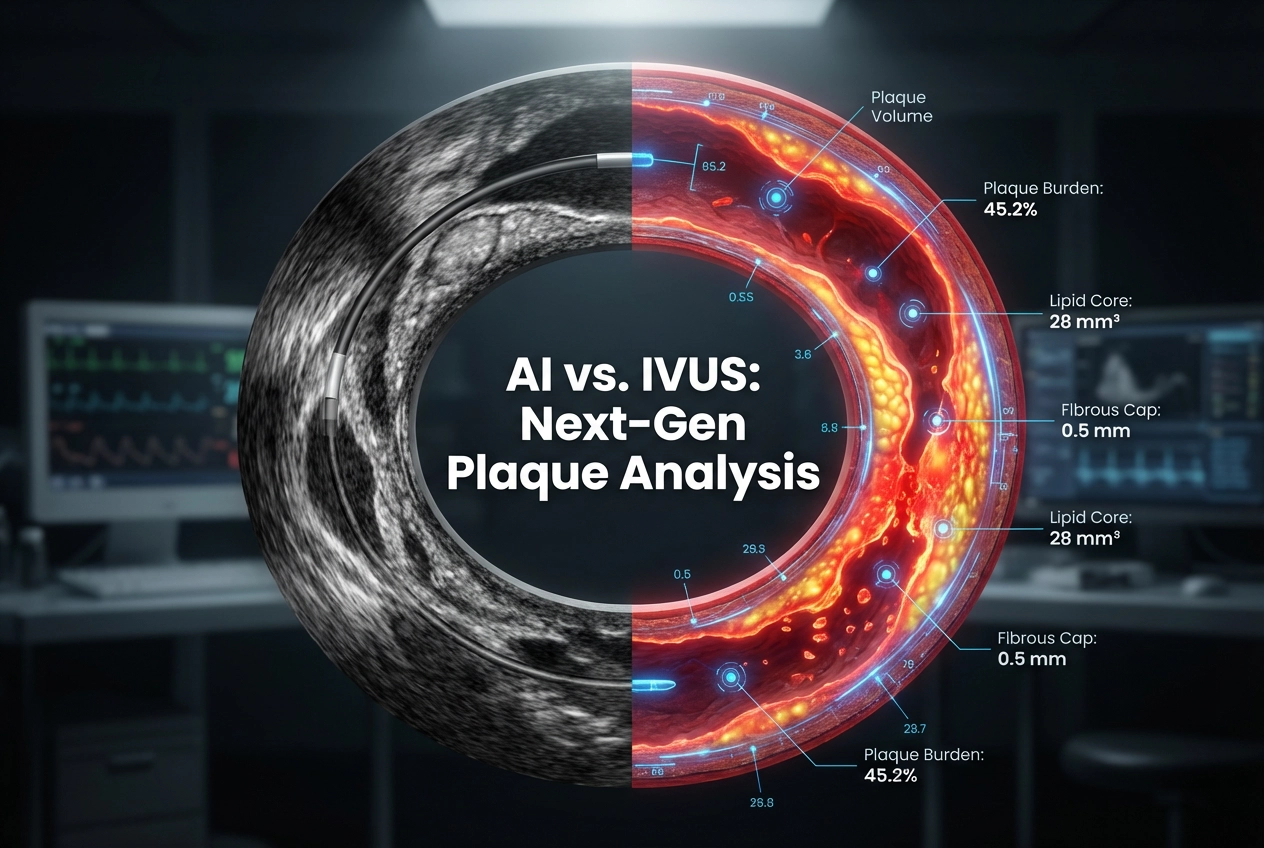
AI coronary plaque quantification has emerged as a transformative tool for modern cardiology. Recent data from the INVICTUS registry demonstrates that automated assessments are now comparable to intravascular ultrasound (IVUS). Because IVUS is the invasive gold standard, matching its precision with non-invasive scans is a major milestone. This technology optimizes image processing times while standardizing interpretation for every patient.
Validating AI Accuracy Against Invasive Standards
The INVICTUS registry study analyzed 108 vessels to compare artificial intelligence-based CCTA quantification (AI-QCT) against core-lab IVUS findings. Researchers found strong Pearson’s correlations for essential metrics like lumen volume and calcium index. Specifically, the correlation for lumen volume reached 0.943. Furthermore, the correlation for plaque volume was 0.833. These high associations were consistent even in challenging segments containing low-attenuation plaques. Consequently, the findings suggest that AI can reliably handle the full spectrum of atherosclerotic disease.
Clinical Benefits of AI Coronary Plaque Quantification
The clinical relevance of these results is profound for routine medical practice. Traditional CCTA interpretation often suffers from inter-observer variability. However, AI-QCT provides rapid and automatic quantification without reader-dependent errors. Therefore, clinicians can achieve more standardized cardiovascular risk assessments. This consistency is vital for monitoring treatment success and making precise therapeutic decisions. Moreover, automated tools allow for faster workflows in busy clinical environments. Because the technology identifies high-risk features accurately, it enables earlier intervention for vulnerable patients.
Frequently Asked Questions
Q1: How accurate is AI compared to IVUS for plaque volume?
AI-QCT shows a strong correlation with IVUS for plaque volume quantification, with studies reporting a Pearson’s coefficient of 0.833. This indicates that AI provides a highly reliable non-invasive alternative to invasive ultrasound imaging.
Q2: Can AI identify high-risk low-attenuation plaques?
Yes, the INVICTUS registry data confirmed that AI-based quantification remains accurate in segments containing low-attenuation and non-calcified plaques. This capability is crucial for identifying plaques most likely to cause acute cardiovascular events.
References
- Nakanishi R et al. Artificial intelligence-based coronary computed tomography angiography quantification of atherosclerosis burden: comparison with intravascular ultrasound in the INVICTUS Registry. Eur Radiol. 2026 Mar 05. doi: 10.1007/s00330-026-12412-y. PMID: 41781729.
- Nurmohamed NS, et al. AI-guided quantitative plaque staging using coronary CT angiography (AI-QCT) for cardiovascular risk prediction. CONFIRM2 Registry. AHA Scientific Sessions. 2025.
- Choi AD, et al. Artificial Intelligence in Coronary Plaque Characterization: Clinical Implications and Evidence Gaps. PMC. 2026.