
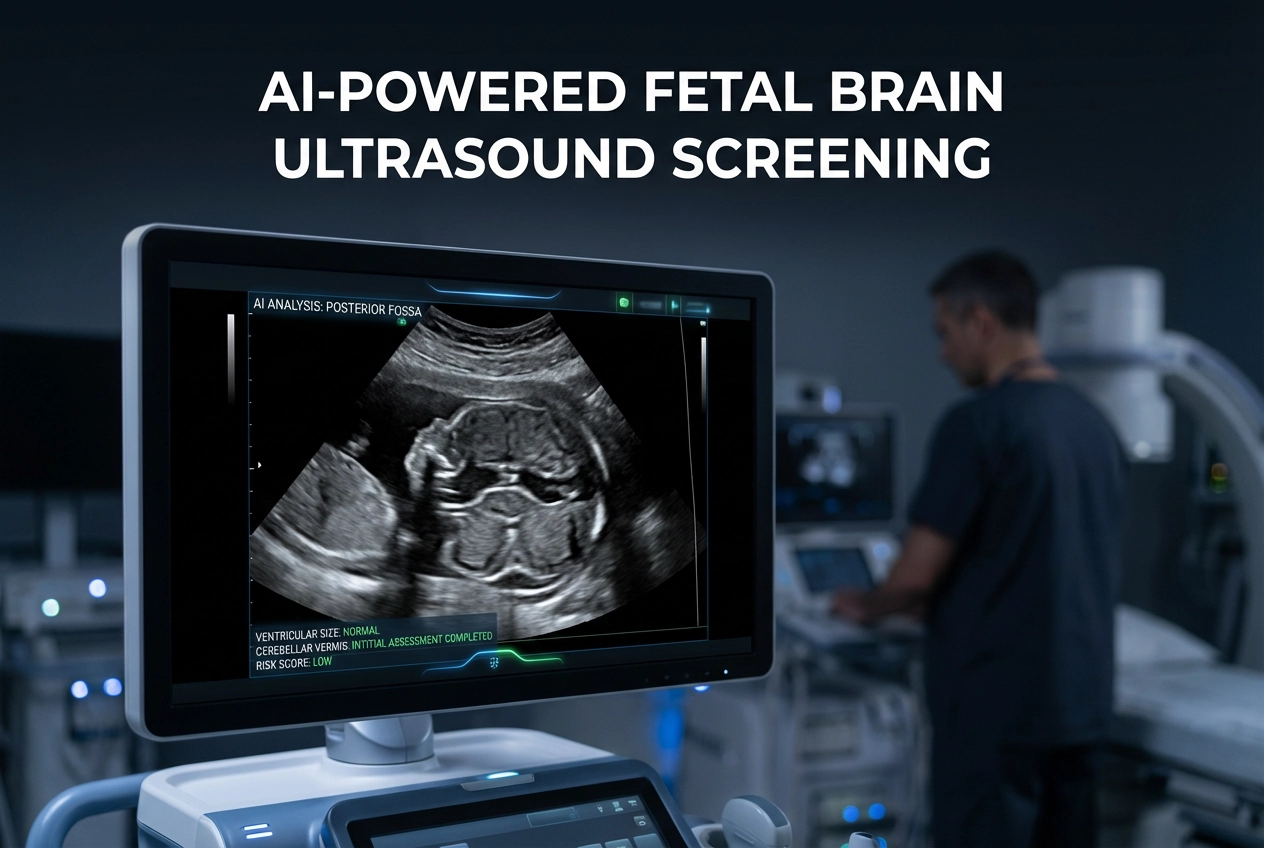
Deep learning technology is transforming prenatal screening. A recent international study, AIRFRAME, focused on developing an advanced algorithm to automatically assess the fetal posterior fossa during first-trimester ultrasound scans. This important tool aims to improve the detection of two major congenital anomalies: Open Spina Bifida (OSB) and Cystic Posterior Fossa (CPF) anomalies. The success of this approach represents a significant step forward for early diagnosis and parental counseling, especially in high-volume settings like those in India.
Evaluating the AI’s Efficacy for Fetal Posterior Fossa Anomalies
Researchers retrospectively analyzed midsagittal fetal brain US images from 251 fetuses. The data, spanning from 2009 to 2024, came from 10 international fetal medicine centers. Notably, the study included 150 normal cases and 101 abnormal cases (43 OSB and 58 CPF anomalies). All diagnoses had confirmation at follow-up. Therefore, researchers manually annotated the images to delineate the posterior fossa structure for training. The team trained three convolutional neural networks (CNNs), then using ensemble averaging for the final predictions. The MobileNetV3 Large Weights algorithm achieved the best performance.
Performance Metrics and Clinical Implications
On the internal test set, MobileNetV3 Large Weights proved highly effective. It achieved an accuracy of 88% (67/76) and an Area Under the Receiver Operating Characteristic Curve (AUC) of 0.94. Furthermore, the model demonstrated a high recall of 81% and a specificity of 93%. Interestingly, the algorithm classified Open Spina Bifida more accurately than Cystic Posterior Fossa anomalies (93% vs 88% accuracy). This high performance suggests a powerful tool for screening. Consequently, the ability to accurately assess the posterior fossa during the 11 to 14-week window is crucial. Early diagnosis of conditions like OSB allows parents and physicians to plan for optimal management, including potential in-utero surgery. Therefore, integrating such AI tools into routine first-trimester screening could significantly enhance diagnostic confidence.
Frequently Asked Questions
Q1: What is the primary purpose of assessing the fetal posterior fossa in the first trimester?
The primary purpose is the early detection of major central nervous system (CNS) anomalies like Open Spina Bifida (OSB) and Cystic Posterior Fossa (CPF) abnormalities. Early diagnosis provides critical time for parental counseling and management planning.
Q2: Which deep learning model showed the best performance in the AIRFRAME study?
The MobileNetV3 Large Weights convolutional neural network (CNN) achieved the best results. It accurately distinguished between normal images and those showing OSB or CPF anomalies with an overall accuracy of 88%.
Q3: How does AI screening relate to traditional first-trimester US screening?
Traditional screening at 11–14 weeks already allows visualization of the posterior fossa. The new AI algorithm augments this process, offering an automatic, rapid, and highly accurate assessment to support the sonographer’s clinical judgment.
References
- Familiari A et al. Development of a Deep Learning Algorithm for Posterior Fossa Abnormality Recognition on First-Trimester US Screening Scans: AIRFRAME Study Part 1. Radiol Artif Intell. 2026 Jan 21. doi: 10.1148/ryai.250394. PMID: 41563074.
- Jain A, et al. Antenatal Posterior Fossa Cystic Malformations. Antenatal Consultations. perinatology.in.
- Pertl B, et al. The Fetal Posterior Fossa on Prenatal Ultrasound Imaging: Normal Longitudinal Development and Posterior Fossa Anomalies. Ultraschall Med. 2019 Dec;40(6):692-721. doi: 10.1055/a-1015-0157.
- Singh P, et al. Early Detection of Fetal Malformation, a Long Distance Yet to Cover! Present Status and Potential of First Trimester Ultrasonography in Detection of Fetal Congenital Malformation in a Developing Country: Experience at a Tertiary Care Centre in India. BMC. 2017 Jan 25;17(1):1.