
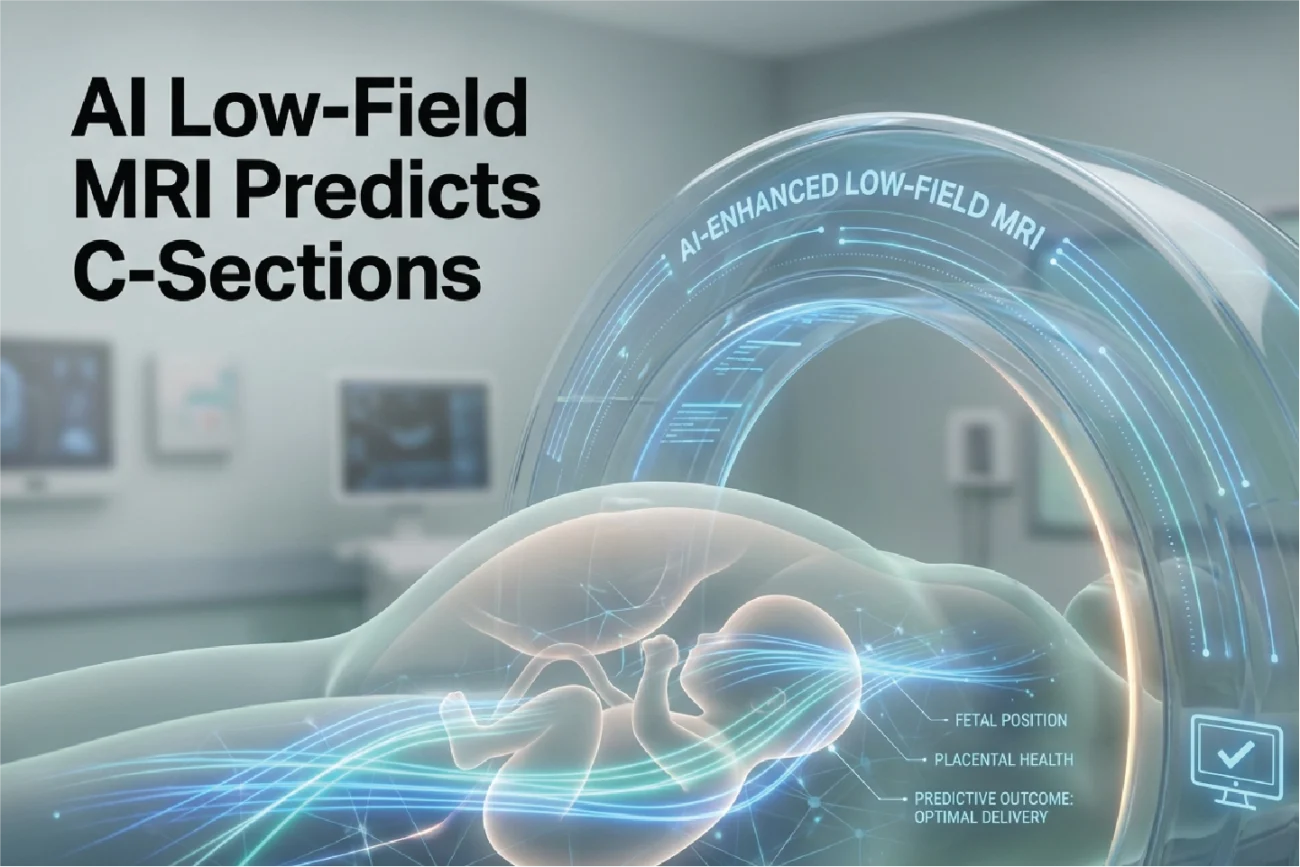
Low-Field MRI Cervix imaging is emerging as a powerful, accessible tool in obstetrics. Researchers recently employed a 0.55 Tesla (T) low-field MRI scanner, alongside deep learning AI, to evaluate the late gestation cervix. This innovative approach sought to automate 3D measurements and correlate them with maternal demographics and birth outcomes. Therefore, the study’s findings suggest a significant new biomarker for predicting emergency Caesarean section (CS) versus spontaneous vaginal birth (SVB).
Automating Cervical Biometry with Low-Field MRI
The prospective cohort study successfully leveraged a 0.55T Freemax MRI scanner to acquire 2D T2-weighted sequences. These sequences allowed for the production of high-quality reconstructed images in 92.9% of the cases. Furthermore, 84.9% of these images were deemed good quality. Consequently, the researchers developed an in-house 3D deep learning segmentation network. This network automatically identified anatomical landmarks and generated both 2D measurements and 3D volumes of the cervix. Importantly, automated biometry showed excellent or good inter-rater variability when compared to manual measurements. Consequently, the researchers demonstrated the reliability of this novel technique.
Low-Field MRI Cervix and Birth Outcome
The primary clinical finding concerns the predictive value of cervical volume. The study included late gestation women (36-41 weeks) attempting their first vaginal birth. Notably, total cervical and stromal volumes increased significantly with cervical length. However, the crucial revelation was the difference in cervical volume between delivery groups. Specifically, the total cervical volume was significantly lower in patients who subsequently required an emergency CS (median 29.6 cc) compared to those who achieved a SVB (median 33.7 cc; p < 0.05). In contrast, maternal demographics did not correlate with total cervical volume. Therefore, cervical volume, as measured by low-field MRI, stands out as an independent imaging biomarker for birth outcome. This finding holds particular promise for managing labor risk.
Implications for Indian Healthcare
Low-field MRI is gaining recognition globally, especially in low-resource settings. Conventional high-field MRI scanners are expensive and require complex infrastructure. Consequently, they are often inaccessible outside major metropolitan centers in countries like India. Low-field devices are smaller, more affordable, and easier to site. For instance, a separate study validated the feasibility of the 0.55T low-field scanner for reliable fetal imaging, which included cervical length measurements. Moreover, MRI itself proves superior to ultrasound for assessing cervical tissue changes that precede delivery. Integrating automated measurement tools, like the deep learning network used here, into low-field systems offers a path to democratize advanced obstetric risk assessment. Clinicians can utilize this accessible technology for better prediction of emergency CS, which may ultimately help reduce maternal and neonatal morbidity.
Frequently Asked Questions
Q1: What is the main finding regarding low-field MRI of the cervix and birth outcomes?
The total cervical volume was significantly lower in women who required an emergency Caesarean section compared to those who had a spontaneous vaginal birth.
Q2: Why is low-field MRI particularly relevant for healthcare in India?
Low-field MRI scanners are more affordable, portable, and easier to install than high-field units. This dramatically increases the accessibility of advanced obstetric imaging in resource-constrained and rural areas.
Q3: What role did AI play in the study?
An in-house 3D deep learning segmentation network was used to automate the identification of anatomical landmarks and generate precise 2D measurements and 3D volumes of the cervix.
References
- Bansal S et al. Low-Field Magnetic Resonance Imaging of the Late Gestation Cervix and Birth Outcome Correlation: A Prospective Cohort Study. BJOG. 2025 Dec 03. doi: 10.1111/1471-0528.70103. PMID: 41332358.
- Verdera J, et al. Reliability and Feasibility of Low-Field-Strength Fetal MRI at 0.55 T during Pregnancy. Radiology. 2023 Oct;309(1):e223002.
- Singh S, et al. Low‐field MRI: Clinical promise and challenges. NMR Biomed. 2021 Jul;34(7):e4525.