
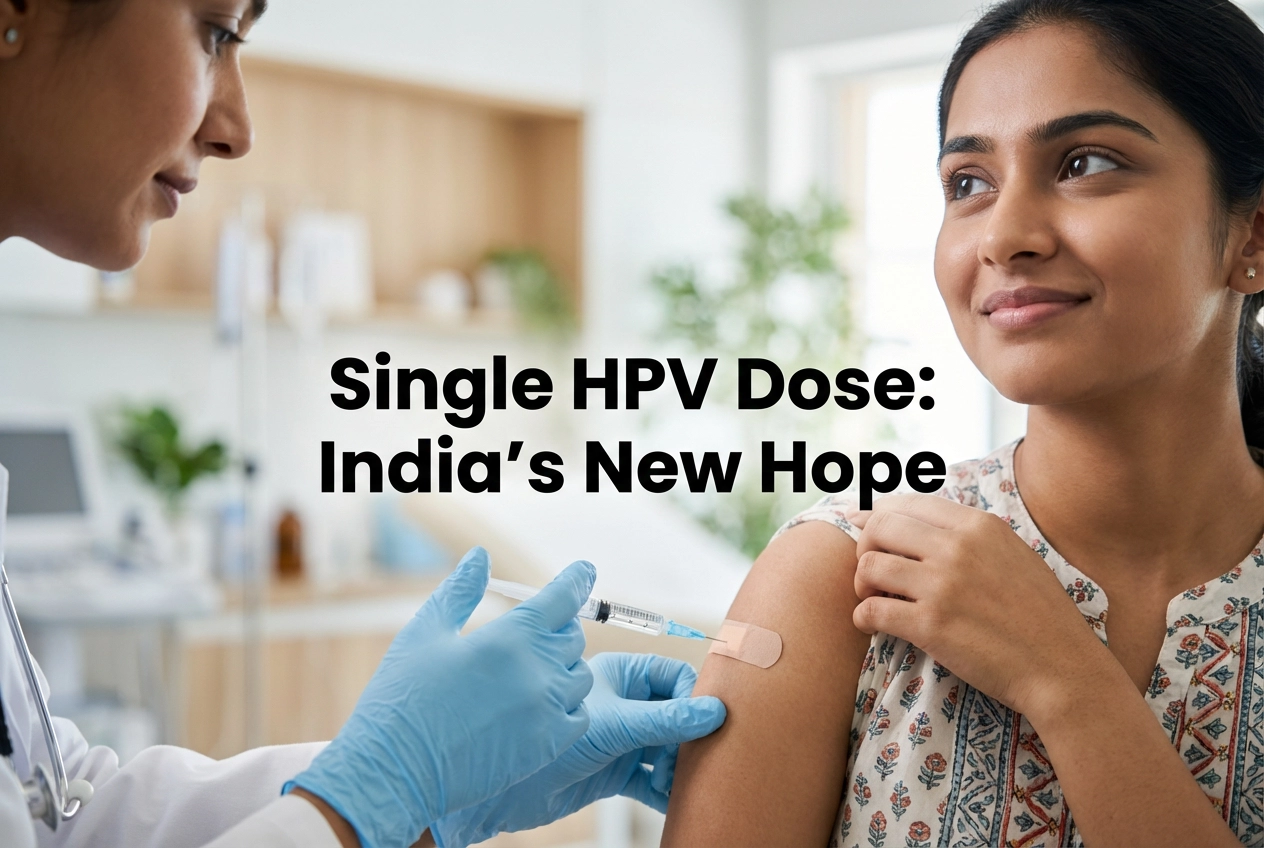
A significant new study suggests a Single Dose HPV Vaccine provides robust protection against the viral infection that leads to cervical cancer. Researchers reported that one shot is just as effective as the current two-dose regimen. Therefore, this finding could be a transformative tool for global public health. The new data is especially crucial for countries like India, where cervical cancer is a major killer. Furthermore, the World Health Organization (WHO) already endorsed a one- or two-dose schedule in 2022, anticipating this strong evidence.
The ESCUDDO Trial: Evidence for a Single Dose HPV Vaccine
The randomized controlled trial, known as the ESCUDDO trial, involved over 20,000 girls aged 12 to 16 in Costa Rica. The researchers from the U.S. National Cancer Institute (NCI) and Costa Rica’s Agency for Biomedical Research tracked participants for five years. Participants received either a bivalent or a nonavalent vaccine. Half the girls then received a second dose six months later, while the rest received an unrelated vaccination. The study’s core finding was clear: a single HPV shot provided about 97% protection against the most cancer-prone HPV strains. Interestingly, this strong protection was similar to the efficacy observed with two doses. Because persistent infection with high-risk HPV types 16 and 18 causes over 77% of cervical cancers globally, this high efficacy is clinically important. Consequently, the results offer the strongest evidence to date to justify a shift in global vaccine policy.
Impact on Cervical Cancer Prevention in India
Globally, cervical cancer kills approximately 340,000 women annually, with India accounting for a significant portion of these deaths. Cervical cancer is a serious public health problem in India; therefore, enhancing the efficiency of the HPV vaccination program is a priority. Currently, Indian guidelines recommend a two-dose schedule for girls aged 9–14 years and a three-dose schedule for females aged 15–26 years. Nevertheless, low global uptake (less than one-third of adolescent girls) highlights the access and cost challenges, especially in low-income settings. Since cost is a primary obstacle to vaccination in India, a proven, effective Single Dose HPV Vaccine regimen would significantly reduce the financial burden and logistics of national rollout programs. Indeed, simplifying the schedule from two or three shots to one makes mass immunization campaigns easier to implement, ultimately accelerating the elimination of cervical cancer. For those interested in advancing their expertise in women’s health and associated cancers, the Post Graduate Program In Obstetrics & Gynaecology offers relevant specialized training.
Frequently Asked Questions
Q1: How effective is one dose of the HPV vaccine compared to two?
The recent large-scale randomized trial found that a single dose of the HPV vaccine provides approximately 97% protection against the high-risk HPV types (16/18) that cause most cervical cancers. This efficacy rate was statistically similar to the protection provided by a two-dose schedule, lasting for at least five years.
Q2: What are the current HPV vaccine recommendations in India?
The current guidelines in India recommend a two-dose schedule for girls aged 9–14 years. Conversely, a three-dose schedule is recommended for females aged 15–26 years, as well as for all immunocompromised individuals, regardless of their age at initiation. Understanding the intricacies of immunization schedules is vital for professionals in General Practice.
Q3: Does the single-dose regimen protect against all HPV-related cancers?
While the study showed high efficacy against HPV infection in the cervix, it did not provide information about HPV-related cancers beyond the cervix (e.g., head-and-neck or anal cancers). Therefore, researchers caution that longer-term monitoring is necessary to confirm the full range of protection. Professionals focusing on cancer management might benefit from exploring the Certification Course In Clinical Oncology.
References
- A single shot of HPV vaccine may be enough to fight cervical cancer, study finds – ETHealthworld
- ESCUDDO Trial: Single-Dose Human Papillomavirus (HPV) Vaccine Noninferiority to Two Doses for Cervical Cancer Prevention. The New England Journal of Medicine, 2025.
- Single HPV vaccine dose matches protection of 2-dose regimen, new trial shows. CIDRAP, University of Minnesota.
- Human papillomavirus vaccination: Good clinical practice recommendations from the Federation of Obstetric and Gynecological Societies of India.
- HPV Vaccination of Girl Child in India: Intervention for Primary Prevention of Cervical Cancer. National Institutes of Health.
Disclaimer: This article was automatically generated from publicly available sources and is provided for informational and educational purposes only. OC Academy does not exercise editorial control or claim authorship over this content. It is not a substitute for professional medical advice, diagnosis, or treatment. Always consult a qualified healthcare provider and refer to current local and national clinical guidelines.