
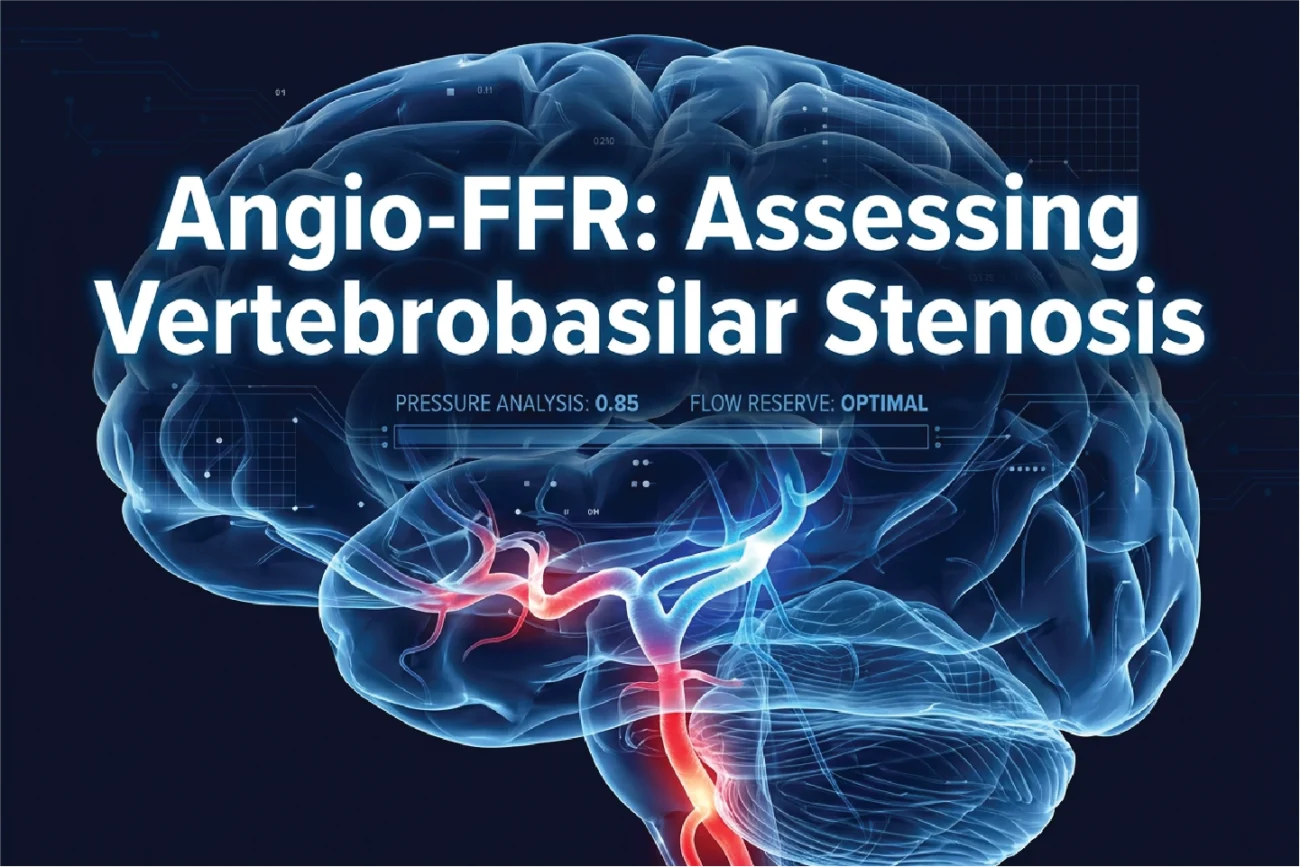
Intracranial Vertebrobasilar Artery Stenosis (IVBS) poses a significant stroke risk; therefore, accurately identifying hemodynamically significant lesions is crucial. While Digital Subtraction Angiography (DSA) measures the degree of stenosis (DS), this anatomical metric may not fully capture a lesion’s physiological impact. The latest research indicates that Angio-FF for IVBS (Angio-based fractional flow) significantly outperforms traditional degree of stenosis measurement in diagnosing symptomatic cases. Thus, Angio-FF provides a non-invasive, functional metric that directly correlates with patient symptoms.
Superior Diagnostic Accuracy of Angio-FF for IVBS
The study retrospectively analyzed 120 patients diagnosed with IVBS using DSA, categorizing them as symptomatic or asymptomatic. Consequently, researchers compared the diagnostic performance of Angio-FF against the simple degree of stenosis. The results showed a notably lower median Angio-FF value in symptomatic lesions (0.66 vs. 0.88, p < 0.001). Furthermore, Angio-FF demonstrated superior diagnostic accuracy, boasting an Area Under the Curve (AUC) of 0.94 compared to DS’s AUC of 0.85 (p < 0.05). Specifically, Angio-FF yielded higher sensitivity (89% vs. 71%) and a better Negative Predictive Value (NPV) (81% vs. 66%). The optimal cutoff value for predicting symptoms was an Angio-FF of 0.75. Additionally, the study confirmed that this non-invasive tool maintains high accuracy across challenging lesion subgroups, including tortuous arteries and tandem lesions, suggesting broad clinical utility.
Why Functional Metrics Outperform Anatomical Assessment
Degree of stenosis (DS), which relies solely on vessel narrowing, often fails to accurately predict whether a patient will become symptomatic. Because of this limitation, a purely anatomical measure cannot capture the complex hemodynamic changes that cause tissue ischemia. Conversely, Angio-FF assesses the pressure drop across the stenosis, providing a functional, patient-specific measurement of blood flow restriction. Therefore, it directly addresses the physiological relevance of the blockage. This shift from an anatomical to a functional assessment aligns with advancements in coronary artery disease management, where Fractional Flow Reserve (FFR) is the gold standard for guiding revascularization decisions. While Angio-FF technology requires specialized software and calculation based on angiography images, it eliminates the need for an invasive pressure wire, which enhances procedural safety and efficiency. However, clinicians must still recognize that severe IVBS carries significant risks of recurrent stroke, emphasizing the ongoing need for accurate diagnostic methods to guide appropriate medical or interventional therapy.
Frequently Asked Questions
Q1: What is Angio-FF?
Angio-FF, or Angio-based fractional flow, is a non-invasive diagnostic metric. It uses specialized software to calculate the functional severity of a stenosis by estimating the pressure drop across a lesion from standard Digital Subtraction Angiography (DSA) images. This method provides a physiological assessment of blood flow without requiring a pressure wire.
Q2: How does Angio-FF compare to traditional degree of stenosis (DS)?
Angio-FF showed higher overall diagnostic accuracy (AUC 0.94) and better sensitivity (89%) and Negative Predictive Value (81%) than the degree of stenosis (DS) in identifying symptomatic intracranial vertebrobasilar artery stenosis (IVBS). Therefore, Angio-FF is superior for determining a lesion’s functional significance.
Q3: What Angio-FF value suggests a lesion is symptomatic?
In this particular study, the optimal Angio-FF cutoff value for predicting symptomatic IVBS was found to be 0.75. Symptomatic lesions showed a significantly lower median Angio-FF (0.66) compared to asymptomatic lesions (0.88).
References
- Liu Y et al. Angiography versus angio-based fractional flow in assessing intracranial vertebrobasilar artery stenosis. Eur Radiol. 2025 Dec 04. doi: 10.1007/s00330-025-12183-y. PMID: 41342928.
- Angiography-Derived Fractional Flow Reserve in Coronary Assessment: Current Developments and Future Perspectives. ScienceOpen.
- Stenting for Symptomatic Intracranial Vertebrobasilar Artery Stenosis in Northeast of China: A Single-Center Study. Front Neurol.
- Intracranial and Extracranial Vertebrobasilar Artery Stenosis Patient Profile in Dr. Moewardi General Hospital. ResearchGate.