
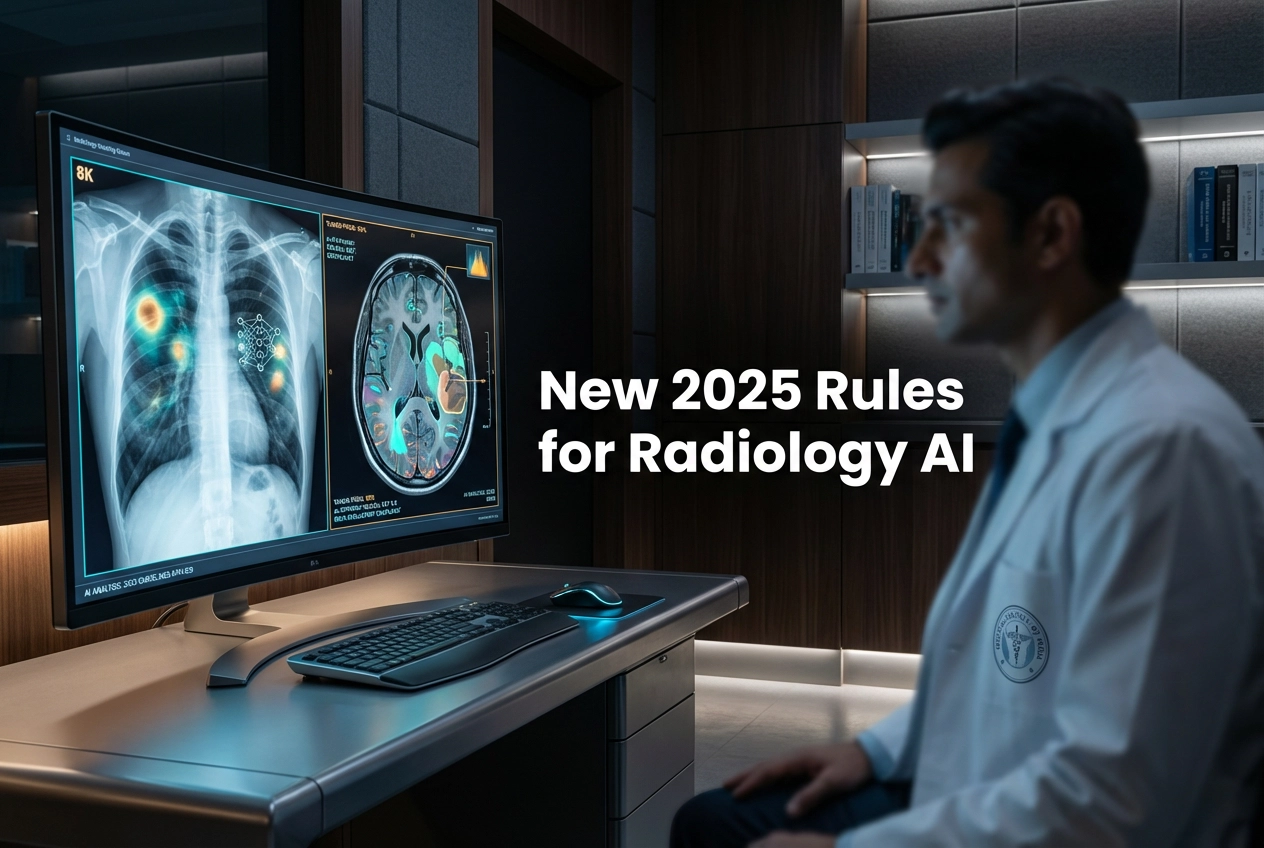
Navigating AI Medical Device Regulation in Radiology
As AI advances in radiology, regulatory frameworks are evolving rapidly to ensure patient safety. A recent review by Pesapane F et al. highlights how the EU, USA, and China are managing AI medical device regulation. While each region has unique pathways, they share a common goal: balancing innovation with rigorous oversight. Consequently, these frameworks provide a roadmap for radiologists and developers globally.
The Regulatory Scenario in the EU and USA
The European Union utilizes a dual-compliance strategy involving the Medical Device Regulation (MDR) and the 2024 AI Act. Specifically, the EU classifies most radiology AI as high-risk systems. This approach mandates strict transparency and human oversight to mitigate potential biases. In contrast, the United States relies on the FDA’s premarket pathways. The FDA uses the 510(k) clearance for devices showing substantial equivalence. Furthermore, the De Novo classification serves novel tools, while the Premarket Approval process addresses high-risk applications. Recently, the FDA emphasized lifecycle management. This ensures that adaptive algorithms perform consistently in real-world clinical settings.
AI Medical Device Regulation in India
India is also making significant strides in AI medical device regulation to align with international standards. In late 2025, the Central Drugs Standard Control Organisation (CDSCO) released comprehensive draft guidance for medical software. This framework categorizes AI imaging tools, such as those for CT and MRI, as Class C medical devices. This designation signifies a moderate-to-high risk profile. Therefore, manufacturers must now obtain formal licenses and provide clinical validation before deployment. Additionally, the Ministry of Health launched the Strategy for AI in Healthcare in India (SAHI) in early 2026. This initiative focuses on ethical and evidence-based AI adoption across the country.
Universal Convergences in AI Oversight
Despite geographical differences, global regulations are becoming surprisingly homogeneous. Most jurisdictions now emphasize patient data protection and risk-based classification. Moreover, there is a universal demand for transparency and bias mitigation. Human oversight remains a non-negotiable requirement in all major markets. These convergences help create a more predictable environment for international developers. Consequently, clinicians can trust that AI tools meet high safety benchmarks regardless of their origin.
Frequently Asked Questions
Q1: What is the main difference between the EU and USA regulatory approaches?
The EU uses a centralized, risk-based AI Act that applies across all sectors. Conversely, the USA follows a sector-specific model led primarily by the FDA for medical technologies.
Q2: How does India classify AI tools used for diagnostic imaging?
Under the 2025 CDSCO guidance, AI tools for imaging like X-rays and MRIs are Class C devices, indicating a moderate-to-high risk to patient health.
Q3: Why is human oversight important in AI medical devices?
Human oversight ensures that a qualified clinician makes the final diagnostic decision. This step prevents automated errors and maintains accountability in clinical practice.
References
- Pesapane F et al. Artificial intelligence as medical device in radiology in 2025: the regulatory scenario in the EU, USA, and China. Eur Radiol. 2026 Mar 15. doi: 10.1007/s00330-026-12460-4. PMID: 41832928.
- Central Drugs Standard Control Organisation (CDSCO). Draft Guidance on Medical Device Software under MDR 2017. Ministry of Health and Family Welfare, India. 2025.
- Ministry of Health and Family Welfare. Strategy for AI in Healthcare in India (SAHI) and BODH Framework. Press Information Bureau. 2026.