
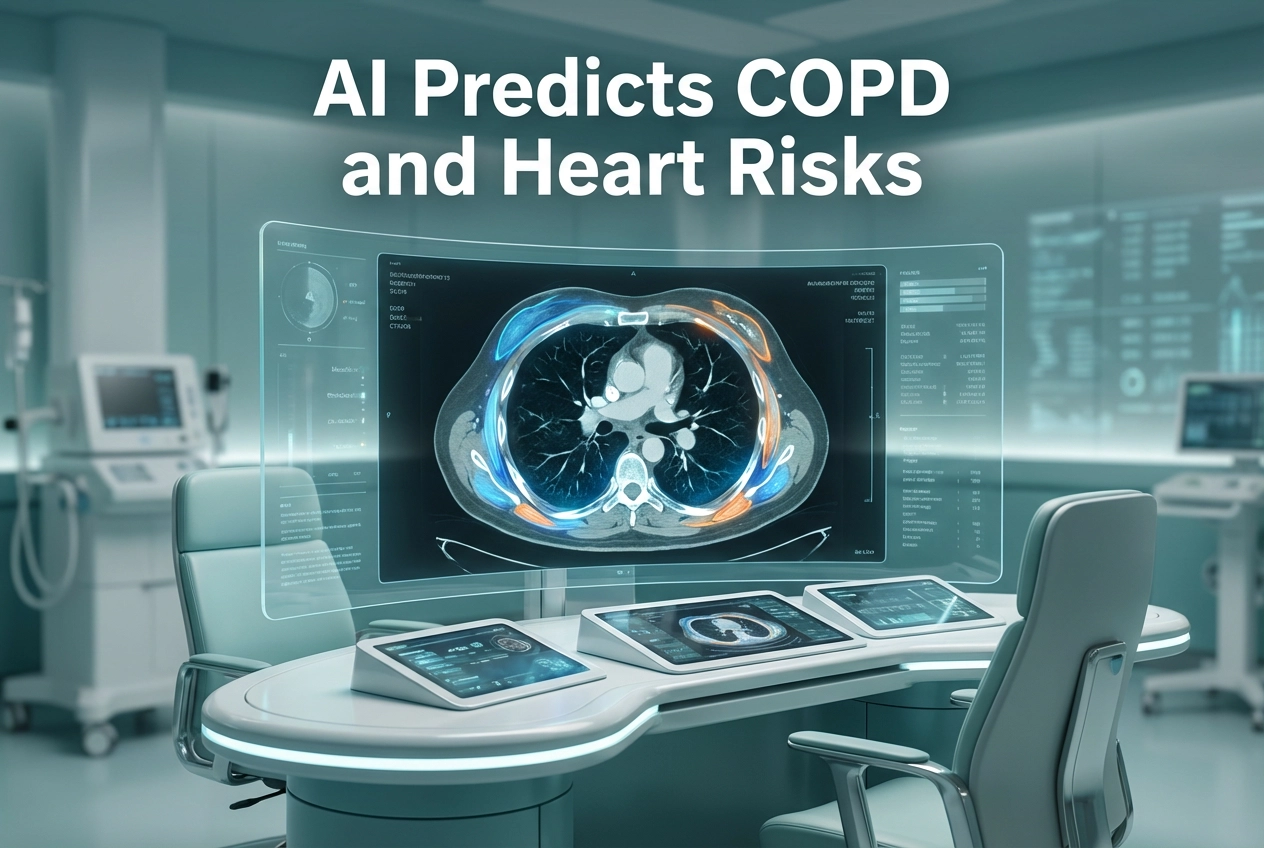
A significant prospective study demonstrates a powerful new application for Artificial Intelligence (AI) in opportunistic disease screening. The research found that AI-measured Myosteatosis—a measure of low skeletal muscle quality—derived from routine Coronary Artery Calcium (CAC) CT scans is a strong, independent predictor of future Chronic Obstructive Pulmonary Disease (COPD). Consequently, integrating this AI tool into clinical workflows could transform early detection strategies for this debilitating condition.
AI-measured Myosteatosis Outperforms Traditional Biomarkers
The Multi-Ethnic Study of Atherosclerosis (MESA) provided the data for this long-term analysis, which tracked 5,535 participants over a 20-year period. Researchers quantified myosteatosis as the lowest quartile of thoracic skeletal muscle mean attenuation. They also measured an emphysema-like lung biomarker from the same scans. Notably, myosteatosis proved to be a more potent standalone predictor of COPD incidence than the emphysema-like lung biomarker, reflecting its potential role as an early indicator of systemic changes associated with lung damage. Therefore, this finding highlights the importance of muscle health as a marker for pulmonary risk.
The Clinical Value of Opportunistic COPD Screening
COPD represents a leading cause of global morbidity and mortality. Furthermore, early identification and intervention significantly improve patient outcomes. The study established that patients in the lowest quartile of muscle quality faced a 2.74-fold higher risk of developing COPD compared to those in the highest quartile. This predictive value remained strong even after adjusting for traditional risk factors, including age, sex, body mass index, and smoking history. The combined presence of both myosteatosis and the emphysema biomarker showed the strongest association with future COPD diagnosis. Thus, utilizing existing cardiac CT scans for this dual assessment offers a highly efficient, opportunistic screening method.
Frequently Asked Questions
Q1: What exactly is myosteatosis in this context?
Myosteatosis refers to the excessive fat infiltration within skeletal muscles, which signifies low muscle quality. In this study, it was quantified as the lowest quartile of thoracic skeletal muscle mean attenuation using the Hounsfield unit (HU) measurements from the CT scans.
Q2: Why is the AI-measured Myosteatosis an ‘opportunistic’ finding?
The measurement is considered opportunistic because it is derived from Coronary Artery Calcium (CAC) CT scans, which patients primarily undergo to assess heart disease risk. The AI tool simply extracts the muscle health data from the existing image, requiring no extra radiation dose or dedicated scan for the COPD prediction.
Q3: Does myosteatosis replace the need to check for emphysema?
No. While myosteatosis was the stronger individual predictor, the study showed that the combined presence of AI-measured Myosteatosis and the emphysema-like lung biomarker provided the strongest overall association with future COPD diagnosis. Both measurements offer complementary prognostic information.
References
- Azimi A et al. Artificial Intelligence-derived Measurements of Myosteatosis from Coronary Artery Calcium CT Scans to Predict COPD: The Multi-Ethnic Study of Atherosclerosis. Radiol Cardiothorac Imaging. 2026 Feb undefined. doi: 10.1148/ryct.250205. PMID: 41609478.
- AI-measured myosteatosis from CAC CT scans helps predict future COPD. AuntMinnie.com. Published January 29, 2026.
- Wei Y et al. CT Attenuation and Cross-Sectional Area of the Pectoralis Are Associated With Clinical Characteristics in Chronic Obstructive Pulmonary Disease Patients. Front Physiol. 2021;12:658406.