
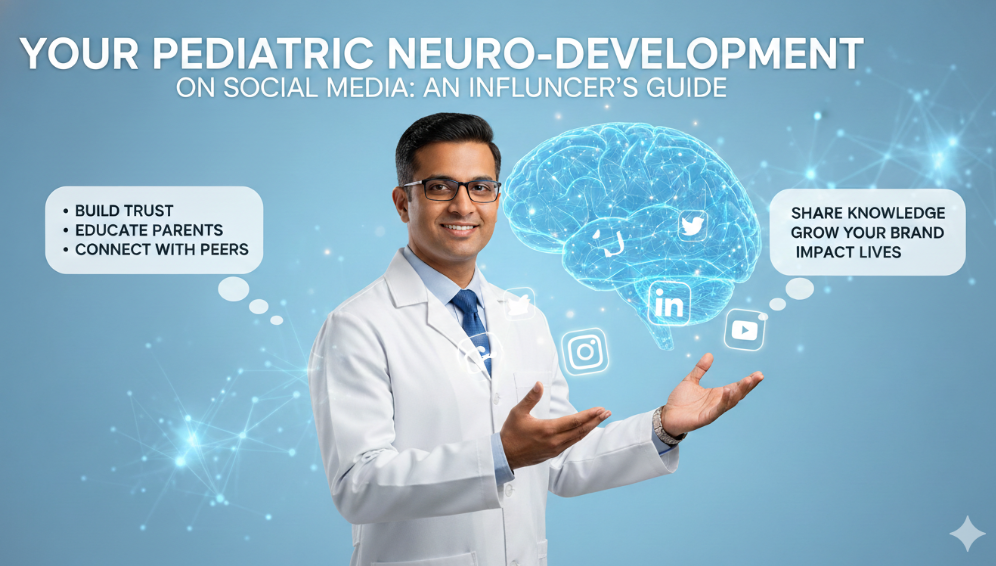
In the contemporary medical landscape, the establishment of a robust digital footprint is increasingly imperative for specialist practitioners. For clinicians dedicated to the field of paediatric neuro-development, social media platforms present an unparalleled avenue for knowledge dissemination, professional networking, and the cultivation of a trusted professional brand. However, effective engagement within this digital sphere necessitates a strategic approach, particularly for junior doctors and residents in India aspiring to make a significant professional impact.
Cultivating a professional brand centered on paediatric neuro-development through social media can substantially augment one’s professional reach and contribute meaningfully to public health literacy. Consequently, a meticulously managed online presence serves to position an individual as an authoritative expert, thereby fostering credibility among patients, professional peers, and referring physicians. Furthermore, it affords a continuous conduit for professional development and inter-specialty collaboration, which is indispensable in a rapidly evolving medical discipline.
Strategic Specialisation within Paediatric Neuro-Development
Prior to the initiation of digital content creation, it is paramount to delineate one’s specific area of specialisation within paediatric neuro-development. Does the practitioner’s focus reside in early intervention strategies for autism spectrum disorders, the intricate management of paediatric seizure pathologies, or perhaps developmental anomalies associated with specific genetic syndromes? Identifying this precise domain of expertise facilitates the development of targeted content, thereby ensuring maximal resonance with the intended professional and public audience. Consider, for example, the case of Dr. Sharma, a paediatric neurology resident who strategically focused her online discourse on differentiating normative from atypical motor developmental trajectories in early childhood—a clinical challenge frequently encountered in outpatient settings. Through this concentrated effort, she rapidly emerged as a valued informational resource for primary care providers.
The formulation of a comprehensive content strategy predicated upon this defined specialisation ensures both thematic consistency and clinical relevance. It is advisable to delineate key thematic areas for exploration, select appropriate content modalities (e.g., brief educational videos, scientific infographics, scholarly articles), and establish a consistent posting schedule. Such a methodical approach mitigates content redundancy and sustains audience engagement.
Methodological Principles for Content Generation and Professional Interaction
When generating digital content, the paramount considerations must be scientific accuracy and evidence-based substantiation. As medical professionals, our fundamental obligation is to disseminate reliable and verifiable knowledge. Communication should employ clear, concise language, meticulously avoiding superfluous medical vernacular. Should technical terminology be indispensable, lucid explanations must accompany its introduction. Furthermore, visual modalities frequently exhibit superior engagement metrics across social media platforms; thus, the integration of high-resolution imagery, illustrative diagrams, or concise video elucidations to explicate complex concepts pertinent to paediatric neuro-development is highly recommended.
Proactive engagement with the professional audience is equally critical. It is essential to respond thoughtfully to inquiries and commentary, participate actively in pertinent professional discussions, and maintain receptiveness to constructive feedback. This reciprocal interaction serves to cultivate a professional community around one’s brand, reinforcing the perception of an accessible and authoritative expert. Moreover, the judicious sharing of anonymised clinical vignettes can provide practical insights and demonstrate clinical acumen, thereby enhancing the relatability of the content for junior medical professionals.
Optimising Digital Presence for Enhanced Visibility
The principles of Search Engine Optimisation (SEO) extend beyond conventional web platforms to encompass social media environments. The strategic deployment of relevant hashtags, particularly those pertaining to paediatric neuro-development and specific clinical conditions under discussion, is crucial. For instance, #PaediatricNeuro, #ChildNeurologyIndia, or #DevelopmentalDelay can significantly enhance the discoverability of posted content. The primary focus keyword should be integrated organically within post captions and descriptive texts. This practice aids platform algorithms in discerning the thematic relevance of the content and consequently presenting it to an interested user base.
Consistency in professional branding, encompassing profile imagery, biographical statements, and overall aesthetic presentation, also contributes to professional recognition. A cohesive online identity renders one’s brand memorable and trustworthy. It is imperative to acknowledge that one’s social media presence functions as an extension of one’s professional persona; therefore, adherence to the highest standards of medical professionalism is perpetually required.
Frequently Asked Questions
Q1: What is the optimal frequency for a specialist to post on social media for brand cultivation?
While consistency is fundamental, the optimal posting frequency may exhibit variability. A strategic approach would involve prioritising 2-3 high-quality, value-driven posts per week over a higher volume of less substantive content.
Q2: Which content formats are most efficacious for conveying complex paediatric neuro-developmental concepts?
Infographics, concise animated explanatory videos, and succinct summaries of clinical case studies are notably effective. The deconstruction of intricate information into digestible, visually engaging formats significantly enhances comprehension and retention.
Q3: What are the ethical considerations pertaining to the discussion of clinical cases on social media?
The discussion of clinical cases is permissible, provided stringent anonymisation protocols are rigorously adhered to. All patient identifiers must be meticulously removed, and the discourse should exclusively focus on educational principles rather than specific patient data. Adherence to patient confidentiality is always paramount.