
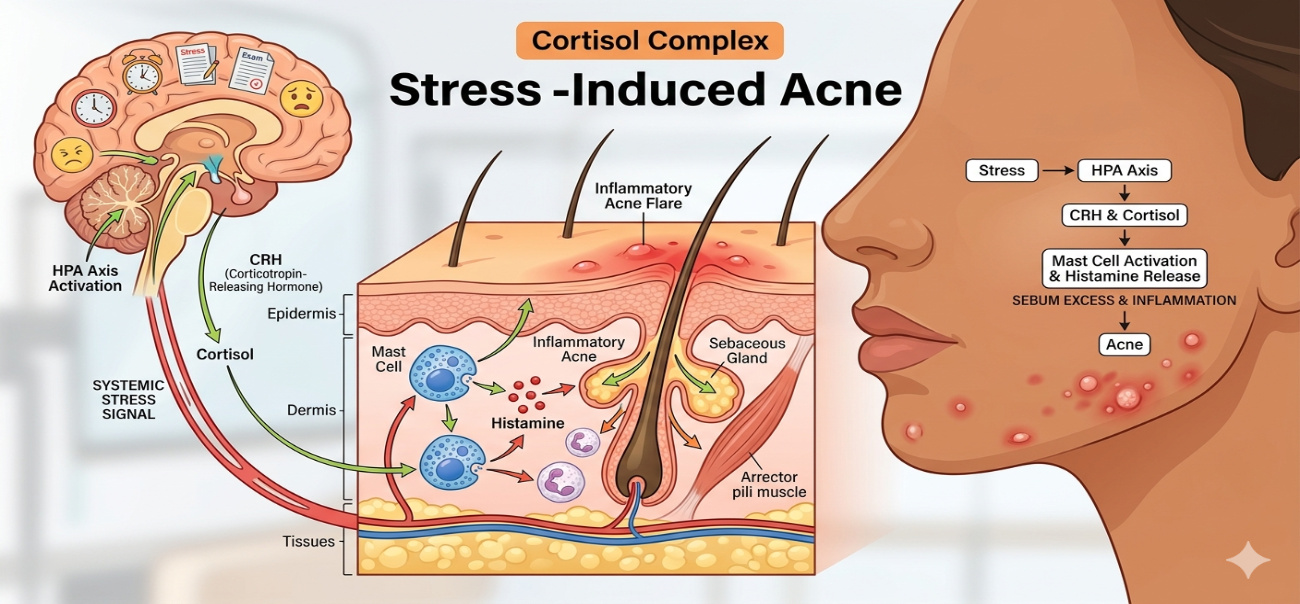
In the bustling OPDs of India, we frequently encounter patients whose inflammatory acne flares coincide with high-stress life events, such as competitive exams or professional deadlines. While we traditionally blame sebum overproduction, modern research highlights a more nuanced “neuro-endocrine-immuno” axis. Central to this is stress-induced histamine acne, a phenomenon where the hypothalamic-pituitary-adrenal (HPA) axis interacts directly with mast cells. Understanding this “Cortisol Complex” allows us to move beyond simple retinoids and address the systemic drivers of follicular inflammation.
The Pathophysiology of the Stress-Histamine Axis
When a patient experiences acute or chronic stress, the hypothalamus releases Corticotropin-Releasing Hormone (CRH). While CRH eventually stimulates cortisol production, it also acts as a potent secretagogue for mast cells located near the sebaceous glands. These mast cells undergo degranulation, releasing histamine and pro-inflammatory cytokines. Consequently, this local histamine release increases vascular permeability and recruits neutrophils to the pilosebaceous unit, exacerbating inflammatory lesions.
Clinical Scenario: The “Exam-Week” Flare
Consider a 24-year-old female resident presenting with a sudden eruption of painful, erythematous papules along the jawline. She reports no change in diet or skincare but notes significant sleep deprivation due to upcoming board exams. Clinically, the lesions appear more edematous than standard acne vulgaris. In this case, the surge in CRH has likely triggered mast cell-mediated histamine release. Therefore, treating her with standard topical benzoyl peroxide alone may yield a slow response because the primary driver is the neurogenic inflammatory cascade rather than C. acnes colonization.
Managing Stress-Induced Histamine Acne in Practice
To manage these cases effectively, clinicians must acknowledge that cortisol isn’t the only culprit. While cortisol increases sebum lipogenesis, histamine serves as the “gasoline” on the inflammatory fire. In addition, substance P—a neuropeptide released from cutaneous sensory nerves during stress—further amplifies mast cell activity. Thus, integrating stress-management counseling or even mild antihistamines in specific recalcitrant cases can sometimes provide the missing link in a patient’s treatment plan.
Addressing the Sebum-Histamine Link
Furthermore, we must recognize that sebocytes express receptors for both CRH and histamine (H1 and H2). When histamine binds to these receptors, it can stimulate the production of proinflammatory lipids. This creates a vicious cycle where stress leads to histamine, which then leads to more irritating sebum. However, by identifying this pattern early, junior doctors can better justify the use of systemic therapies or lifestyle modifications to break the cycle of “stress-flare-stress.”
Frequently Asked Questions
Q1: Can antihistamines be used as a primary treatment for acne? While antihistamines are not first-line therapies for acne vulgaris, they may serve as an adjunctive treatment for patients showing clear signs of neurogenic inflammation or “stress-induced histamine acne.” Some studies suggest that blocking H1 receptors can reduce sebum production and inflammation.
Q2: How does cortisol specifically differ from histamine in acne pathogenesis? Cortisol primarily acts by increasing the size and activity of sebaceous glands, leading to oilier skin. In contrast, histamine acts as an immediate inflammatory mediator that recruits immune cells and increases the redness and swelling of existing lesions.
Q3: Why is the jawline often the site for stress-related flares? The “U-zone” or jawline is highly sensitive to hormonal fluctuations. Stress increases adrenal androgens alongside cortisol, and the high density of mast cells in this region makes it particularly susceptible to CRH-mediated histamine release.