
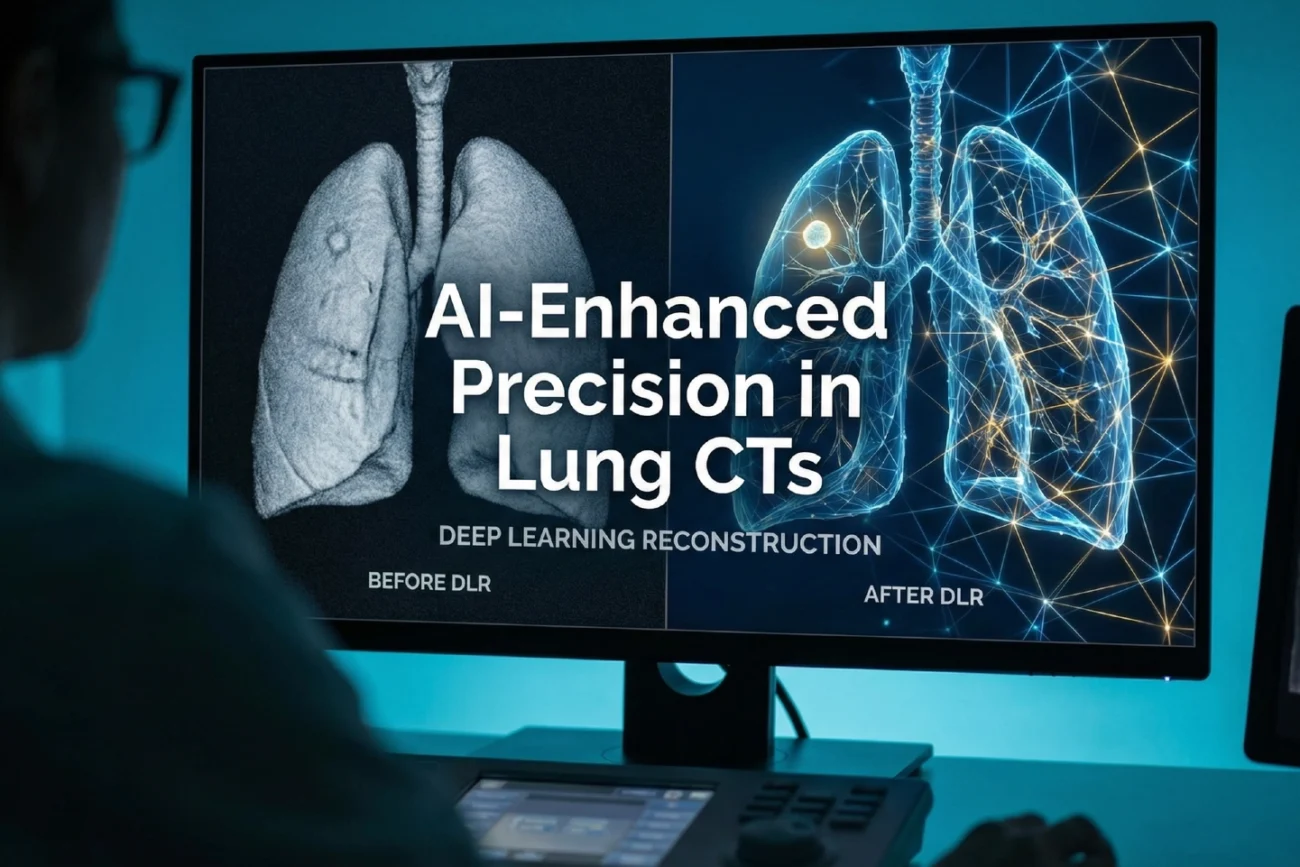
AI-Powered CT Scans: A New Era for Lung Nodule Detection
Deep learning reconstruction CT offers a transformative approach to lung cancer screening by significantly lowering radiation doses. Researchers recently evaluated the TrueFidelity (TF) algorithm in the lung kernel to assess its clinical utility. This advancement allows radiologists to identify nodules with high precision while keeping radiation exposure minimal. Consequently, patients receive safer diagnostic care without compromising on image clarity or detail.
Clinical Efficacy of Deep Learning Reconstruction CT
The study demonstrated that TF Lung significantly reduces image noise compared to standard iterative reconstruction methods. Furthermore, it maintains excellent nodule sharpness, which is vital for early malignancy detection. Radiologists observed that malignancy-related features were as clear on ultra-low-dose scans as on contrast-enhanced images. Therefore, this technology could standardize safer screening protocols across diverse healthcare settings.
Overcoming Screening Barriers in India
Clinicians in India face unique challenges with high tuberculosis prevalence during lung screening procedures. However, high-quality images from deep learning reconstruction CT help distinguish between inflammatory and malignant lesions. Additionally, the improved signal-to-noise ratio ensures that even small, sub-centimeter nodules remain visible. Because of these benefits, the adoption of AI-driven reconstruction is likely to increase in local diagnostic centers.
Frequently Asked Questions
Q1: What are the primary benefits of using TF Lung in CT scans?
TF Lung significantly decreases image noise and improves contrast-to-noise ratios while preserving the sharpness of lung nodules at ultra-low radiation doses.
Q2: How does the radiation dose of ultra-low-dose CT compare to standard protocols?
Ultra-low-dose CT protocols utilize significantly less radiation, making them safer for routine screenings while deep learning algorithms maintain diagnostic-quality images.
References
- Kim J et al. Initial experience of deep learning reconstruction algorithm in lung kernel: clinical usefulness for lung nodules at ultra-low-dose protocol. Eur Radiol. 2026 Mar 12. doi: 10.1007/s00330-026-12404-y. PMID: 41817709.
- Hata A et al. Deep-learning reconstruction for ultra-low-dose lung CT: Volumetric measurement accuracy and reproducibility of artificial ground-glass nodules in a phantom study. Br J Radiol. 2021;94(1128):20210915.
- Kumar V et al. Lung cancer screening in India: Preparing for the future using smart tools & biomarkers to identify highest risk individuals. Indian J Med Res. 2025;161(1):15-28.