How AI Thresholds Impact Breast Tomosynthesis Screening
Understanding Digital Breast Tomosynthesis AI in Screening
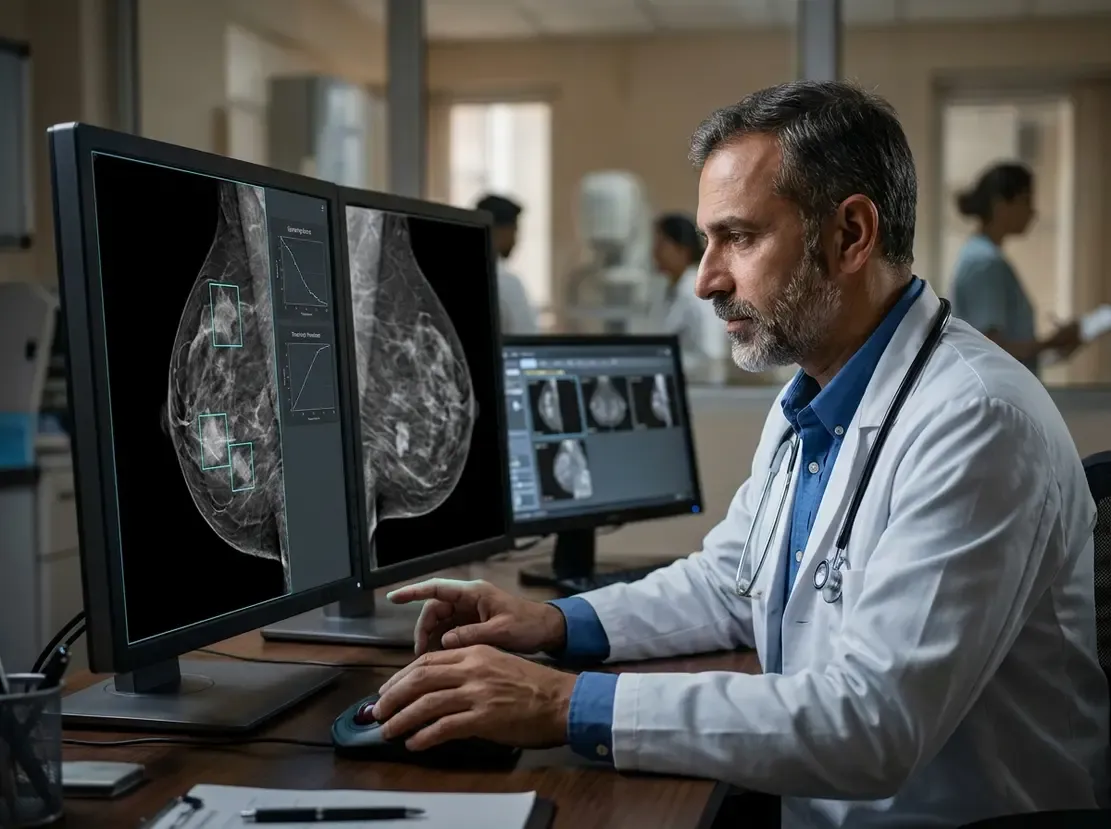
Clinicians increasingly evaluate digital breast tomosynthesis AI to enhance early breast cancer detection. Breast cancer remains a leading health burden globally, and accurate screening saves lives. Digital breast tomosynthesis improves lesion conspicuity, especially in women with dense breast tissue. However, radiologist reading times remain high. Artificial intelligence algorithms can optimize this clinical workflow. Therefore, researchers investigated how different decision thresholds impact screening accuracy.
Evaluating Diagnostic Thresholds in DBT Screening
In a recent retrospective cohort study, researchers analyzed screening examinations from 1,780 asymptomatic women. Remarkably, over 82% of these women presented with dense breasts. Radiologists initially evaluated all scans using BI-RADS guidelines alongside computer-aided detection. Meanwhile, a deep learning algorithm independently reviewed each examination. The investigators tested three distinct operating cutoffs. These included a high-sensitivity threshold, a Youden index threshold, and a recall rate-matched threshold. Consequently, the team evaluated sensitivity, specificity, and recall metrics across each setting.
Key Study Findings and Clinical Trade-offs
The study revealed critical trade-offs between cancer detection and recall rates. At the Youden index threshold, the algorithm showed numerically higher sensitivity than standard radiologist reading. Specifically, the system reached 77.8% sensitivity compared to 66.7% for radiologists. However, this gain came at the cost of lower specificity. In contrast, matching the recall rate preserved high specificity but reduced standalone sensitivity. Furthermore, the algorithm helped identify interval cancers that radiologists initially missed. Thus, threshold selection directly governs clinical utility.
Implications for Radiology Workflows in India
These findings carry significant relevance for radiology practices in India. Indian women often develop breast cancer at a younger age with high breast density. Moreover, India faces an acute shortage of specialized breast radiologists. Implementing calibrated artificial intelligence can streamline high-volume screening clinics. However, standalone deployment remains premature without human oversight. Clinicians should instead leverage these tools as concurrent decision support. Therefore, appropriate threshold tuning ensures optimal cancer detection without burdening healthcare systems with unnecessary recalls.
Frequently Asked Questions
Q1: Why is threshold optimization crucial for digital breast tomosynthesis AI?
Threshold optimization balances cancer detection rates against false-positive recalls. Consequently, selecting the correct cutoff prevents excessive secondary examinations while maintaining high diagnostic sensitivity.
Q2: How did the AI perform compared to radiologists in the study?
The AI demonstrated higher numerical sensitivity at its optimal Youden threshold. However, standard radiologist interpretation maintained higher specificity and generated fewer false-positive recalls.
Q3: Can AI replace human radiologists in breast cancer screening?
Currently, AI functions best as an assistive tool rather than an independent reader. Therefore, hybrid models combining radiologist expertise with AI assistance provide the safest clinical approach.
References
- Yang LC et al. Threshold optimization of artificial intelligence in digital breast tomosynthesis screening: a retrospective comparison study. Eur Radiol. 2026 Nov 27. doi: 10.1007/s00330-026-13113-2. PMID: 43099137.
- Magni V et al. Artificial intelligence for digital breast tomosynthesis: Impact on diagnostic performance, reading times, and workload in the era of personalized screening. Eur J Radiol. 2023 Jan;158:110631. doi: 10.1016/j.ejrad.2022.110631. PMID: 36481480.
- Bahl M et al. Artificial Intelligence for Digital Breast Tomosynthesis Screening with and without Prior Examinations in BreastScreen Norway. Radiology: Artificial Intelligence. 2026;8(4):e250988.