
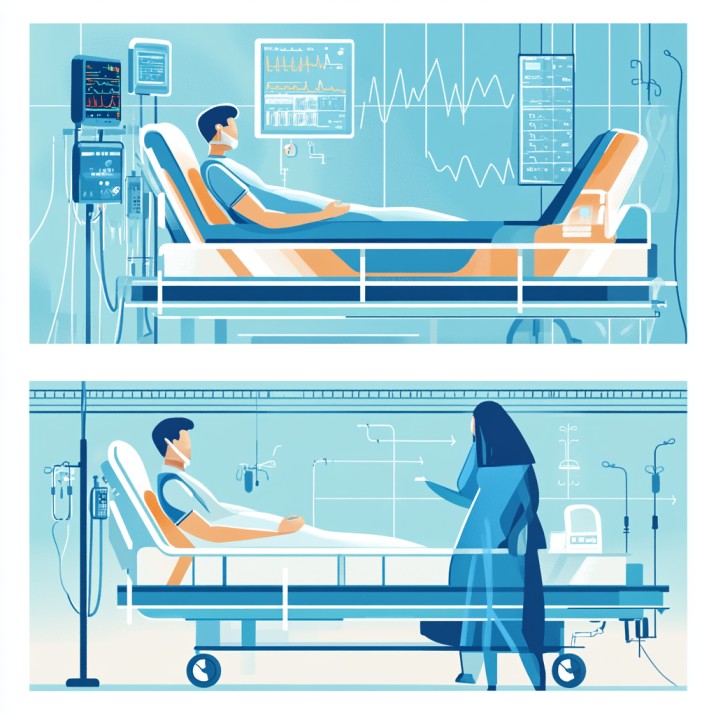
For emergency medicine professionals, the well-being of critically ill patients extends beyond the initial stabilization. As patients recover in the Intensive Care Unit (ICU), physical rehabilitation plays a crucial role in improving long-term outcomes. However, this process is not without risks. To maximize benefits and minimize harm, it’s essential to implement robust safety assessment tools. This blog post will explore some key safety assessment tools for physical rehabilitation of ICU patients, drawing on recent research to provide practical insights.
Why is Safety Assessment Crucial in ICU Rehabilitation?
Physical rehabilitation, including early mobilization, is increasingly recognized for its ability to reduce physical complications and improve patient outcomes in the ICU [1, 2]. While associated with low adverse event rates [3], a higher rehabilitation dose delivered too early might not add benefit or might cause harm [4]. Thus, a detailed risk assessment is critical to judge when it is safe to start rehabilitation [5, 6].
The interpretation of safety data in ICU rehabilitation is limited by the variation in how studies define adverse event outcomes [3]. Differences include the specific physiological variables monitored, and what is considered an unsafe change [7-12]. Furthermore, many previous attempts at consensus on an adverse event tool [3, 13] have not gained widespread use, nor have they included opinions from patients or their caregivers [4, 14-18].
Key Safety Assessment Tools
A recent Delphi study published in Critical Care by Woodbridge et al. (2024) aimed to address this gap, focusing on developing tools to enhance the safety of physical rehabilitation in the ICU. This study identified essential assessment tools that are directly applicable to the practice of emergency medicine. These tools include:
1. Adverse Event Tool
This tool defines adverse events based on clinician and patient/carer consensus. Instead of relying on specific thresholds of physiological variables (such as blood pressure), it focuses on events that:
- Stop the mobilization treatment.
- Do not resolve with rest.
- Cause symptoms related to cardiovascular deterioration or haemodynamic instability.
- Require new or increased treatments [Woodbridge et al., 2024].
This tool includes specific events such as [Woodbridge et al., 2024]:
- Cardiovascular Instability: Bradycardia, tachycardia, hypotension, hypertension, tachypnoea, bradypnoea.
- Respiratory Issues: Arterial oxygen desaturation/abnormal blood gases.
- Airway Issues: Unplanned displacement or dysfunction of endotracheal or tracheostomy tubes.
- Neurological Changes: Seizure, stroke, any other neurological deterioration.
- Falls and Injuries: Any fall, which includes any injury sustained.
- Other Events: Death, cardiac or respiratory arrest, need for acute surgery.
The adverse event tool is designed to be clear and concise [Woodbridge et al., 2024], facilitating uniform measurement of safety in studies and clinical practice.
2. Risk Assessment Tool for Patients on Vasoactive Drugs
Recognizing that cardiovascular instability is a major concern when patients are receiving vasoactive drugs [5, 22, 23], this tool identifies specific risk factors to evaluate before initiating physical rehabilitation [Woodbridge et al., 2024]. The key indicators are related to:
- Vasoactive Drug Specifics: This includes the dose of the drug, recent changes in dose, number of vasoactive drugs and the reason for use of these drugs. The tool advises caution when two or more vasoactive drugs are being used, or if the dose has recently increased, or if a medium or above dose is used. However, the tool advises that specific cut off doses should not be specified, and the risks should always be determined in the context of individual patient factors. [Woodbridge et al., 2024].
- Cardiovascular Considerations: The tool looks into trends in heart rate, blood pressure and heart rhythm. It also mentions that signs of inadequate perfusion, poor cardiac output and any recent arrhythmia should also be considered. [Woodbridge et al., 2024].
- Other factors: This includes assessing pre-morbid functional status, degree of cooperation, disease specific factors and other factors such as severe respiratory failure, active bleeding or unstable fractures [Woodbridge et al., 2024].
The tool provides guidance on assessing specific factors that are associated with a higher risk of adverse events, such as patients on multiple vasoactive drugs, and the need to proceed with extra caution when using specific support systems like IABP and ECMO [Woodbridge et al., 2024]. It also highlights aspects such as inadequate analgesia, reduced consciousness level and limited mobilisation after surgeries that need to be considered before mobilising patients [Woodbridge et al., 2024]. The tool advises the clinicians to involve senior members of the team before mobilising patients who they perceive to be at a higher risk [Woodbridge et al., 2024].
This tool emphasizes the importance of individualized risk assessments and does not set firm cutoff doses for vasoactive drugs, instead highlighting when to exercise more caution [Woodbridge et al., 2024].
Implications for Emergency Medicine Professionals
These tools provide a structured approach to assessing safety in ICU rehabilitation, directly relevant to emergency medicine:
- Enhanced Communication: Using a standardized adverse event tool improves communication and ensures a common understanding of what constitutes an adverse event.
- Improved Decision-Making: The risk assessment tool guides clinicians in making safer decisions about physical rehabilitation for patients on vasoactive drugs.
- Patient-Centric Care: By including patient and caregiver perspectives in the development of the adverse event tool, this approach ensures patient needs are considered.
- Promoting Early Mobilization: These tools provide guidance and ensure safer implementation of early mobilization strategies in the ICU, which in turn aids recovery and reduces complications.
Conclusion
The safety of physical rehabilitation in the ICU is crucial for optimizing patient outcomes and minimizing harm. By using standardized tools such as the adverse event tool and the risk assessment tool outlined in this article, emergency medicine professionals can ensure that physical rehabilitation of ICU patients is safe, effective and patient-focused.
To enhance your knowledge and expertise in the field of emergency medicine, consider exploring the below courses offered by OC Academy:
Clinical Fellowship in Emergency Medicine with MRCEM Training
International Post Graduate Program in Emergency Medicine
Postgraduate Diploma in Acute Medicine
These courses are tailored to equip you with the skills needed to manage complex situations in the emergency department, including the safe and effective implementation of rehabilitation strategies.
References
- Devlin JW, Skrobik Y, Gelinas C, Needham DM, Slooter AJC, Pandharipande PP, Watson PL, Weinhouse GL, Nunnally ME, Rochwerg B, et al. Clinical practice guidelines for the prevention and management of pain, agitation/sedation, delirium, immobility, and sleep disruption in adult patients in the ICU. Crit Care Med. 2018;46:e825-73.
- Wang YT, Lang JK, Haines KJ, Skinner EH, Haines TP. Physical rehabilitation in the ICU: a systematic review and meta-analysis. Crit Care Med. 2022;50:375-88.
- Nydahl P, Sricharoenchai T, Chandra S, Kundt FS, Huang M, Fischill M, Needham DM. Safety of patient mobilization and rehabilitation in the intensive care unit. Systematic review with meta-analysis. Ann Am Thorac Soc. 2017;14:766-77.
- Team Study Investigators, Anzics Clinical Trials Group, Hodgson CL, Bailey M, Bellomo R, Brickell K, Broadley T, Buhr H, Gabbe BJ, Gould DW, et al. Early active mobilization during mechanical ventilation in the ICU. N Engl J Med. 2022;387:1747-58.
- Hodgson CL, Stiller K, Needham DM, Tipping CJ, Harrold M, Baldwin CE, Bradley S, Berney S, Caruana LR, Elliott D, et al. Expert consensus and recommendations on safety criteria for active mobilization of mechanically ventilated critically ill adults. Crit Care. 2014;18:658.
- Cuthbertson BH, Goddard S. Benefits and harms of early rehabilitation. Intensive Care Med. 2017;43:1878-80.
- Schaller SJ, Anstey M, Blobner M, Edrich T, Grabitz SD, Gradwohl-Matis I, Heim M, Houle T, Kurth T, Latronico N, et al. Early, goal-directed mobilisation in the surgical intensive care unit: a randomised controlled trial. Lancet. 2016;388:1377-88.
- Sricharoenchai T, Parker AM, Zanni JM, Nelliot A, Dinglas VD, Needham DM. Safety of physical therapy interventions in critically ill patients: a single-center prospective evaluation of 1110 intensive care unit admissions. J Crit Care. 2014;29:395-400.
- TEAM Study Investigators, Hodgson C, Bellomo R, Berney S, Bailey M, Buhr H, Denehy L, Harrold M, Higgins A, Presneill J, et al. Early mobilization and recovery in mechanically ventilated patients in the ICU: a bi-national, multi-centre, prospective cohort study. Crit Care. 2015;19:81.
- Moss M, Nordon-Craft A, Malone D, Van Pelt D, Frankel SK, Warner ML, Kriekels W, McNulty M, Fairclough DL, Schenkman M. A randomized trial of an intensive physical therapy program for patients with acute respiratory failure. Am J Respir Crit Care Med. 2016;193:1101-10.
- Brummel NE, Jackson JC, Girard TD, Pandharipande PP, Schiro E, Work B, Pun BT, Boehm L, Gill TM, Ely EW. A combined early cognitive and physical rehabilitation program for people who are critically ill: the activity and cognitive therapy in the intensive care unit (ACT-ICU) trial. Phys Ther. 2012;92:1580-92.
- Nydahl P, Gunther U, Diers A, Hesse S, Kerschensteiner C, Klarmann S, Borzikowsky C, Kopke S. PROtocol-based MobilizaTION on intensive care units: stepped-wedge, cluster-randomized pilot study (Pro-Motion). Nurs Crit Care. 2020;25:368-75.
- Needham DM. Johns Hopkins University Outcomes After Critical Illness & Surgery (OACIS) Group. Monitoring & Documentation System for Physiological Changes & Potential Safety Events for ICU Rehabilitation 2013. https://icurehabnetwork.org/resources/. Accessed 10 Oct 2023.
- Meyer MJ, Stanislaus AB, Lee J, Waak K, Ryan C, Saxena R, Ball S, Schmidt U, Poon T, Piva S, et al. Surgical Intensive Care Unit Optimal Mobilisation Score (SOMS) trial: a protocol for an international, multicentre, randomised controlled trial focused on goal-directed early mobilisation of surgical ICU patients. BMJ Open. 2013;3:e003262.
- Morris PE, Berry MJ, Files DC, Thompson JC, Hauser J, Flores L, Dhar S, Chmelo E, Lovato J, Case LD, et al. Standardized rehabilitation and hospital length of stay among patients with acute respiratory failure: a randomized clinical trial. JAMA. 2016;315:2694-702.
- Nickels MR, Aitken LM, Walsham J, Barnett AG, McPhail SM. Critical Care Cycling Study (CYCLIST) trial protocol: a randomised controlled trial of usual care plus additional in-bed cycling sessions versus usual care in the critically ill. BMJ Open. 2017;7:e017393.
- Schweickert WD, Jablonski J, Bayes B, Chowdhury M, Whitman C, Tian J, Blette B, Tran T, Halpern SD. Structured mobilization for critically ill patients: a pragmatic cluster-randomized trial. Am J Respir Crit Care Med. 2023;208:49-58.
- Fossat G, Baudin F, Courtes L, Bobet S, Dupont A, Bretagnol A, Benzekri-Lefevre D, Kamel T, Muller G, Bercault N, et al. Effect of in-bed leg cycling and electrical stimulation of the quadriceps on global muscle strength in critically ill adults: a randomized clinical trial. JAMA. 2018;320:368-78.
- Woodbridge, H.R., McCarthy, C.J., Jones, M. et al. Assessing the safety of physical rehabilitation in critically ill patients: a Delphi study. Crit Care 28, 144 (2024). https://doi.org/10.1186/s13054-024-04919-x
- Stiller K, Phillips A. Safety aspects of mobilising acutely ill inpatients. Physiother Theory Pract. 2003;19:239-57.
- Berney SC, Rose JW, Denehy L, Granger CL, Ntoumenopoulos G, Crothers E, Steel B, Clarke S, Skinner EH. Commencing out-of-bed rehabilitation in critical care-what influences clinical decision-making? Arch Phys Med Rehabil. 2019;100:261-9.