Can Low-Voltage Area Ablation Improve Persistent AF Care?
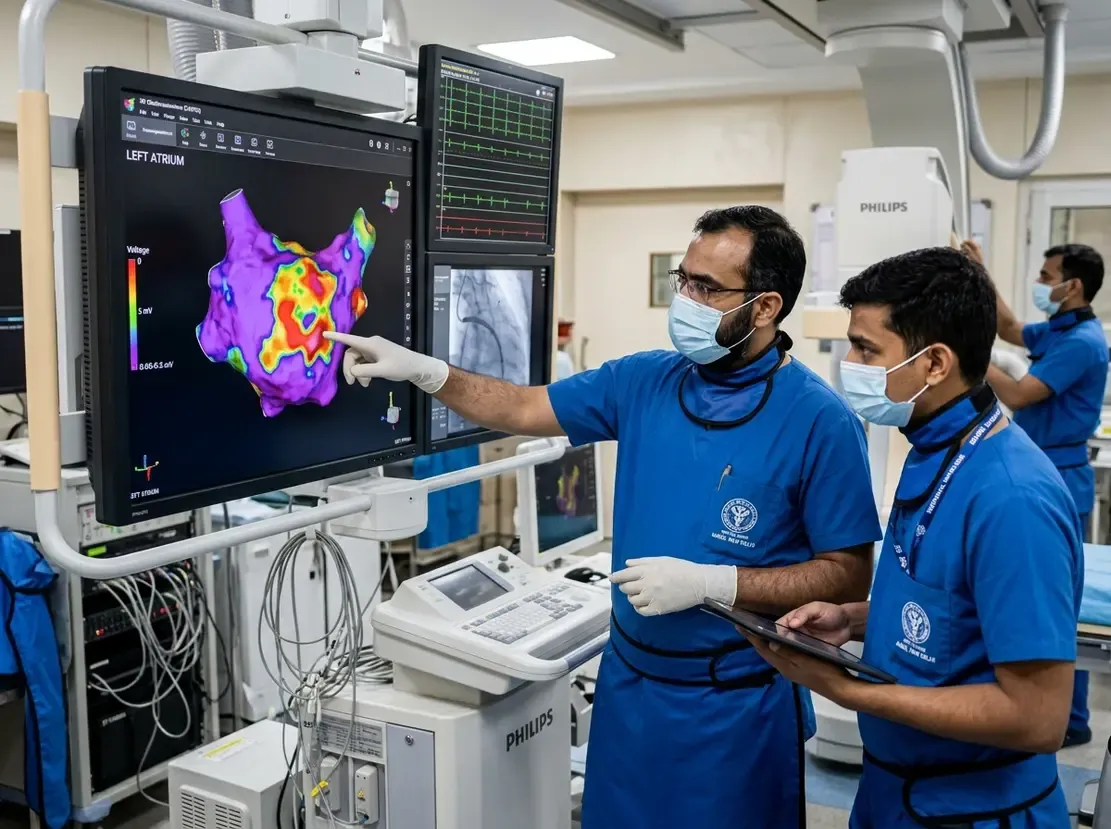
Catheter ablation provides substantial rhythm control for patients suffering from persistent atrial fibrillation.
However, pulmonary vein isolation alone often yields modest long-term success rates in this challenging population.
Clinicians frequently evaluate low-voltage area ablation as an adjunctive strategy to target atrial substrate.
In this context, the randomized COAST-AF clinical trial evaluated whether adding substrate modification improves outcomes.
The investigators presented their late-breaking findings to clarify the true clinical utility of this approach.
Trial Design and Patient Population
The multicenter COAST-AF trial enrolled 508 adult patients across 14 specialized Canadian ablation centers.
Specifically, participants presented with persistent atrial fibrillation lasting longer than three months.
Researchers randomized 253 individuals to pulmonary vein isolation plus substrate modification.
Meanwhile, 255 individuals received standard pulmonary vein isolation alone.
Overall, 54% of all enrolled participants displayed electroanatomical low-voltage areas during high-density mapping.
The trial monitored clinical recurrences over a mean follow-up period of 21 months.
Outcomes of Low-Voltage Area Ablation
In the overall study population, adjunctive low-voltage area ablation failed to show statistical superiority.
Arrhythmia recurrence occurred in 49.4% of patients in the combined ablation arm.
By comparison, 57.5% of patients in the control group experienced recurrence.
Consequently, this overall difference did not reach statistical significance.
Furthermore, the combined strategy required longer procedure durations and greater radiofrequency delivery time.
Nevertheless, procedural safety profiles remained comparable between both treatment groups.
Subgroup Efficacy in Fibrotic Atria
Although overall outcomes appeared neutral, prespecified subgroup analyses revealed compelling benefits.
Among 268 patients with confirmed scar areas, recurrence occurred in 49.3% of the combined group.
In contrast, 69.2% of scar patients receiving isolation alone suffered recurrence.
Therefore, adjunctive substrate ablation significantly reduced arrhythmia recurrence and overall burden in this subgroup.
Conversely, patients without electrical scar derived no benefit from empiric extra ablation.
Thus, electrophysiologists must tailor substrate modification strictly to patients with mapped atrial scarring.
Frequently Asked Questions
Q1: What did the primary analysis of the COAST-AF trial demonstrate?
The primary analysis showed that adjunctive low-voltage area ablation did not significantly reduce recurrence across all patients.
Q2: Which patient subset benefited from low-voltage area ablation?
Patients with documented electroanatomical scarring achieved a significant reduction in arrhythmia recurrence and overall arrhythmia burden.
Q3: Did substrate ablation increase procedural complications?
No, the trial observed similar complication rates between treatment arms, although procedure times were longer.
References
- Nery PB et al. Low-Voltage Area Ablation for Persistent Atrial Fibrillation: The COAST-AF Randomized Clinical Trial. JAMA. 2026 Nov 08. doi: 10.1001/jama.2026.24331. PMID: 42999998.
- Nordin A et al. Low-Voltage Ablation in Persistent Atrial Fibrillation: The IDEAL-AF Randomized Clinical Trial. JAMA. 2026; doi: 10.1001/jama.2026.17274. PMID: 42669133.
- Masuda M et al. Complete Low-Voltage Area Ablation in Persistent Atrial Fibrillation: Post Hoc Subanalysis of the SUPPRESS-AF Trial. Circ J. 2025; doi: 10.1253/circj.CJ-24-0450.