
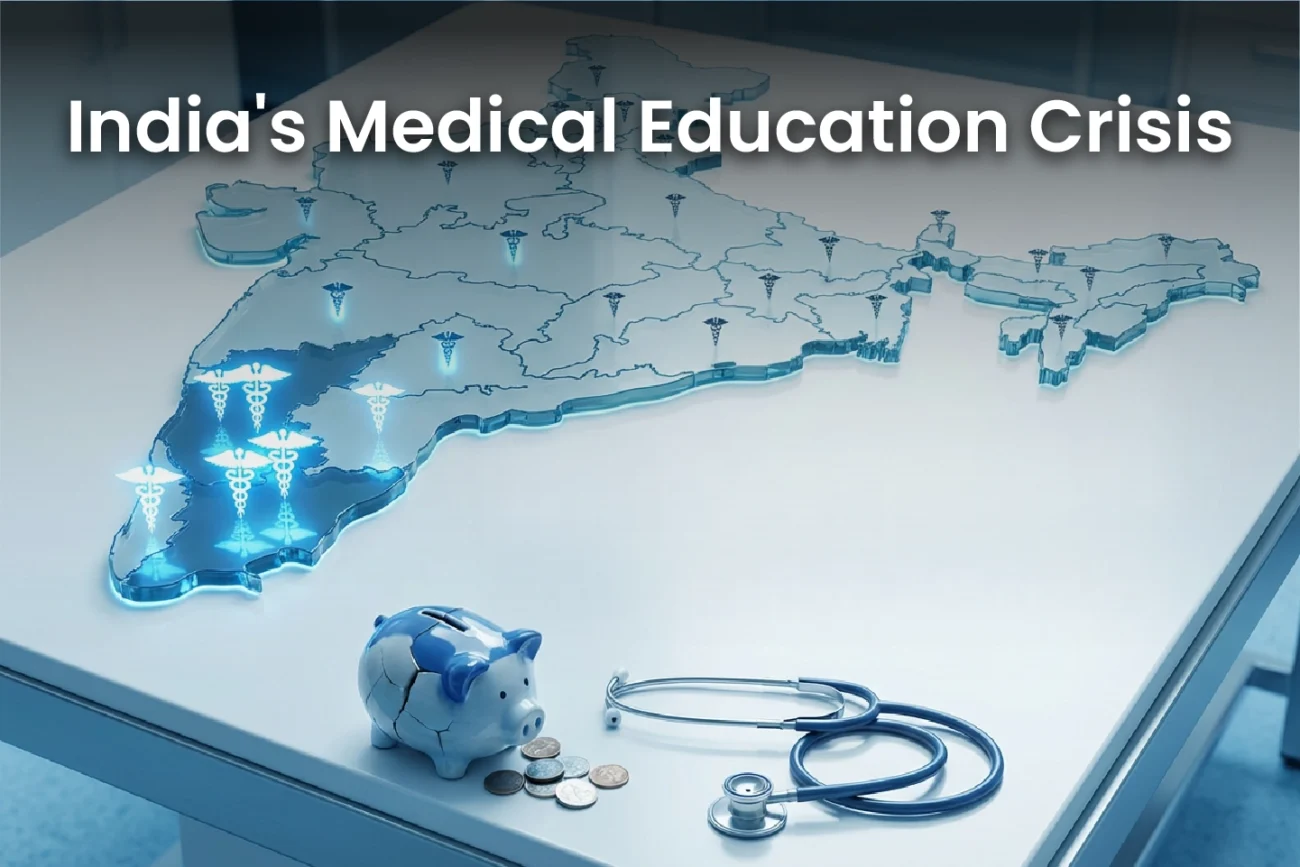
The Parliamentary Standing Committee on Health and Family Welfare recently presented its 167th Report to the Rajya Sabha. The committee expressed significant concern regarding the highly uneven Medical Seats Distribution across the country. In fact, it also flagged the escalating cost of medical education as a major challenge. The report states that some regions, like Bihar, offer as few as 21 MBBS seats per million people, which falls severely short of the national average of 75 seats per million population. Conversely, states such as Karnataka, Telangana, and Tamil Nadu boast approximately 150 seats per million, and Puducherry has an extreme concentration with close to 2,000 or more seats per million. Consequently, many students must travel to other states or even abroad to pursue a medical degree.
The Disparity in Medical Seats Distribution
The panel strongly urged the NMC to issue clear guidelines for establishing new medical colleges. This recommendation applies especially to states with fewer than 100 MBBS seats per million population. The committee acknowledged the UG-MSR 2023 guidelines, which permit new colleges to have an annual intake capacity of 50, 100, or 150 MBBS seats. Notwithstanding this, the committee recommended granting permission to increase undergraduate MBBS seats up to a maximum of 250 in a phased manner, provided a college maintains adequate infrastructure and faculty. Therefore, the government should prioritize opening medical colleges in underserved districts, encouraging them to utilize locally available government medical colleges and hospitals for imparting services.
Addressing the High Cost and Faculty Shortages
The affordability of medical education remains a critical concern. Tuition fees frequently range from Rs 60 lakhs to Rs 1 crore or even more, which effectively excludes students from poor families. The committee thus recommended that the government apply the state government fee structure to 50 per cent of seats in private medical colleges. For the remaining 50 per cent, the fee structure must be decided in consultation with each state’s fee regulatory committee. Furthermore, the panel reiterated its suggestion for the ministry, in collaboration with states, to consider need-based scholarships for deserving students. Moreover, running medical colleges and hospitals on a PPP (Public-Private Partnership) model or giving tax benefits to groups can be explored as alternative options. If you are considering further specialization to manage future high-level patient loads, explore our Foundation Comprehensive Training For New Doctor program.
Addressing the persistent faculty shortages, particularly in remote areas, is also essential. The committee stressed the need to provide better incentives for teaching positions. Consequently, competitive salaries, job security, and structured career growth must be prioritized over ad-hoc or contractual appointments. Moreover, the panel believes the recently introduced ‘Aadhaar-based Biometric Attendance System’ by the NMC will significantly help curb the menace of ‘ghost faculty’ and zero attendance. The committee suggested that more robust IT solutions, such as face recognition and geo-positioning monitoring, will give impetus to monitoring faculty attendance.
Quality Assurance and the Future of Assessment (NExT)
Limited domestic seats compel many Indian students to seek admission outside the country. However, Foreign Medical Graduates (FMGs) often face significant challenges in passing the license examination and obtaining permanent registration. Consequently, the panel reiterated its recommendation that the FMG Regulations 2021 should act as a facilitator, thereby streamlining the registration and internship procedures while maintaining quality assurance. In order to improve the doctor-to-population ratio, the government must encourage the expansion of domestic medical colleges. Additionally, the introduction of the National Exit Test (NExT) will instill a universal and standardized assessment for all medical graduates. This change will ultimately lead to better quality medical education and training across the country. The committee also recommended a system where reputed institutes like AIIMS function as mentor institutes for all other medical colleges in their respective zones to monitor educational standards.
Frequently Asked Questions
Q1: What is the key disparity in medical seat distribution highlighted by the committee?
The committee highlighted that while the national average is 75 MBBS seats per million population, some states like Bihar have only 21 seats per million. Conversely, other regions like Karnataka, Telangana, and Tamil Nadu have approximately 150 seats per million, with Puducherry having close to 2,000 or more seats per million.
Q2: How does the committee propose to regulate the high cost of private medical education?
The committee recommended that the government apply the state government fee structure to 50 per cent of the seats in private medical colleges. The other 50 per cent of seats will have their fees decided in consultation with the state’s fee regulatory committee.
Q3: What solutions did the committee suggest for the issue of ‘ghost faculty’?
The panel endorsed the NMC’s recently introduced ‘Aadhaar-based Biometric Attendance System’. Additionally, it suggested employing more robust IT solutions, such as face recognition and geo-positioning monitoring, to strengthen administrative oversight of faculty attendance.
References
- Par committee expresses concern over uneven distribution of medical seats acrosscountry – ETHealthworld
- Uneven MBBS seat distribution to high fees: Parliamentary panel flags medical education challenges – medicaldialogues.in
- NExT Exam Deferred: NMC Confirms Delay, Assures Gradual Implementation and Stakeholder Consensus – EducationToday
- Parliamentary panel flags stark disparity in medical seats and soaring education costs – telegraphindia.com
Disclaimer: This article was automatically generated from publicly available sources and is provided for informational and educational purposes only. OC Academy does not exercise editorial control or claim authorship over this content. It is not a substitute for professional medical advice, diagnosis, or treatment. Always consult a qualified healthcare provider and refer to current local and national clinical guidelines.