
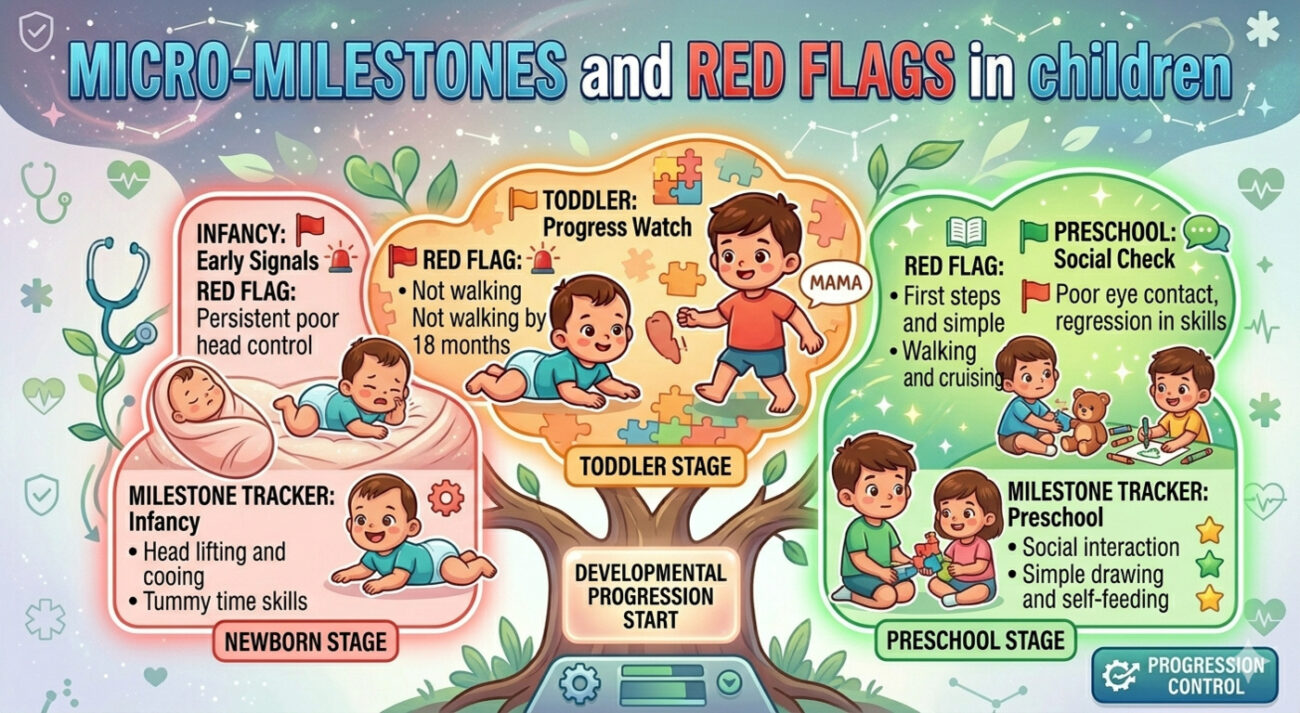
In the bustling pediatric outpatient department, assessing child development is a daily, critical routine. Most parents and junior doctors naturally focus on “macro-milestones”—the grand, highly visible achievements like walking independently, speaking the first word, or achieving bowel control. However, true neurodevelopmental mastery lies in observing the micro-milestones. These are the subtle, transient, yet absolutely critical foundational skills that must emerge before the larger milestones can be achieved. For the astute resident, understanding these granular developmental steps transforms a basic well-child check into a highly sensitive neurological screening. Consequently, recognizing the absence of these micro-milestones, alongside established “red flags,” allows for rapid early intervention. This comprehensive guide will sharpen your clinical eye, ensuring you never miss the subtle whispers of a developing—or struggling—nervous system.
Decoding the Scaffolding: What are Micro-Milestones?
Micro-milestones act as the physiological scaffolding of the developing brain and peripheral nervous system. For example, before an infant can successfully reach for and grab a toy (a major motor milestone), they must first develop smooth visual tracking and midline hand play. If a resident only asks the parents, “Can the baby grab the toy?” they entirely miss the underlying mechanics of why the baby might be failing. Is it a visual processing deficit? A motor planning issue? A tonal abnormality?
Therefore, observing the micro-milestones isolates the specific neurological lesion with much greater accuracy. Furthermore, these subtle markers often appear weeks or even months before a major developmental delay becomes glaringly obvious to the family. By tracking these granular steps, the physician shifts from a reactive diagnostic stance to a proactive, neuroprotective approach.
Mapping the Developmental Domains
To operationalize this in your daily practice, you must break down development into distinct domains. The table below illustrates how micro-milestones build up to macro-milestones, alongside the critical red flags for each category.
| Developmental Domain | Foundational Micro-Milestone | Eventual Macro-Milestone | Absolute Red Flag |
| Gross Motor | Head control during traction | Independent walking | Persistent head lag beyond 4 months |
| Fine Motor | Midline hand play / Raking | Neat pincer grasp | Early handedness before 18 months |
| Speech & Language | Reciprocal cooing / Babbling | Two-word phrases | Lack of purposeful pointing by 18 months |
| Social & Cognitive | Joint attention | Interactive pretend play | No response to name by 12 months |
The Absolute Red Flags: When to Worry Immediately
While micro-milestones require a trained, observant eye, red flags must act as blaring sirens in your clinical assessment. The most critical red flag in all of pediatric neurology is developmental regression. The loss of any previously acquired skill, whether it is motor, linguistic, or social, is never normal. It demands an immediate, exhaustive neuro-metabolic and genetic workup to rule out degenerative encephalopathies or conditions like Landau-Kleffner syndrome.
Additionally, the resident must remain highly vigilant for asymmetry. Parents might proudly report that their 9-month-old is “right-handed.” However, hand dominance developing before eighteen months of age is not a sign of advanced intelligence; it is a profound red flag for a contralateral hemiplegia or a unilateral brain injury (like mild cerebral palsy). Furthermore, persistent primitive reflexes (such as the Moro or Asymmetric Tonic Neck Reflex) beyond their expected age of integration strongly suggest an underlying central nervous system insult preventing higher cortical control.
Clinical Scenario: The “Quiet” Infant
Consider a 10-month-old infant, Leo, brought in for a routine check-up. The parents are entirely unconcerned, proudly stating that Leo is a “very quiet, easy baby” who can sit up perfectly without support. Initially, the resident might quickly check off the gross motor milestone and prepare to conclude the visit.
However, purposefully observing the social and communicative micro-milestones reveals an entirely different story. Leo does not respond when the physician calls his name. Furthermore, he lacks joint attention—when the doctor points to a colorful toy across the room, Leo stares blankly at the doctor’s hand rather than following the trajectory of the point. He also exhibits no reciprocal babbling. These missing micro-milestones are glaring red flags for a potential Autism Spectrum Disorder (ASD) or a profound hearing impairment. Consequently, the resident avoids the dangerous trap of false reassurance and immediately refers Leo for formal audiological testing and early intervention services.
Avoiding the “Wait and See” Trap
One of the most dangerous phrases in pediatric practice is “he will grow out of it.” While there is certainly a recognized spectrum of normal development, the junior doctor must fiercely advocate for early, aggressive screening. When a red flag is present, or a distinct cluster of micro-milestones is absent, delaying a referral actively deprives the child of crucial neuroplasticity windows.
Clinical Pearl: Always validate parental intuition. If a parent states that “something just feels off” about their child’s development, take it seriously. Parents are the most astute observers of their child’s micro-milestones, even if they lack the medical vocabulary to describe them accurately.
Therefore, you must utilize validated screening tools like the Ages and Stages Questionnaire (ASQ) or the M-CHAT-R to objectify your clinical suspicions. Documenting these micro-deficits clearly in the medical record ensures that the multidisciplinary team has a precise baseline to measure future progress against.
Frequently Asked Questions
Q1: How does prematurity affect the assessment of these milestones?
For any child born prematurely, you must strictly use their “corrected age” (chronological age minus the number of weeks born prematurely) when assessing milestones. This correction should be applied until the child reaches exactly two years of chronological age to avoid falsely diagnosing a developmental delay.
Q2: What exactly is “joint attention,” and why is it so important?
Joint attention is the shared focus of two individuals on an object. It is achieved when one individual alerts another to an object by means of eye-gazing, pointing, or other verbal or non-verbal indications. Its absence is one of the earliest and most reliable micro-milestone indicators for Autism Spectrum Disorder.
Q3: Is “toe-walking” considered a developmental red flag?
Idiopathic toe-walking can be a normal variant in toddlers who are just learning to walk. However, if it is persistent, associated with tight heel cords, or appears alongside speech delays, it becomes a major red flag for mild spastic diplegia (Cerebral Palsy), Duchenne Muscular Dystrophy, or Autism Spectrum Disorder.