Thyroid Cancer: 10-Year Study Backs Microwave Ablation
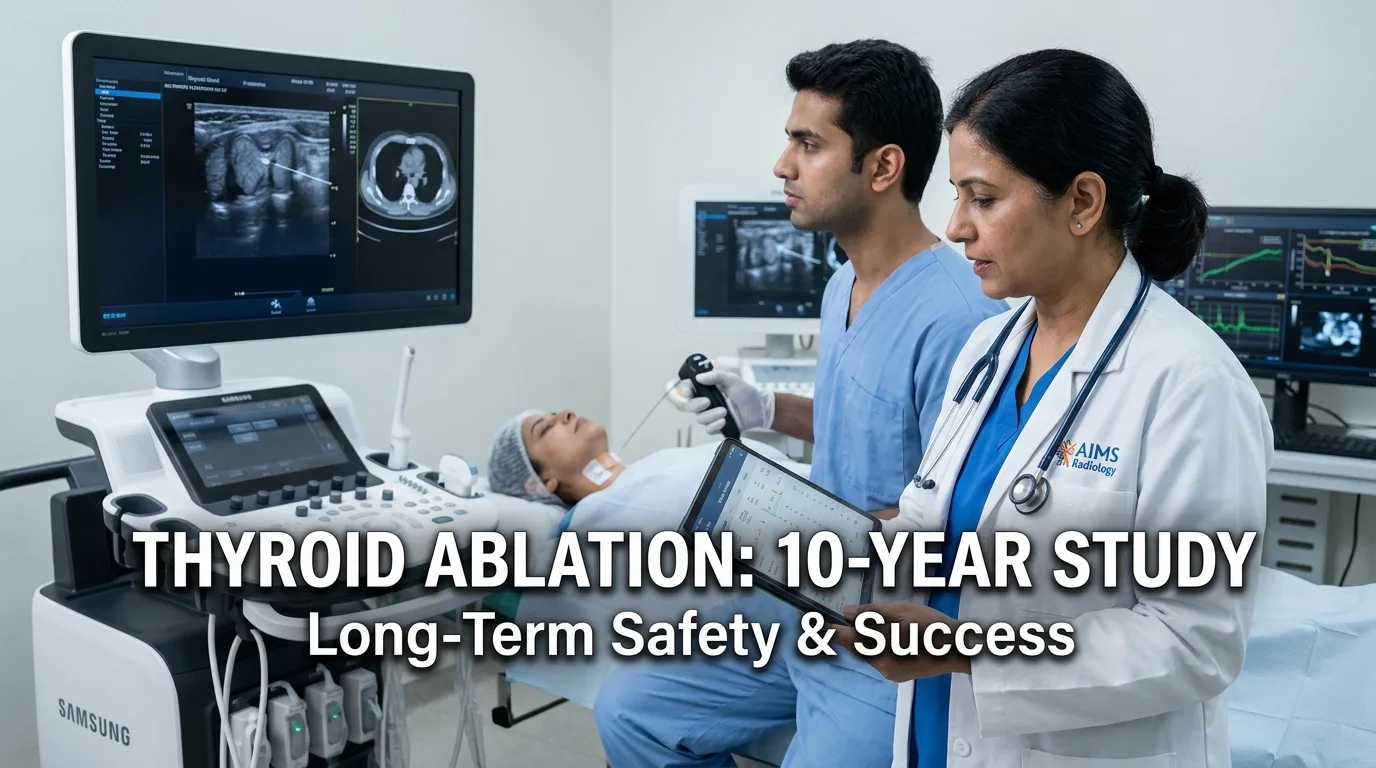
Recent long-term clinical data has shed light on alternative treatments for low-risk thyroid cancers. Specifically, a landmark 10-year follow-up study evaluated the safety and efficacy of ultrasound-guided microwave ablation thyroid carcinoma management compared to traditional surgical resection. This retrospective analysis of unifocal T1aN0M0 papillary thyroid carcinoma (PTC) provides valuable insights for clinicians aiming to minimize treatment invasiveness while preserving organ function.
Indeed, managing small thyroid malignancies often involves weighing surgical risks against oncological outcomes. Historically, physicians relied heavily on surgical resection. However, newer minimally invasive techniques offer promising alternatives.
Comparing Microwave Ablation Thyroid Carcinoma with Surgical Resection
In this retrospective trial, the medical team studied 134 patients with unifocal T1aN0M0 PTC. Specifically, they split patients into two cohorts who underwent either ultrasound-guided ablation or surgery between June and October 2014. Consequently, the investigators gathered clinical data over a complete 120-month follow-up period.
The investigators focused on several primary endpoints. These included local tumor recurrence, new tumor development, distant metastasis, and lymph node metastasis. Additionally, they tracked secondary endpoints like volume reduction rates and procedure-related complications.
Long-Term Efficacy and Safety Profile
Ultimately, the researchers observed no statistically significant difference in disease progression-free survival between the two cohorts. Therefore, both techniques achieved excellent long-term oncological control over ten years. However, the ablation group demonstrated a significantly lower overall complication rate than the surgical cohort.
Furthermore, most complications in the ablation group were mild and transient. In contrast, permanent complications occurred only in the surgical resection group. Notably, ablation patients preserved their normal thyroid function and completely avoided lifelong hormone replacement therapy. Consequently, these findings suggest that thermal ablation offers a safe, highly effective, and less invasive management strategy.
Frequently Asked Questions
Q1: What are the main benefits of choosing microwave ablation over surgical resection for unifocal papillary thyroid carcinoma?
Microwave ablation offers a minimally invasive alternative that successfully preserves normal thyroid function. Consequently, patients avoid lifelong thyroid hormone replacement therapy and experience fewer permanent complications compared to surgery.
Q2: Does microwave ablation provide comparable long-term cancer control to traditional surgery?
Yes, the 10-year study demonstrated that progression-free survival rates remain highly comparable between both groups. Therefore, clinicians can confidently consider ablation for selected patients with low-risk unifocal T1aN0M0 tumors.
Q3: Did patients in the microwave ablation cohort experience any permanent complications?
No, the investigators documented zero permanent complications in the ablation group. In contrast, only patients in the surgical resection cohort suffered permanent complications.
References
- Wang ZQ et al. Microwave ablation versus surgical resection for unifocal T1aN0M0 papillary thyroid carcinoma: a 10-year follow-up study. Eur Radiol. 2026 Jul 18. doi: 10.1007/s00330-026-12724-z. PMID: 42470479.
- Zhao ZL et al. Microwave Ablation versus Surgical Resection for US-detected Multifocal T1N0M0 Papillary Thyroid Carcinoma: A 10-Center Study. Radiology. 2024 Apr;311(1):e230459. doi: 10.1148/radiol.230459. PMID: 38563669.
- Wei Y et al. Microwave Ablation versus Surgical Resection for Solitary T1N0M0 Papillary Thyroid Carcinoma. Radiology. 2022 Sep;304(3):704-713. doi: 10.1148/radiol.212313. PMID: 35536133.