
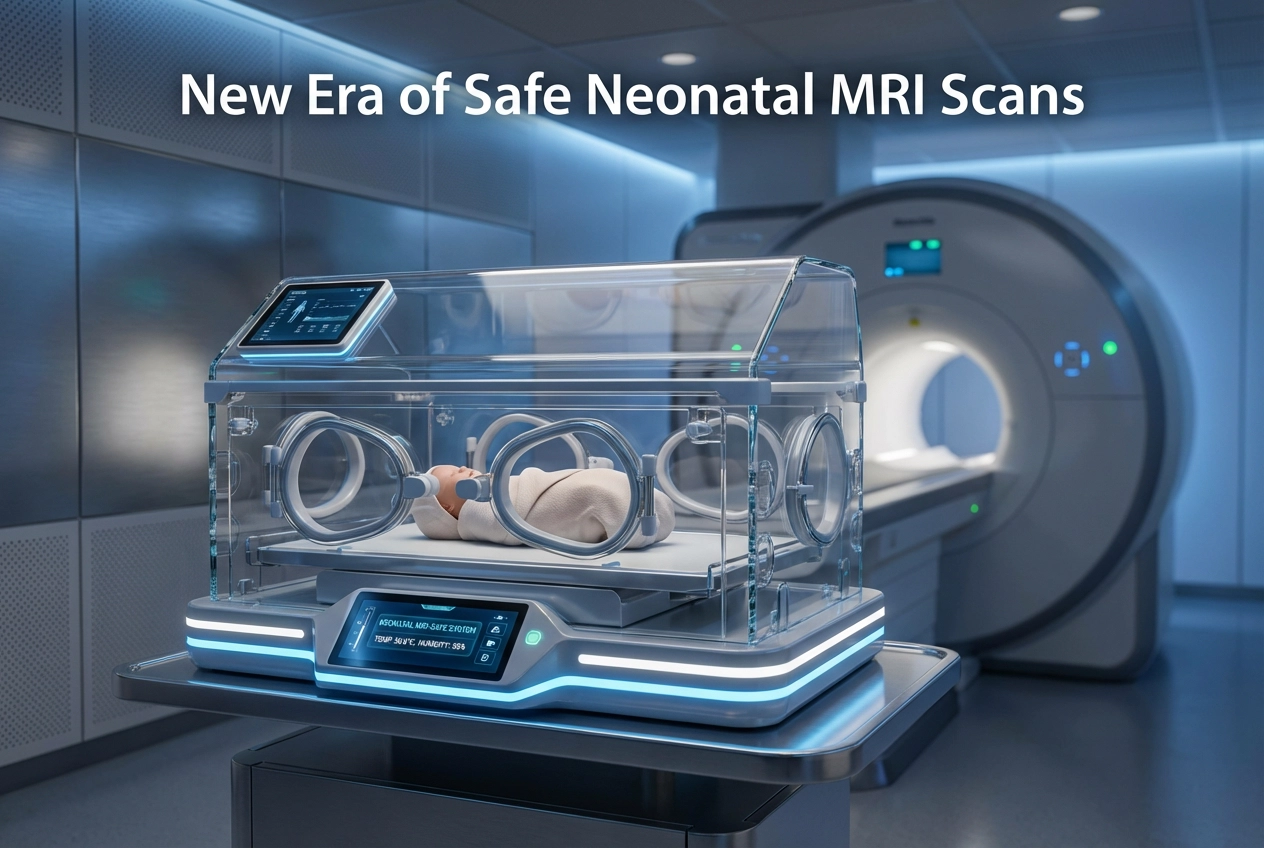
Neonatal cerebral Magnetic Resonance Imaging (cMRI) presents significant logistical and safety challenges. The recent evaluation of an innovative MR-compatible incubator (icMRI) with an integrated 16-channel head coil addresses these issues. Therefore, doctors can achieve optimal temperature, humidity, and real-time vital monitoring to ensure patient safety and stability during imaging. This new system offers better feasibility and vastly improved image quality compared to conventional cMRI (ccMRI) using an adult head coil, according to a recent study.
Improving Neonatal cMRI Image Quality and Safety
The study compared 53 neonates examined with the incubator (icMRI) to 50 examined without (ccMRI). Neonates who underwent icMRI had a significantly lower weight at the time of imaging. However, the total imaging time was significantly shorter using the incubator (p = 0.03). This is because the MR-compatible incubator streamlines the transfer process, which limits the need for additional handling of fragile infants. Furthermore, other research also shows that specialized incubators decrease infant handling by half and reduce overall procedure time by an average of 20 minutes.
Objective image quality improved substantially with the new system. The icMRI led to a significant increase in the Signal-to-Noise Ratio (SNR) across all sequences (p ≤ 0.006). This was true in both the parieto-occipital white matter and the basal ganglia. Conversely, motion artifacts dramatically decreased from 31% to only 14% using the MR-compatible system. Diagnostic image quality improved from a subjective rating of 3.5 to 4.3 points. Importantly, a controlled environment is essential for successful neonatal MRI. This is because it reduces the risk of environmental stress and instability.
Clinical Relevance of the MR-compatible Incubator
Critically, the use of this dedicated system was associated with a reduced need for general anesthesia (p = 0.03). Achieving optimal immobility through non-sedative methods is strongly recommended for this vulnerable population. Therefore, avoiding sedation carries fewer risks of complications for newborns. Additionally, the integrated 16-channel radiofrequency receiving head coil improves objective image quality, which reveals additional diagnostic information compared to initial ultrasound findings. The integration of a dedicated neonatal coil array into the incubator is a key technical advance. This is because it optimizes the Signal-to-Noise Ratio (SNR) and enables modern imaging techniques. Overall, the icMRI technique offers better feasibility, improved image quality, and shorter scan times. Also, it reduces the need for general anesthesia compared to traditional methods.
Frequently Asked Questions
Q1: Why is a dedicated MR-compatible incubator necessary for neonatal cMRI?
A dedicated MR-compatible incubator is necessary because it provides a precisely controlled environment for temperature, humidity, and real-time vital monitoring, which ensures the safety and stability of term and preterm neonates during the cMRI procedure. Moreover, its integrated head coil significantly improves image quality and reduces motion artifacts.
Q2: How does the new icMRI system benefit the newborn patient?
The new icMRI system benefits the newborn by optimizing safety, handling, and monitoring during transport and imaging. Thus, it correlates with improved image quality, shorter scan times, and a reduced need for general anesthesia, which carries fewer risks for the fragile patient population.
Q3: How much did motion artifacts decrease with the icMRI?
Using the icMRI system, image motion artifacts decreased significantly from 31% of the examinations to 14%, resulting in a substantial improvement in diagnostic quality scans.
References
- Tischendorf P et al. Neonatal cerebral imaging: feasibility and image quality using an MR-compatible incubator equipped with a 16-channel head coil. Eur Radiol. 2025 Dec 22. doi: 10.1007/s00330-025-12219-3. PMID: 41428043.
- Lammers Medical Technology. MR Imaging of the Newborn: A Technical Perspective. Radiology Key. 2017 Sep 18.
- AuntMinnie. MRI-compatible incubator increases procedure use for neonates. 2010 Aug 30.
- Malhotra A et al. Principles of a controlled imaging environment for neonatal brain MRI: Strategies for optimal image quality and safety. Pediatr Radiol. 2024 Nov 23.
- Müller F et al. Comparison of image quality in brain MRI with and without MR compatible incubator and predictive value of brain MRI at expected delivery date in preterm babies. J Perinat Med. 2020 Sep 25.
- University of Kentucky. MRI-Compatible Incubator Ensures Safety of Newborns, Supports Pediatric Research. 2015 Mar 25.