
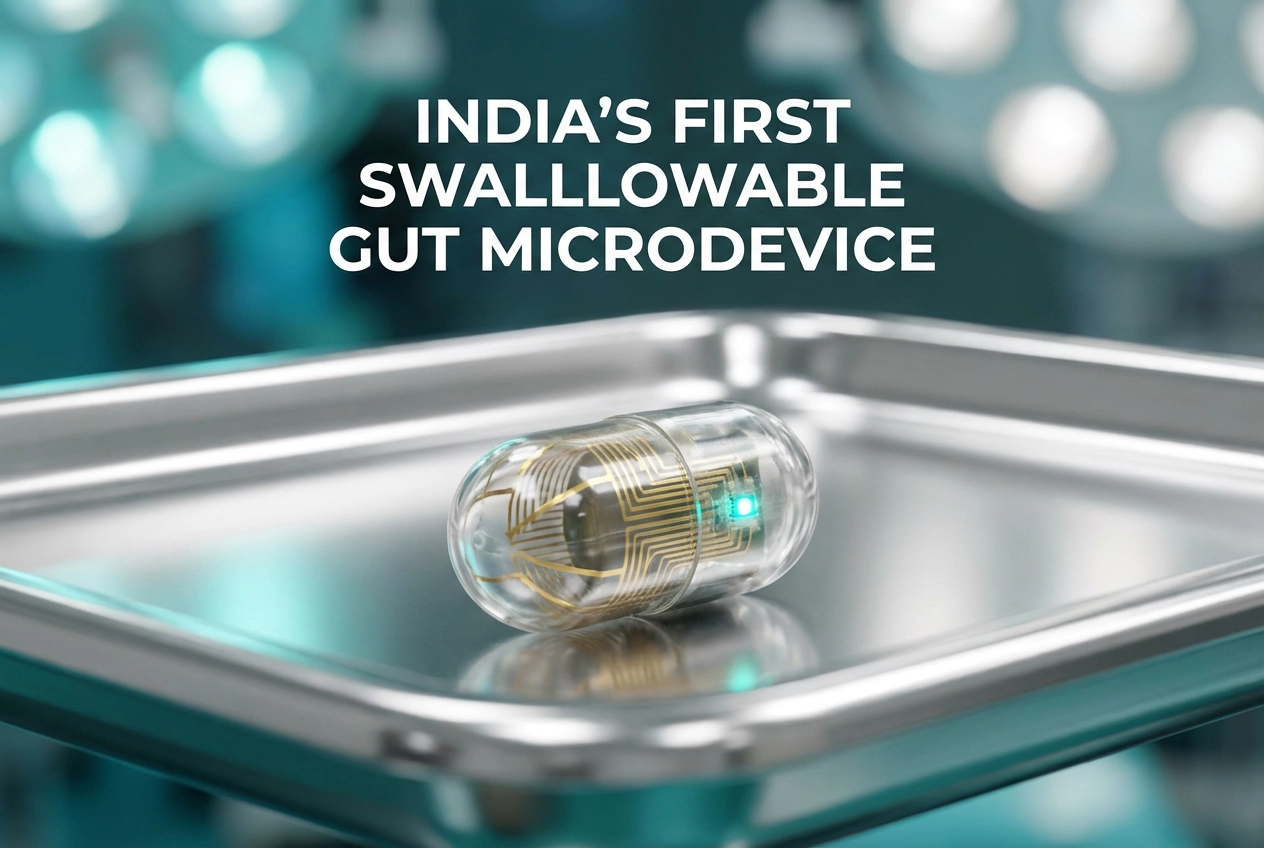
The Swallowable Microdevice marks a significant leap forward in digestive disease diagnostics. Scientists from IIT Delhi and AIIMS New Delhi successfully tested this novel pill. This technology collects microbiome samples directly from the small intestine, addressing a long-standing challenge in gut research. Traditional methods, such as endoscopy, are invasive. However, stool samples only offer indirect insight into the critical upper GI tract. Consequently, this innovation promises to reshape personalised medicine and gut health research.
The Non-Invasive Solution to Microbiome Sampling
Gut microbes influence many conditions, ranging from inflammatory bowel disease (IBD) and infections to diabetes and neurological disorders. Nearly half of all human cells are microbial. Therefore, accurately studying these organisms is vital for understanding human health. This new device overcomes limitations of current sampling tools. Researchers validated the pill-sized microdevice in Sprague–Dawley rats, demonstrating robust performance. Furthermore, the device autonomously moves from the stomach into the intestine, collecting site-specific samples. It then exits the body naturally. The process requires neither surgery nor tissue injury.
Engineering the Swallowable Microdevice for Precision
The ICMR-funded device measures only 7 mm by 2.7 mm, approximately the size of a grain of rice. A specialised enteric-coated gelatin shell encases the pill. This coating protects the device from the harsh acidity of the stomach. Once the pill reaches the intestine, the higher pH level triggers the coating to dissolve. Intestinal fluid enters the device, enabling sample collection. Subsequently, a specialised hydrogel swells to securely seal the inlet. This sealing action is crucial because it prevents sample contamination as the device completes its journey through the lower gut. Importantly, the research team successfully retrieved sufficient genetic material for detailed microbial sequencing in four out of five animals.
Biomarker Detection and Future Clinical Impact
Beyond microbial DNA, the smart pill also detected intestinal alkaline phosphatase. This is an important biochemical marker of gut health. Consequently, the device samples both microbial and chemical signals with high precision. Using advanced nanopore sequencing, researchers successfully identified gut microbes down to the species level. Co-senior author Dr. Samagra Agarwal from AIIMS New Delhi notes that direct study of the small intestine opens new clinical possibilities. Understanding the local microbes and released chemicals is key. In fact, this information could enable earlier disease detection and more targeted treatments. Although the research is currently limited to animal studies, the findings provide a strong proof of concept for future human clinical applications. Clinicians interested in refining their diagnostic skills in this area may find value in advanced training regarding Postgraduate Diploma In Gastroenterology.
Frequently Asked Questions
Q1: What is the primary advantage of the Swallowable Microdevice over traditional methods?
The primary advantage is its ability to non-invasively collect site-specific samples directly from the small intestine, which is inaccessible by standard stool tests and requires invasive endoscopy for direct sampling. This provides a more accurate picture of the upper GI tract microbiome.
Q2: Who developed this new gut-sampling technology?
The technology was developed through a collaborative effort by scientists from the Indian Institute of Technology (IIT) Delhi and the All India Institute of Medical Sciences (AIIMS) New Delhi. The project was funded by the Indian Council of Medical Research (ICMR).
Q3: Besides gut bacteria, what else did the smart pill sample?
The device was also able to detect intestinal alkaline phosphatase, which is a critical biochemical marker associated with gut health, inflammation, and intestinal barrier function. The pill samples both microbial and chemical signals.
References
- Swallowable ‘Smart Pill’ samples gut bacteria from inside, opening new window into digestive diseases – ETHealthworld
- IIT Delhi and AIIMS Researchers Develop a Swallowable Microdevice That Can Collect Microbial Samples from the Small Intestine – iitd.ac.in
- Intestinal alkaline phosphatase preserves the normal homeostasis of gut microbiota – researchgate.net
- A Small Pill-like Ingestible Microdevice for Site-specific Microbiome Sampling in the Upper GI Tract – Small (Journal title based on search results)
Disclaimer: This article was automatically generated from publicly available sources and is provided for informational and educational purposes only. OC Academy does not exercise editorial control or claim authorship over this content. It is not a substitute for professional medical advice, diagnosis, or treatment. Always consult a qualified healthcare provider and refer to current local and national clinical guidelines.