
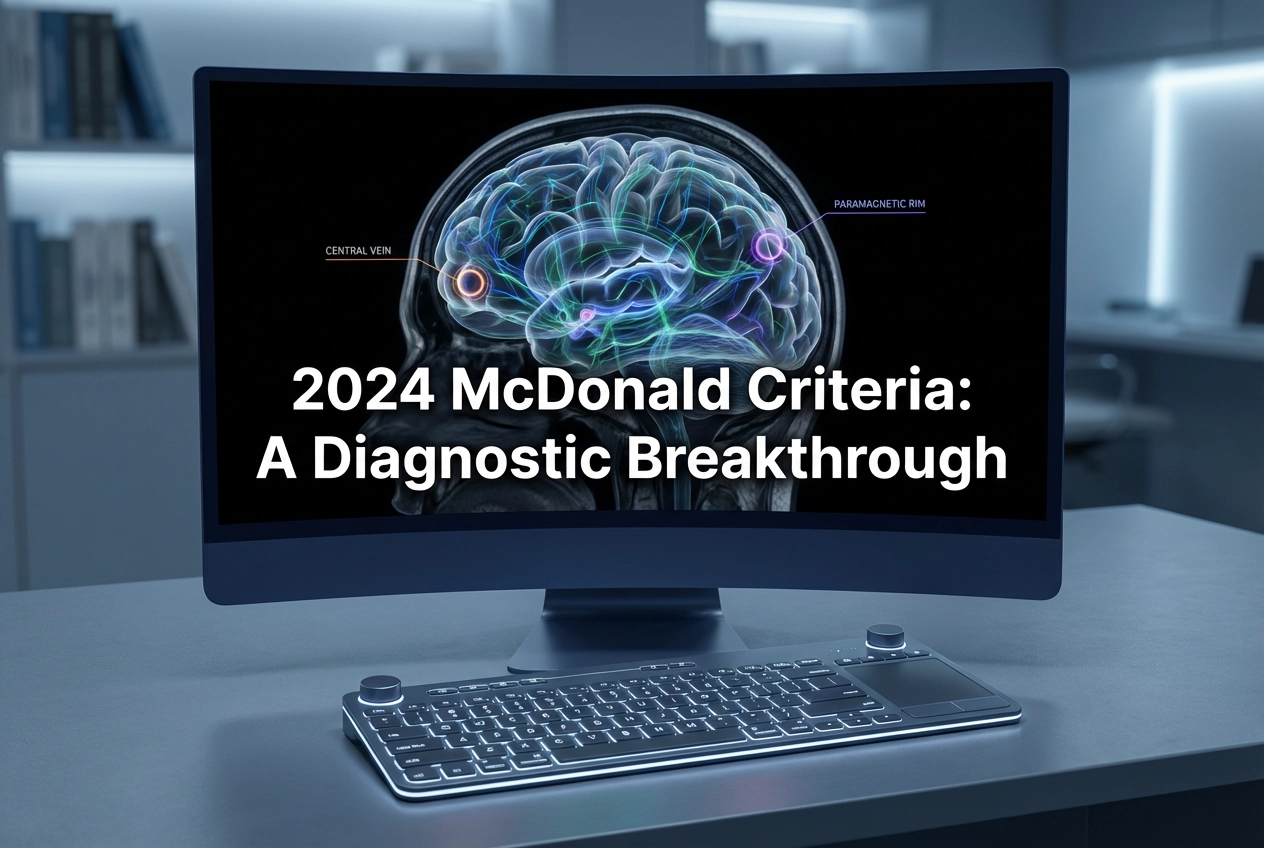
MRI biomarkers of MS have become indispensable tools for modern neurology. While the 2017 McDonald criteria significantly improved diagnostic accuracy, clinicians still face challenges with atypical cases. Consequently, the medical community has shifted toward identifying specific imaging features to prevent misdiagnosis. These features provide a clearer picture of the underlying pathophysiologic processes. Therefore, staying updated on these changes is essential for Indian practitioners who encounter diverse patient presentations.
Conventional Diagnostics and Limitations
Historically, the 2017 revised McDonald criteria served as the gold standard for diagnosing Multiple Sclerosis. These guidelines rely on demonstrating dissemination in space and time through T2-weighted and gadolinium-enhancing lesions. However, these conventional markers sometimes lack the specificity required to distinguish MS from its mimics, such as neuromyelitis optica or small vessel disease. Furthermore, the improper application of these standards can lead to significant diagnostic errors. This is particularly relevant in clinical settings where atypical neurological symptoms are frequent. Thus, physicians must look beyond standard imaging to achieve higher diagnostic precision.
Integrating MRI Biomarkers of MS in Clinical Practice
The 2024 revised McDonald criteria now formally recognize emerging MRI biomarkers of MS to enhance diagnostic specificity. Specifically, the central vein sign and paramagnetic rim lesions have transitioned from research tools to clinical aids. The central vein sign identifies a small vessel within a lesion, which is a hallmark of perivenular demyelination. Moreover, paramagnetic rim lesions indicate chronic active inflammation, often suggesting a more aggressive disease course. Additionally, the new criteria include the optic nerve as a fifth topographic site for dissemination in space. Consequently, these updates allow for earlier and more accurate diagnosis in patients who might have previously remained in a diagnostic gray zone.
The Role of Advanced Imaging Techniques
Artificial intelligence-driven analysis is another emerging field that complements these biomarkers. AI algorithms can capture subtle imaging features that often escape human perception. Furthermore, these tools help streamline clinical workflows by automating the detection of new or enlarging lesions. This technological integration is vital for radiologists managing high patient volumes in India. Notably, accurate interpretation of these advanced features remains essential for maintaining clinical standards. By combining human expertise with machine precision, neurologists can better predict disease progression and tailor therapeutic strategies.
Frequently Asked Questions
Q1: What are paramagnetic rim lesions and why are they important?
Paramagnetic rim lesions are imaging markers that indicate chronic active inflammation at the edge of MS lesions. They are highly specific to Multiple Sclerosis and often correlate with a more severe or progressive disease course.
Q2: How does the central vein sign help in differentiating MS from mimics?
The central vein sign is a highly specific feature of MS lesions because it reflects the perivenular nature of the disease. Most MS mimics, like migraine-related lesions or vascular disease, rarely show this specific venocentric pattern.
References
- Lim TR et al. Conventional and Emerging MRI Biomarkers of Multiple Sclerosis. Radiographics. 2026 Mar undefined. doi: 10.1148/rg.250069. PMID: 41746824.
- Montalban X et al. Diagnosis of multiple sclerosis: 2024 revisions of the McDonald criteria. Lancet Neurol. 2025;24(10):850-865.
- Filippi M et al. 2024 MAGNIMS-CMSC-NAIMS consensus recommendations on the use of MRI for the diagnosis of multiple sclerosis. Lancet Neurol. 2025;24(10):866-879.