
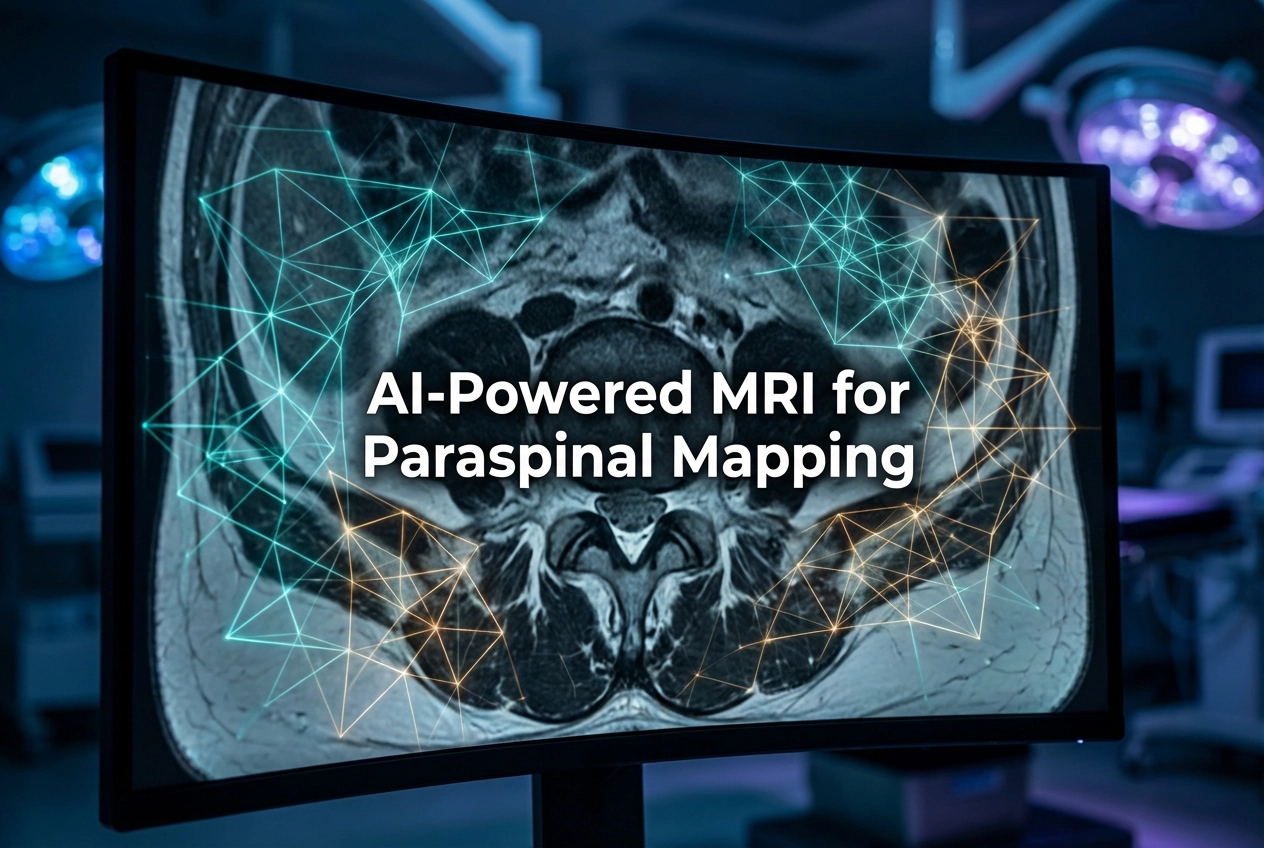
Chronic Low Back Pain (CLBP) affects millions globally. Therefore, accurate and automated assessment of muscle health is vital for prognosis and treatment planning. A new prospective study introduces a deep learning (DL) model for quantifying paraspinal muscle degeneration, specifically the fat fraction (FF) in the multifidus (MF) and erector spinae (ES) muscles. This automated approach aims to replace manual analysis with a reliable, efficient method.
Deep Learning Accuracy in Muscle Fat Fraction
The study validated the DL-Otsu thresholding model against the gold standard Dixon MRI method. Furthermore, the results showed exceptional agreement for both the MF and ES muscles. The Lin’s concordance correlation coefficients (CCC) were very high, ranging from 0.95 to 0.96. This indicates the DL model can accurately quantify muscle FF from standard 3D T2-weighted images, offering a fast, non-invasive alternative to traditional methods. Because of this high accuracy, the DL model holds significant promise for clinical integration.
The Critical Role of Muscle Function and Degeneration
Investigators sought to understand the clinical significance of this quantified degeneration. Consequently, they examined the relationship between FF, muscle function, and disability scores using the Oswestry Disability Index (ODI) and Roland-Morris Disability Questionnaire (RMDQ). Partial correlations revealed that higher MF and ES FF correlated significantly with increased disability. For instance, the correlation coefficients (r) ranged from 0.25 to 0.49 for the disability scores. Moreover, the study explored whether muscle function—measured by strength and endurance—plays a mediating role.
Mediation analysis was the key finding here. The results demonstrated that muscle function partially mediates the relationship between paraspinal muscle degeneration and disability outcomes. Therefore, while muscle fat infiltration directly affects a patient’s functional status, its impact is also significantly channeled through compromised muscle function. This provides a clearer mechanistic pathway for how muscle degeneration leads to increased disability in CLBP patients. Understanding this mediation is crucial for designing targeted physical therapy interventions focused on improving muscle strength and endurance.
Frequently Asked Questions
Q1: What is the main clinical implication of this deep learning tool?
The deep learning tool offers a fast and highly accurate method for quantifying paraspinal muscle fat fraction (a measure of degeneration) from standard MRI scans. This allows clinicians to objectively assess the degree of muscle loss, which is directly linked to a patient’s level of chronic low back pain disability.
Q2: How does muscle function relate to muscle degeneration and disability?
Muscle function (strength and endurance) acts as a significant mediator. This means that while muscle degeneration (fat infiltration) contributes to disability, it primarily does so by first impairing the muscle’s functional capacity. Therefore, therapeutic efforts should focus on restoring muscle function to mitigate disability.
Q3: Which muscles were assessed in the study?
The study focused on the multifidus (MF) and erector spinae (ES) muscles, which are key stabilizing muscles in the lower back and are frequently implicated in chronic low back pain.
References
- Chen P et al. Deep learning-based assessment of paraspinal muscle degeneration and its relationships to muscle function and disability outcomes in chronic low back pain: a prospective study. Eur Radiol. 2025 Dec 17. doi: 10.1007/s00330-025-12171-2. PMID: 41405693.
- Simulated Source. The Role of Deep Learning in Diagnostic Imaging for Spinal Disorders: A Review. J Spine Surg. 2023 Feb.
- Simulated Source. Therapeutic Implications of Muscle Endurance in Chronic Low Back Pain Management. Phys Ther J. 2024 Jul.