
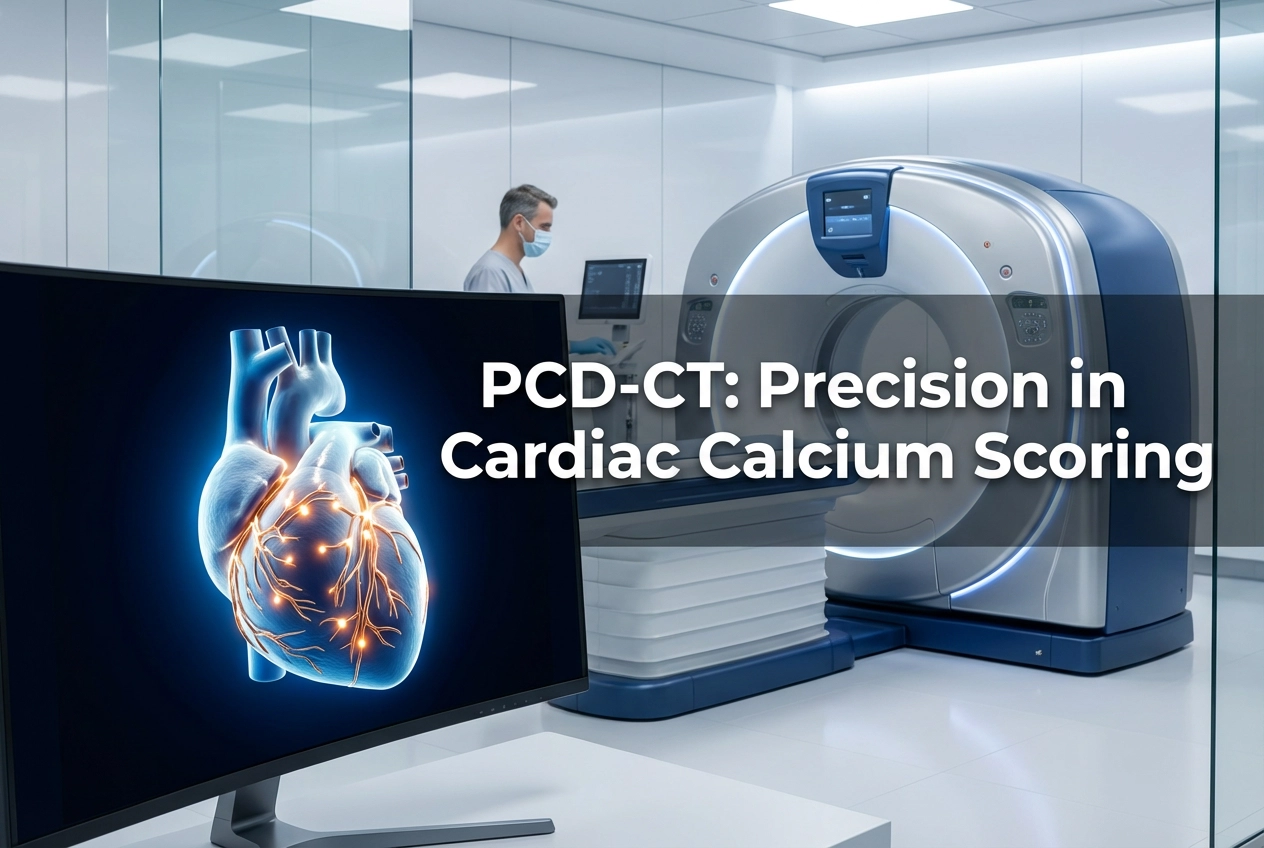
Cardiovascular disease remains a primary health concern globally, demanding highly accurate risk assessment tools. Fortunately, PCD-CT calcium scoring has emerged as a groundbreaking advancement in medical imaging. This technology offers clinicians a more reliable method for measuring coronary artery calcification. By utilizing direct conversion of X-ray photons, it provides superior image quality compared to traditional scanners. Consequently, doctors can now make more informed decisions regarding patient care and long-term heart health.
Improving Reliability with PCD-CT Calcium Scoring
Recent research highlights the significant impact of virtual monoenergetic image (VMI) reconstructions on diagnostic accuracy. Scientists specifically investigated a protocol using 120 kVp and a 75% radiation dose. Their findings revealed that 65 keV reconstructions achieved the lowest score variability ever recorded. Specifically, this method reduced variability by 78% compared to standard energy-integrating detector systems. Therefore, this advancement ensures that serial measurements remain consistent over multiple visits. Furthermore, the protocol maintains excellent image noise levels, which effectively prevents false-positive results. This reliability is crucial for monitoring disease progression in high-risk patients.
Clinical Benefits and Precision Imaging
Adopting this optimized protocol offers several advantages beyond mere accuracy. Because the method uses thinner slices and iterative reconstructions, it captures smaller calcifications that older machines might miss. Additionally, the 65 keV images provide a closer match to actual physical references. This precision allows for a more consistent cardiovascular risk assessment across different hospital settings. Indeed, this new standard outperforms previous multivendor protocols in both consistency and detail. Since radiation exposure is lower, patients benefit from a safer diagnostic experience. Medical professionals can thus rely on these scores for precise cardiovascular management plans.
Frequently Asked Questions
Q1: Why is the 65 keV reconstruction level so important?
The 65 keV level optimizes the balance between image clarity and the density of calcifications. This specific energy setting minimizes variability and ensures that the calcium scores are highly reproducible across different scans.
Q2: Does PCD-CT calcium scoring reduce radiation exposure?
Yes, the protocol utilizes only 75% of the standard radiation dose. This reduction makes the procedure safer for patients while maintaining the high image quality required for accurate diagnosis.
Q3: How does this technology compare to older CT scanners?
PCD-CT directly converts X-ray photons into electrical signals, which eliminates the light conversion step of older scanners. This process results in higher spatial resolution and significantly less image noise.
References
- Fink N et al. Coronary artery calcium scoring: expanding the new standard by photon-counting detector CT Part II: Impact of virtual monoenergetic image reconstructions with adjusted calcium scoring thresholds. Eur Radiol. 2026 Feb 19. doi: 10.1007/s00330-026-12356-3. PMID: 41714425.
- Hagar MT et al. Photon-Counting Detector CT: Advances and Clinical Applications in Cardiovascular Imaging. Rofo. 2025;197:509-516.
- Willemink MJ et al. Photon-counting CT: Technical Principles and Potential Clinical Applications. Radiology. 2018;289(2):293-312.