
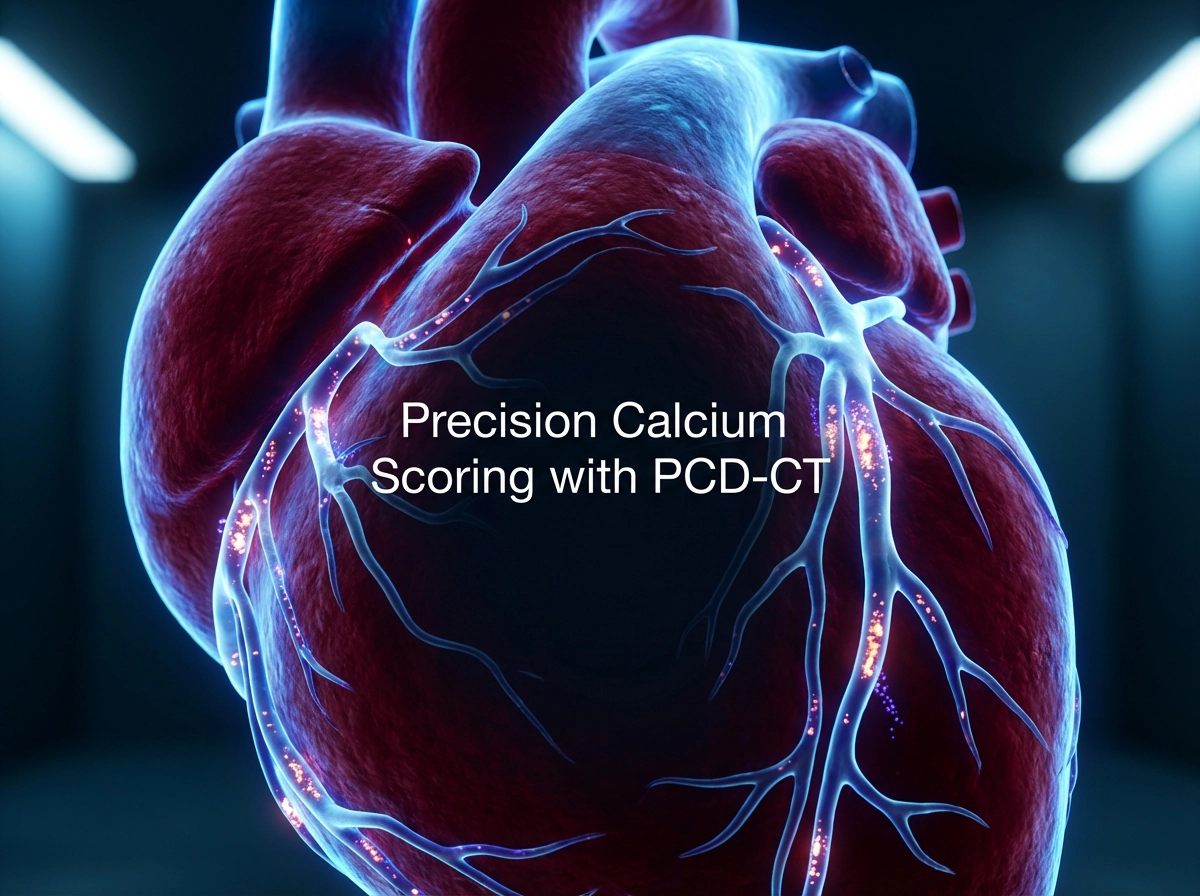
Cardiovascular diseases represent a leading health challenge in India today. Consequently, coronary artery calcium scoring has emerged as an essential tool for identifying patients at risk of future cardiac events. Recent breakthroughs in imaging hardware now offer even greater precision for clinicians. Specifically, photon-counting detector (PCD) CT technology provides a superior way to quantify arterial calcifications. This advancement helps doctors personalise treatments like statins more effectively than before.
Advances in Coronary Artery Calcium Scoring
Traditional energy-integrating detectors often produce variable results due to image noise and artefacts. However, research by Fink and colleagues demonstrates that PCD-CT significantly improves measurement consistency. They found that a thin-slice, 1-mm protocol reduces score variability by 37% compared to standard PCD settings. Furthermore, this optimized approach reduces radiation doses by 25%. Such improvements ensure that radiologists can provide reliable data for longitudinal patient tracking. This level of accuracy was previously difficult to achieve with older scanner generations.
Clinical Impact in the Indian Healthcare Context
In India, heart disease often affects people in their prime productive years. Therefore, early and accurate detection of subclinical atherosclerosis is vital for public health. PCD-CT provides more accurate volume and mass scores, which align closely with physical references. Additionally, it minimizes the risk of false-positives that can lead to unnecessary medical anxiety. By adopting these high-resolution protocols, Indian diagnostic centers can offer world-class preventive screening. Ultimately, better reproducibility leads to more confident clinical decisions and improved patient outcomes.
Frequently Asked Questions
Q1: Why is reproducibility critical in calcium scoring?
Reproducibility ensures that differences in scores between two scans reflect actual disease progression rather than technical errors. Consistent scoring is necessary for tracking the long-term effectiveness of preventive therapies and lifestyle interventions.
Q2: How does PCD-CT manage to reduce radiation doses?
PCD-CT utilizes more efficient detectors and quantum iterative reconstruction algorithms. These technologies maintain high image quality and low noise even when the scanner uses a lower tube current, protecting patients from unnecessary exposure.
Q3: Can PCD-CT detect more calcifications than standard CT?
Yes, the enhanced spatial resolution allows for the detection of smaller or less dense calcifications that older systems might miss. In clinical studies, optimized PCD-CT protocols detected more calcified lesions than older energy-integrating systems while maintaining diagnostic clarity.
References
- Fink N et al. Coronary artery calcium scoring: expanding the new standard by photon-counting detector CT-Part I: Impact of tube voltage, tube current, slice thickness, and quantum iterative reconstructions. Eur Radiol. 2026 Feb 19. doi: 10.1007/s00330-026-12355-4. PMID: 41711882.
- Alluri K et al. Assessment of Impact of Coronary Artery Calcium On Cardiovascular Risk Stratification in an Indian Cohort. Fortune J Health Sci. 2019;2(3):44-53.
- Symons R et al. Coronary artery calcium scoring with photon-counting CT: first in vivo human experience. Int J Cardiovasc Imaging. 2021;37(6):2017-2026.