
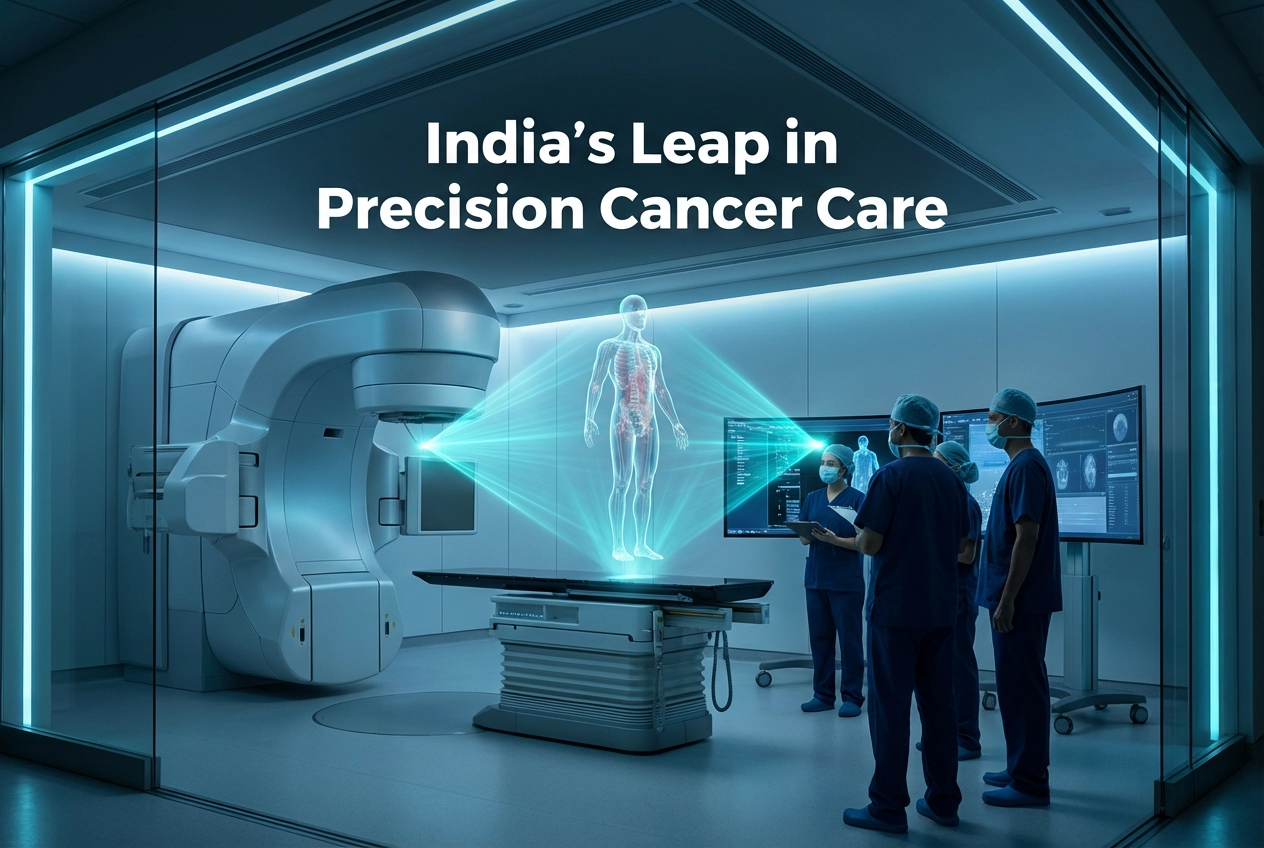
India faces a significant challenge in cancer care, with nearly one million new cases diagnosed every year. Moreover, only one in five patients accesses advanced radiation technology, creating a critical gap in outcomes, waiting times, and quality of life. Conversely, Precision Radiation Therapy (PRT), long misunderstood as a blunt instrument, is undergoing a profound transformation. Dr. Tejinder Kataria, Chairperson of Radiation Oncology at Medanta–The Medicity, explains that modern radiation oncology is now a discipline where physics meets medicine. When applied with precision, even nuclear energy becomes a powerful tool for healing. For medical professionals looking to master these cutting-edge cancer treatment modalities, an Oncology Speciality Course can provide essential knowledge.
Radiation therapy is an essential component in nearly 50 per cent of all cancer treatments. Up to 80 per cent of patients who receive radiation achieve a cure or long-term disease control, either alone or when combined with surgery and chemotherapy. However, Dr. Kataria emphasizes that outcomes rely increasingly on precision, speed, and patient comfort, not just the dose itself.
The Core Principles of Precision Radiation Therapy
Modern platforms now deliver treatment with sub-millimetre accuracy. Advanced imaging, real-time motion tracking, and sophisticated dose calculations support this capability. Therefore, the radiation dose does not change, but its efficient delivery fundamentally changes. This shift translates into shortened treatment times without compromising clinical outcomes. Consequently, these improvements are more than simple technical upgrades; they directly reshape the patient experience. Faster delivery means reduced anxiety, less time on the treatment couch, and greater tolerance, particularly for elderly patients, children, and those with complex tumours. Furthermore, at the system level, shorter treatment times allow centres to treat significantly more patients each day, thereby improving access in an overstretched oncology ecosystem.
Surface-Guided Radiation Therapy (SGRT): Enhancing Patient Safety
Newer-generation platforms like the Varian EDGE system enable this precision-driven, patient-centric care. A key patient-centric advance is IDENTIFY surface-guided radiation therapy (SGRT). This technology uses three high-resolution cameras to continuously monitor the patient’s skin surface during treatment. SGRT allows clinicians to detect even the slightest patient movement in real-time, improving accuracy and ensuring better dose guidance. Consequently, patient tolerance is enhanced during treatment.
SGRT is particularly beneficial for patients who struggle to remain immobile, such as the elderly, children, or those with lung or breast cancers. Moreover, SGRT often eliminates the need for uncomfortable immobilisation devices. The system also supports respiratory-gated radiotherapy, which synchronises radiation delivery with a patient’s breathing cycle. This is a crucial feature for precisely targeting tumours in the chest and upper abdomen, ensuring accuracy even when tumours move with respiration. For those interested in the advanced imaging supporting these techniques, exploring a Radiology Speciality Course would be beneficial.
HyperArc and RapidArc: Speed and Efficacy for Complex Tumours
The evolution from conventional linear accelerators to highly sophisticated systems has been rapid over the last 15 years. Older machines had limitations, including longer treatment times and limited beam flexibility, often exposing surrounding healthy tissues to higher radiation doses. In contrast, modern platforms address these issues by combining sub-millimetric accuracy with high-dose-rate delivery. For example, the EDGE system delivers radiation at nearly double the dose rate, up to 2,400 monitor units per minute, compared to 1,200 in older systems.
For complex tumours, especially in the brain, HyperArc technology enables the treatment couch and radiation beam to rotate through nearly 360 degrees. This sophisticated automation allows clinicians to treat multiple brain metastases in a single session with exceptional accuracy without repeated repositioning. Because of its design, HyperArc assures high conformity, rapid dose fall-off, and spares organs-at-risk, often halving the delivery time compared to older techniques. Optimised dose delivery via non-coplanar beams further improves efficiency. In clinical practice, the use of these technologies means treatment throughput can increase significantly, moving from 30–40 patients per day to as many as 60, without compromising quality. This represents a near 70 per cent improvement in efficiency. Professionals involved in diagnosing complex neurological issues could benefit from the Neurology Speciality Courses.
Overall, Dr. Kataria notes that strengthening high-end cancer infrastructure is essential to reducing delays and improving outcomes at scale in India. Although treatment costs remain between Rs.10,000 and Rs.50,000, depending on complexity, these technological gains improve efficiency without substantially increasing the financial burden on patients. Those looking to pursue advanced study in oncology can consider the Postgraduate Diploma In Cancer And Clinical Oncology.
Frequently Asked Questions
Q1: What is the main advantage of modern Precision Radiation Therapy over older techniques?
The main advantage is sub-millimetre accuracy, combined with real-time tracking and high-dose-rate delivery. This allows for significantly shorter treatment times, which improves patient comfort, reduces anxiety, and spares critical healthy organs much more effectively, leading to better clinical outcomes and lower toxicity.
Q2: How does Surface-Guided Radiation Therapy (SGRT) improve patient experience?
SGRT uses 3D cameras to continuously monitor the patient’s surface position in real-time. This eliminates the need for permanent skin markings (tattoos) and often removes the requirement for uncomfortable immobilisation devices. It also ensures the radiation beam is only delivered when the patient is in the correct position, enhancing safety and accuracy.
Q3: How is access to advanced radiation technology in India currently?
India sees nearly 1 million new cancer cases annually, but only about 20 per cent of patients currently access advanced radiation technologies, even though nearly 80 per cent could potentially benefit from them. Strengthening high-end cancer infrastructure is essential to close this access gap.
References
- Precision Turns Radiation into a Powerful Tool for Healing: Dr Kataria – ETHealthworld
- Revolutionising cancer care with precision radiation therapy – Express Healthcare
- C-RAD sets up India Experience Center for precision radiotherapy – Healthcare Radius
- First experience and clinical results using a new non-coplanar mono- isocenter technique (HyperArc™) for Linac-based VMAT radiosurgery in brain metastases – IRCCS Ospedale Sacro Cuore Don Calabria
- Dosimetric quality of HyperArc in boost radiotherapy for single glioblastoma: comparison with CyberKnife and manual VMAT – PubMed Central
Disclaimer: This article was automatically generated from publicly available sources and is provided for informational and educational purposes only. OC Academy does not exercise editorial control or claim authorship over this content. It is not a substitute for professional medical advice, diagnosis, or treatment. Always consult a qualified healthcare provider and refer to current local and national clinical guidelines.