
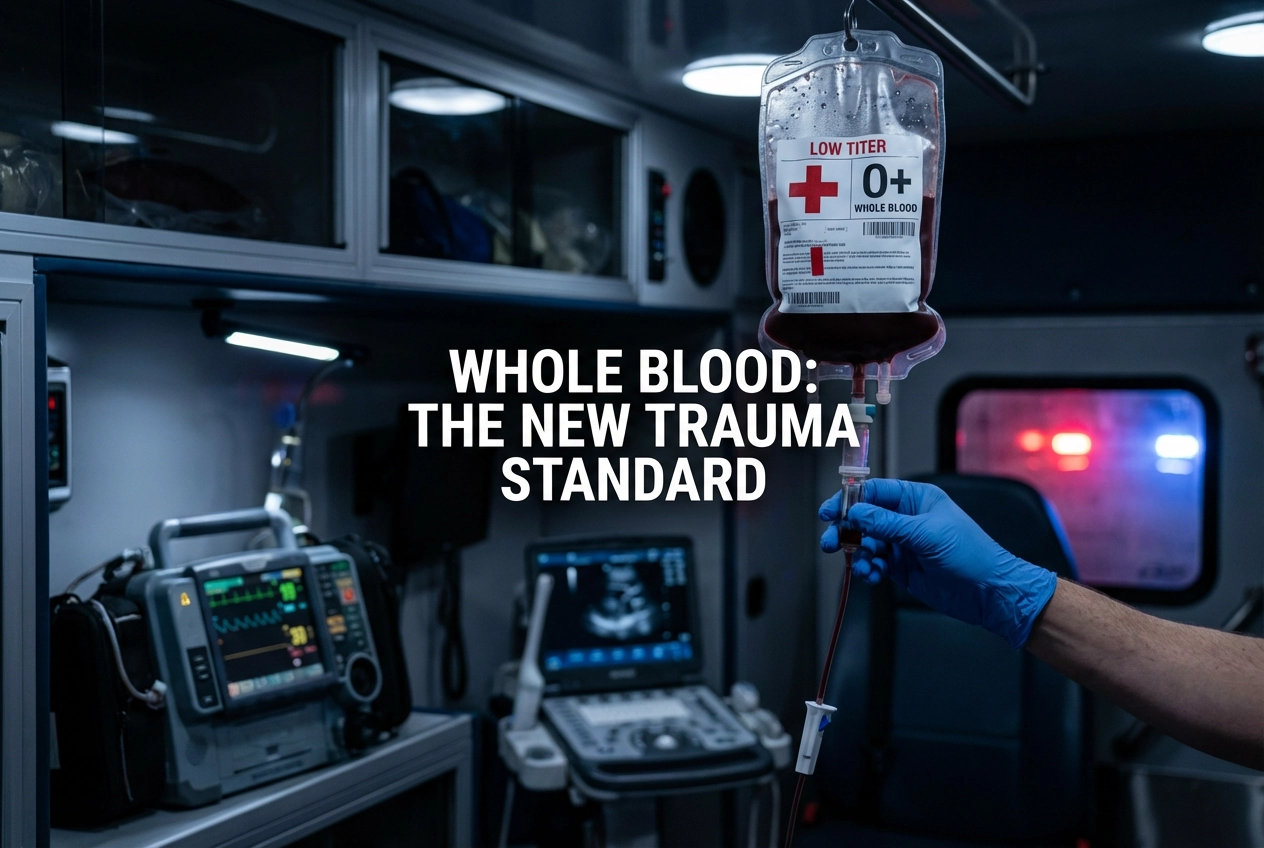
Prehospital Whole Blood Transfusion remains a central topic for emergency medical services dealing with severe trauma. Clinicians often debate whether using whole blood provides a survival advantage over standard component therapy. Moreover, a recent phase 3 randomized controlled trial, known as the SWIFT trial, investigated this comparison across ten air ambulance services in England. Consequently, this multicenter study evaluated whether whole blood could reduce death or the need for massive transfusions within 24 hours.
Outcomes of Prehospital Whole Blood Transfusion
Researchers randomized 942 patients to receive either two units of whole blood or standard care consisting of separate red cells and plasma. After excluding certain cases, 616 participants remained in the primary analysis. Furthermore, the results showed that the primary outcome occurred in 48.7% of the whole blood group. Meanwhile, the standard-care group experienced the same outcome in 47.7% of cases. Therefore, the trial demonstrated that whole blood was not superior to standard blood components. Specifically, the relative risk was 1.02, indicating no significant statistical difference between the two strategies.
Clinical Implications and Safety
Safety remains a paramount concern when introducing new prehospital protocols. Interestingly, the standard-care group reported slightly more serious adverse events than the whole blood group. Specifically, researchers recorded 37 events in standard care compared to 31 in the whole blood arm. However, patients receiving whole blood showed higher prothrombin times compared to those receiving components. Despite these differences, the incidence of thrombotic events remained similar across both groups. Thus, both methods appear relatively safe for prehospital use in major trauma.
Relevance for Trauma Care in India
Indian medical professionals often face unique challenges, such as long transport times and limited prehospital resources. While this trial showed no clinical superiority for whole blood, logistical factors may still favor its use in some settings. For instance, storing a single product is often easier than managing multiple components in an ambulance. Moreover, faster administration times could benefit patients during the \”golden hour\” of trauma care. Consequently, Indian trauma centers might consider these logistical benefits even if survival rates remain comparable. Future research should explore if specific subgroups in India might benefit more from this approach.
Frequently Asked Questions
Q1: Is whole blood more effective than blood components for trauma patients?
According to the SWIFT trial, prehospital whole blood is not superior to standard component therapy in reducing 24-hour mortality or the need for massive transfusion.
Q2: Were there any safety concerns associated with using whole blood?
The trial found no major safety concerns. In fact, serious adverse events were slightly more common in the standard-care group than in the whole blood group.
Q3: Why might whole blood still be used despite these trial results?
Whole blood offers logistical advantages, including simpler storage and faster administration, which are crucial in high-pressure prehospital environments.
References
- Smith JE et al. Prehospital Whole Blood in Traumatic Hemorrhage – a Randomized Controlled Trial. N Engl J Med. 2026 Mar 17. doi: 10.1056/NEJMoa2516043. PMID: 41841706.
- Green L et al. Results of the SWIFT randomized controlled trial. Presented at ISICEM 2026.
- Queen Mary University of London. Landmark trial on whole blood transfusion published in NEJM. March 2026.
- Kumar S et al. World trauma education: hemorrhage control training for healthcare providers in India. PMC6380203. 2019.