
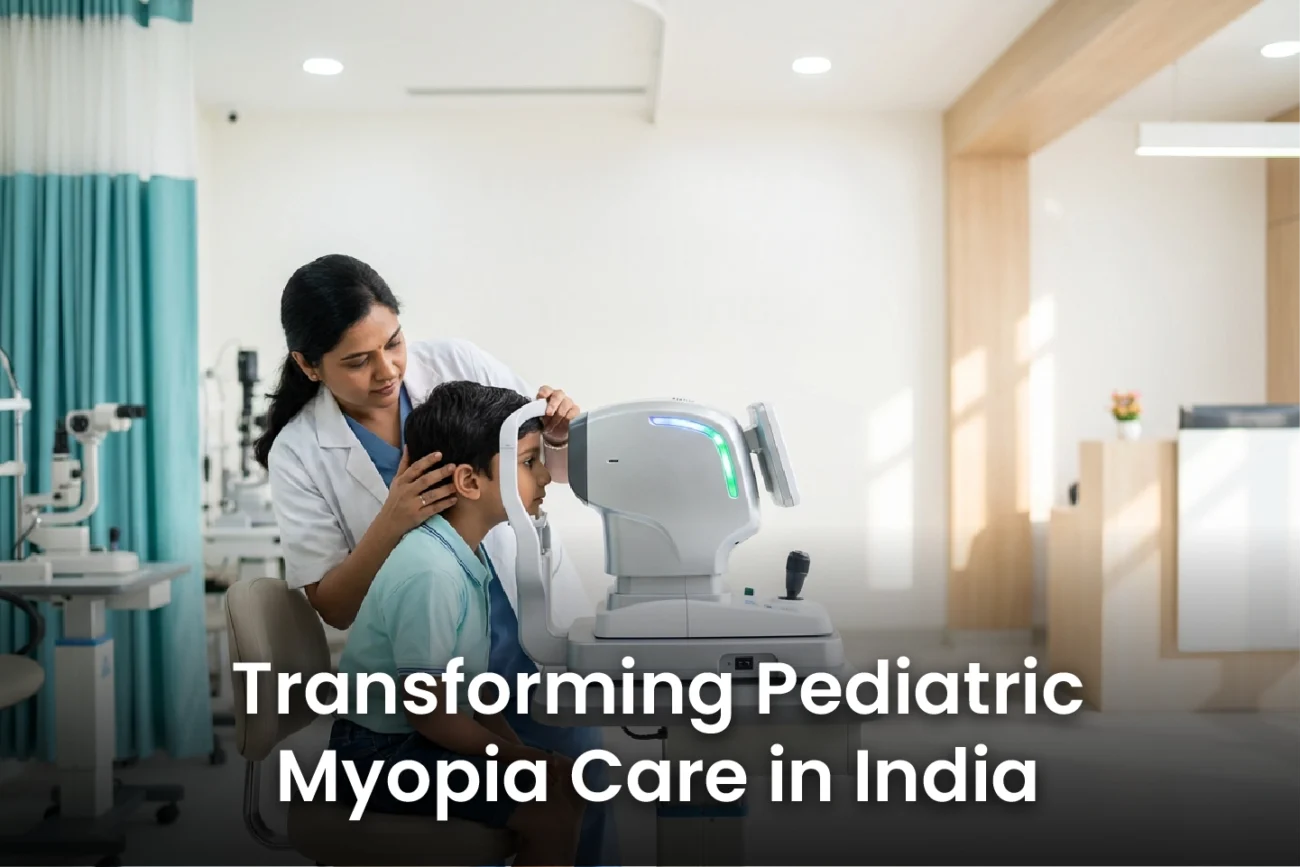
Remidio Innovative Solutions, a leading medical device maker, launched the PRISTINE OBM 12, an automated optical biometry and autorefraction system, to significantly improve the accuracy and consistency of pediatric myopia management. This new platform is specifically designed for use in children, consolidating axial length measurement, full ocular biometry, and autorefraction into a single, automated scan. The company asserts that the device can deliver 12 essential ocular parameters within seconds, allowing for objective monitoring and easy integration with electronic medical record (EMR) systems.
The Critical Role of Optical Biometry in Myopia Progression
Myopia is a growing public health concern, affecting nearly 30% of the global population and projected to reach 50% by 2050. Notably, childhood myopia prevalence in urban India has risen dramatically, climbing from approximately seven percent to nearly 21 percent over the past decade. Therefore, precise and repeatable measurements are absolutely critical for long-term care. This early onset of vision impairment increases the lifetime risk of serious complications, including retinal detachment, glaucoma, and myopic maculopathy. Clinical guidelines and expert consensus statements from the All India Ophthalmological Society (AIOS) emphasise the need for standardised management strategies in the Indian context. Furthermore, axial length measurement, provided by advanced optical biometry, is a more stable and direct parameter for monitoring progression compared to refraction alone, which can often fluctuate. For this reason, many clinics relying only on refraction do not fully capture the true progression of myopia.
Addressing Challenges in Pediatric Eye Care
Pediatric myopia care faces several historical barriers. These include high variability between measurements, the difficulty of obtaining reliable data from young children, and limited access to axial length measurement outside of tertiary centres. Consequently, high-volume clinics often experience long waiting times, making comprehensive assessment a challenge. The PRISTINE OBM 12 directly addresses these issues with advanced features. For instance, the system employs automatic alignment, intelligent auto-capture, and 3D eye tracking. Therefore, it only takes measurements when accurate fixation is achieved. This technology minimises operator dependence and dramatically improves the repeatability of results. Also, it streamlines clinic workflows by consolidating multiple assessments into a single, quick scan. Professionals focused on improving **pediatric care** will find advanced screening methods essential.
Expanding Access and Standardising Clinical Data
Remidio CEO Anand Sivaraman stated that advanced automation, including auto-capture and 3D eye tracking, standardises measurements and minimises variability. This standardisation supports faster, more confident clinical decision-making. Moreover, its compact design facilitates deployment not only in tertiary hospitals but also in secondary centres and community clinics. Certainly, this expansion is essential for democratizing access to advanced pediatric eye assessment across the country. Dr Jitendra Jethani, a pediatric ophthalmologist, confirmed the system’s ability to provide consistent biometry and refraction, even in children with unstable fixation. Because it captures all essential parameters in a single scan, the device effectively eliminates operator variability and provides reliable data under real-world conditions. Expertise in **ophthalmology** is key to interpreting these sophisticated diagnostic results.
Frequently Asked Questions
Q1: What specific challenges does the PRISTINE OBM 12 address in pediatric myopia management?
The system addresses challenges such as unreliable measurements in young children, high variability between devices, a previous reliance on refraction alone (which does not capture true progression), and limited access to axial length measurement outside specialized tertiary centers.
Q2: What is the primary clinical benefit of using optical biometry (axial length) over traditional refraction for myopia?
Axial length, measured by optical biometry, provides a more stable and direct measurement of the eye’s physical growth, which is the primary anatomical change in myopia. Unlike refraction, this measurement does not fluctuate, making it the superior parameter for objectively monitoring and tracking true myopia progression and the effectiveness of interventions. Practitioners looking to deepen their skills in this specialised area might explore the Certification Course In Ophthalmology.
References
- Remidio Launches Automated Biometry System to Improve Pediatric Myopia Care – ETHealthworld.
- Holden BA, et al. Global prevalence of myopia and high myopia and temporal trends from 2000 through 2050. Ophthalmology. 2016.
- AIOS Guidelines-Childhood Myopia-2 – Scribd.
- AIOS issues guidelines to manage childhood myopia – Drug Today.
- Prevention and management of childhood progressive myopia: National consensus guidelines – ResearchGate.
- Protecting Your Child’s Vision: The Essential Role of Optical Biometry in Myopia Management – myopiafocus.org.
- A Comparison of Optical Biometers Used in Children for Myopia Control – PMC.
Disclaimer: This article was automatically generated from publicly available sources and is provided for informational and educational purposes only. OC Academy does not exercise editorial control or claim authorship over this content. It is not a substitute for professional medical advice, diagnosis, or treatment. Always consult a qualified healthcare provider and refer to current local and national clinical guidelines.