
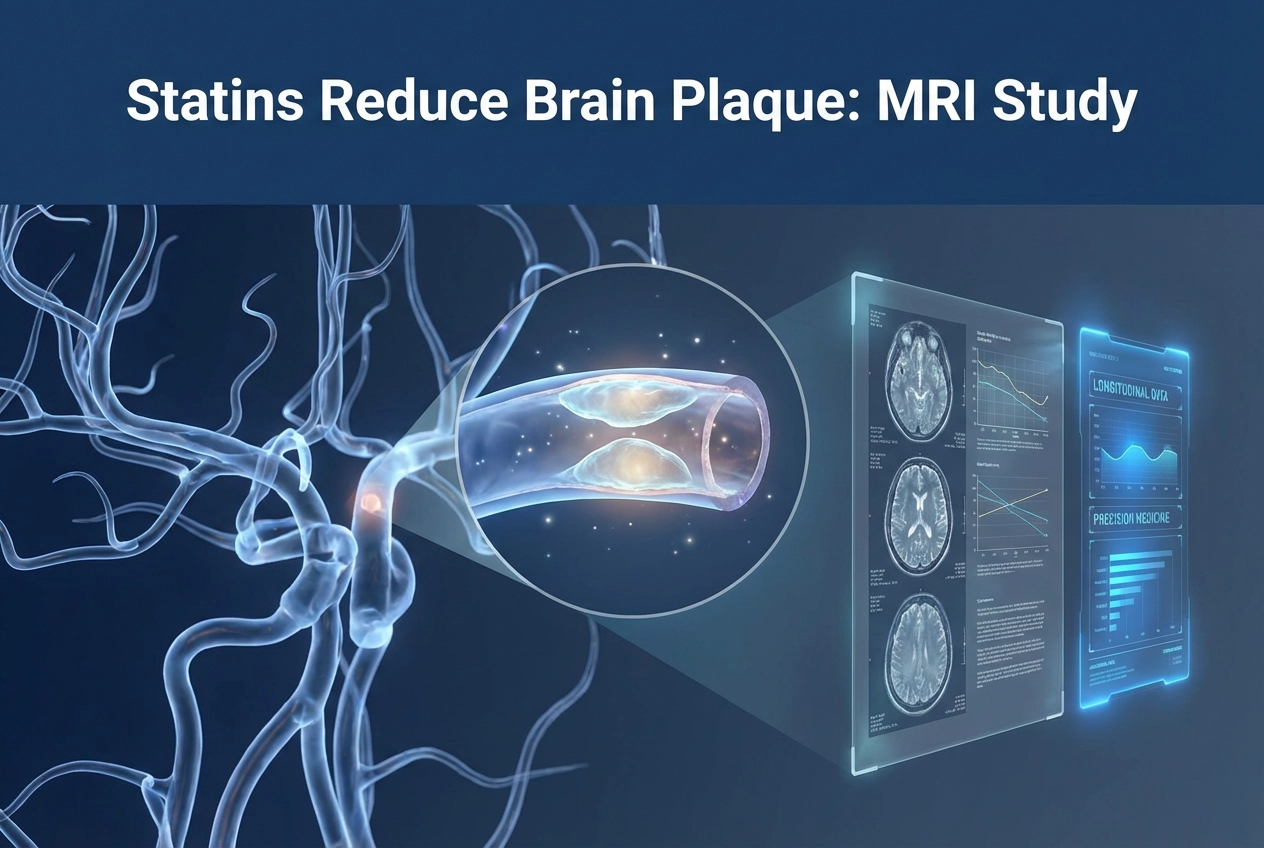
Intracranial atherosclerotic stenosis (ICAS) significantly increases the risk of recurrent ischemic stroke, especially in certain patient populations. Therefore, physicians aggressively pursue effective lipid management strategies. A new study utilizes high-resolution magnetic resonance (MR) vessel wall imaging to assess the effects of moderate-dose statin therapy on Statin Intracranial Plaque. This imaging technique provides highly detailed, non-invasive visualisation of plaque characteristics, which is essential for monitoring treatment response. The findings offer crucial insights for doctors aiming to stabilise vulnerable plaques and ultimately prevent debilitating strokes.
High-Resolution MR and Plaque Monitoring
Vessel wall magnetic resonance imaging (VW-MRI) offers a theoretical basis for evaluating the therapeutic efficacy of lipid-lowering drugs on ICAS plaques. Generally, statins are the frontline treatment for managing cholesterol and lowering low-density lipoprotein cholesterol (LDL-C). Evidence confirms that a significant reduction in LDL-C is directly linked to a lower incidence of major vascular events. Consequently, a key goal in ICAS treatment is achieving an LDL-C level of <1.8 mmol/L or a reduction exceeding 50% from baseline.
Furthermore, high-resolution imaging helps physicians track plaque evolution in situ. While traditional angiography only measures the degree of luminal stenosis, VW-MRI also shows changes in plaque composition and instability features. Active treatment reduces imaging markers of vulnerability, such as the plaque enhancement volume. After all, reducing plaque enhancement suggests a stabilization of the lesion and a decreased risk of rupture.
Understanding Statin Intracranial Plaque Changes
Studies on both moderate and intensive statin regimens have consistently shown their ability to induce favorable changes in ICAS. Specifically, high-dose statins decrease the total wall volume and the volume of plaque enhancement. Similarly, long-term moderate-dose statin therapy often leads to a measurable reduction in plaque length and thickness. This reduction indicates regression. Moreover, some individuals experience a decrease in the lipid-rich necrotic core (LRNC) volume, particularly after over a year of treatment.
The original study on moderate-dose statin therapy targeted plaques with mild to moderate stenosis. This is important. Stabilizing these less severe lesions can prevent progression to severe stenosis or rupture. However, physicians must recognize that response to statin therapy is variable. While many patients show improvement, some individuals are non-responders, even with aggressive lipid-lowering efforts. Therefore, VW-MRI is an invaluable tool. It helps identify non-responders so doctors can adjust therapy, perhaps by adding a PCSK9 inhibitor.
Frequently Asked Questions
Q1: What specific changes do statins cause in intracranial plaques?
Statins cause structural changes like a reduction in plaque length and wall thickness. More importantly, they lead to a decrease in plaque enhancement volume and a reduction in the lipid-rich necrotic core, which ultimately stabilizes the plaque and reduces its vulnerability to rupture.
Q2: Why is high-resolution MR vessel wall imaging (VW-MRI) important for ICAS treatment?
VW-MRI is crucial because it non-invasively monitors in situ plaque changes, unlike traditional angiography, which only measures stenosis. Therefore, doctors can use VW-MRI to assess a patient’s response to statin therapy and identify non-responders for whom an intensification or change in treatment might be necessary.
Q3: What LDL-C goal should doctors aim for in patients with ICAS?
Guidelines and meta-analyses suggest that a target LDL-C level of less than 1.8 mmol/L or at least a 50% reduction from the patient’s baseline LDL-C level is necessary for effectively preventing major vascular events and improving clinical outcomes.
References
- Hu J et al. The effects of moderate-dose statin therapy on intracranial plaques with mild to moderate stenosis: a high-resolution MR vessel wall imaging study. Eur Radiol. 2026 Jan 13. doi: 10.1007/s00330-025-12247-z. PMID: 41528477.
- Evaluation of the effect of statin treatment on intracranial atherosclerotic plaques using magnetic resonance vessel wall imaging: a case series. Front Neurol. 2025 Mar 16. doi: 10.3389/fneur.2025.1539212.
- Assessment of Therapeutic Response to Statin Therapy in Patients With Intracranial or Extracranial Carotid Atherosclerosis by Vessel Wall MRI: A Systematic Review and Updated Meta-Analysis. Front Cardiovasc Med. 2021 Oct 27. doi: 10.3389/fcvm.2021.742935.