
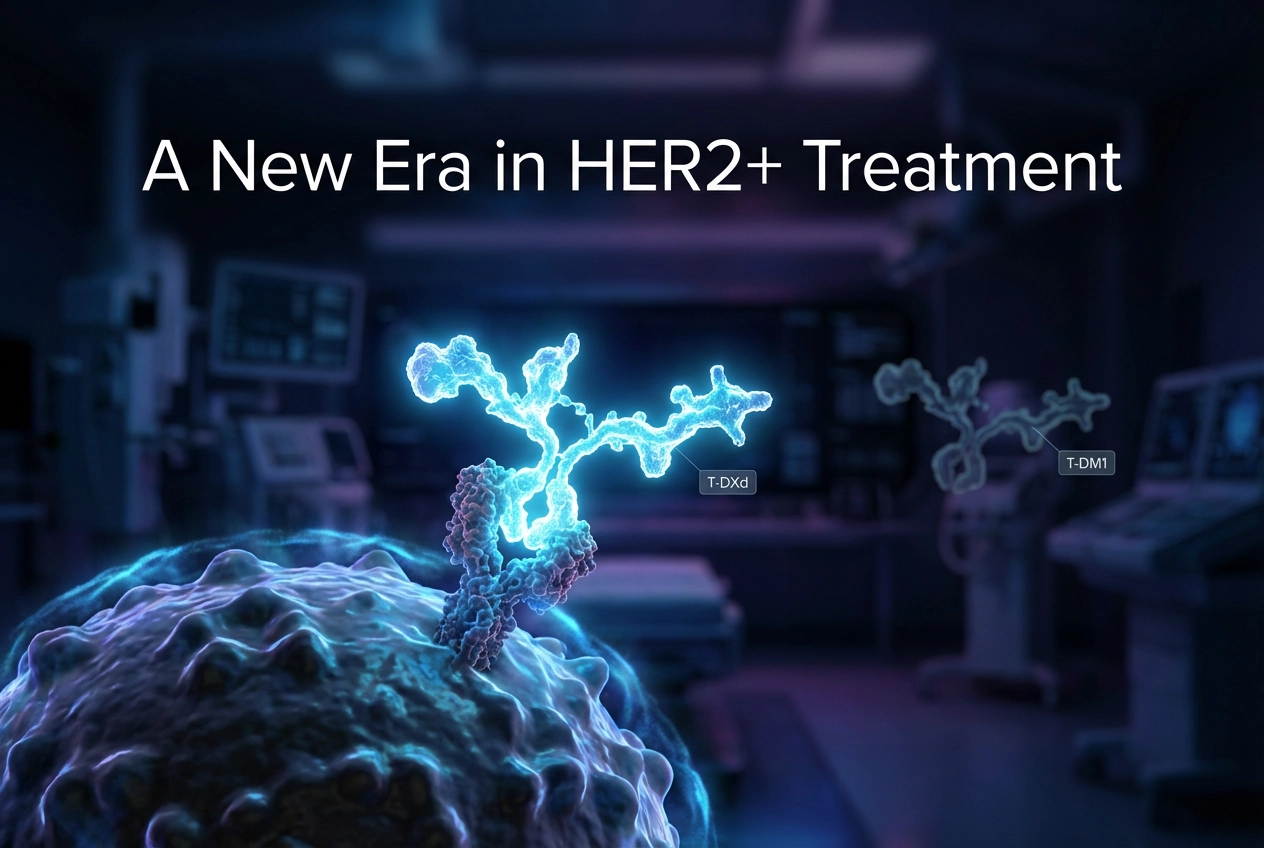
Patients with HER2-positive early breast cancer and residual invasive disease after neoadjuvant therapy are at high risk for recurrence. A groundbreaking shift in therapy has occurred with the DESTINY-Breast05 trial. Specifically, this phase 3 trial investigated postneoadjuvant trastuzumab deruxtecan (T-DXd) against the current standard, trastuzumab emtansine (T-DM1). T-DXd showed significant superiority, which redefines the management of T-DXd breast cancer in this curative setting.
T-DXd: Establishing a New Adjuvant Standard of Care
The international, randomized trial enrolled 1635 patients with high-risk HER2-positive disease. The investigators tracked invasive disease-free survival (IDFS) as the primary endpoint. Furthermore, they followed disease-free survival (DFS) as a key secondary endpoint. The results were remarkably positive: T-DXd reduced the risk of an invasive-disease event or death by an impressive 53% compared to T-DM1 (Hazard Ratio [HR], 0.47; 95% Confidence Interval [CI], 0.34 to 0.66; P<0.001). Moreover, the three-year IDFS rate was 92.4% in the T-DXd group, while it was 83.7% with T-DM1. This magnitude of benefit establishes T-DXd as the superior agent.
Clinically Meaningful Reductions in Brain Metastasis
The superior IDFS benefit was consistent across all prespecified subgroups. This consistency further supports T-DXd replacing T-DM1 as the new standard of care for high-risk residual disease. Importantly, the study also tracked the brain metastasis-free interval. The data showed clinically meaningful reductions in the risk of brain metastasis. This is a significant advantage. Because CNS recurrence is a critical area of unmet need in this population, the T-DXd benefit in this area offers major therapeutic value.
Monitoring the Safety Profile of T-DXd Breast Cancer Treatment
Although T-DXd offers superior efficacy, clinicians must closely consider its safety profile. T-DXd had a higher rate of adverse events (AEs) leading to treatment discontinuation (11.6% vs. 5.1%). Additionally, the rate of grade 3 or higher AEs was notably higher in the T-DXd group (42.5%) compared to the T-DM1 group (27.2%). Interstitial lung disease or pneumonitis (ILD/pneumonitis) remains the primary safety concern for the drug. Specifically, the rates of adjudicated, drug-related ILD or pneumonitis were significantly higher with T-DXd (11.0%) than with T-DM1 (2.3%). However, most cases were low-grade, and therefore, vigilant monitoring and early intervention remain essential for safe use.
Frequently Asked Questions
Q1: What did the DESTINY-Breast05 trial investigate?
The trial compared two antibody-drug conjugates, trastuzumab deruxtecan (T-DXd) and trastuzumab emtansine (T-DM1), as postneoadjuvant therapy for patients with HER2-positive early breast cancer who still had residual invasive disease after initial treatment.
Q2: How much better was T-DXd than T-DM1?
T-DXd reduced the risk of invasive disease recurrence or death (invasive disease-free survival) by 53% compared to T-DM1, representing a highly significant clinical benefit in this high-risk population.
Q3: What is the main safety concern with T-DXd?
The primary safety concern is interstitial lung disease or pneumonitis (ILD/pneumonitis). The T-DXd group had an 11.0% incidence of adjudicated, drug-related ILD/pneumonitis, compared to 2.3% in the T-DM1 group. However, most cases were low-grade and manageable with close monitoring.
References
- Loibl S et al. Trastuzumab Deruxtecan in Residual HER2-Positive Early Breast Cancer. N Engl J Med. 2025 Dec 10. doi: 10.1056/NEJMoa2514661. PMID: 41370739.
- AstraZeneca India launches Trastuzumab deruxtecan for HER-2 positive metastatic breast cancer patients in India from January 2024. astrazeneca.in.
- DESTINY-Breast05: T-DXd vs T-DM1 in high-risk HER2+ early breast cancer. VJOncology.