
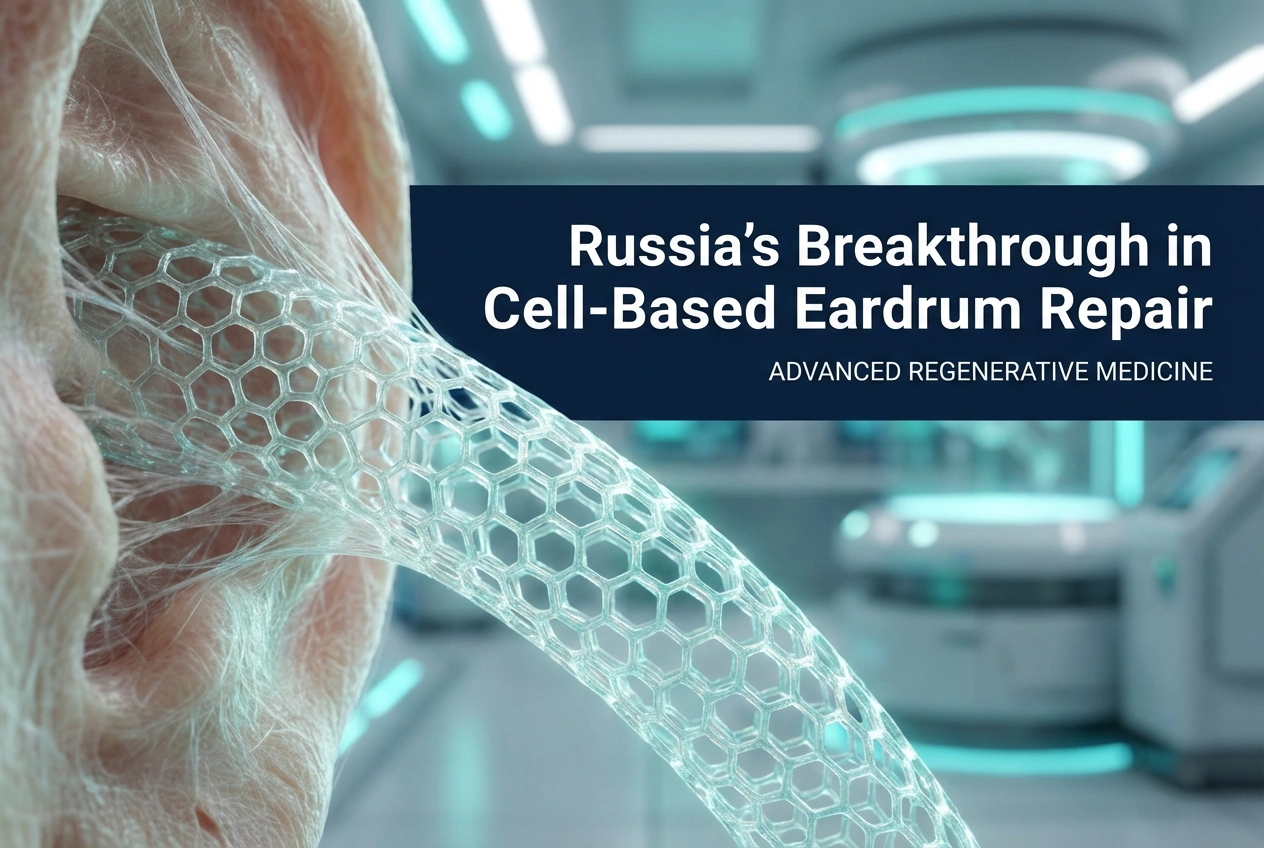
Russia has announced a major breakthrough in regenerative medicine, beginning the clinical use of a pioneering cell-based technology for tympanic membrane regeneration. Consequently, this world-first application, performed at the Clinical Centre of I. M. Sechenov First Moscow State Medical University, represents a significant shift from experimental science to practical otologic medicine.
The Translational Pathway to Cell-Based Eardrum Repair
Sechenov University became the first medical institution in Russia to complete the entire translational pathway for this cell-based medicinal product (CBMP). Furthermore, this process included fundamental research, certified production of the cell product, and subsequent clinical use within the same medical facility. University Rector Petr Glybochko emphasized the achievement, noting state programs supporting science and education backed the research. This breakthrough could potentially replace complex traditional surgical techniques.
Mechanism of Cell Spheroids in Tympanic Membrane Regeneration
The innovative technology relies on the patient’s own biological material. Thus, researchers first extract cells from a patient’s adipose (fat) tissue. They then form these cells into tiny, three-dimensional clusters known as cell spheroids. These spheroids are implanted at the damaged eardrum site along with a resorbable membrane. Over time, the membrane dissolves, allowing the cell spheroids to replace the scaffold with new, patient-specific tissue. This regenerated tissue closely matches the structure and function of a natural eardrum.
Addressing Limitations of Conventional Tympanoplasty
Tympanic membrane perforation affects approximately four to five people per 1,000, commonly resulting from infections, trauma, or sudden pressure changes. Conversely, conventional tympanoplasty involves a complex surgical procedure that does not always guarantee stable outcomes. Existing techniques face graft failure rates ranging between 10 and 20 per cent. The new cell-based procedure is significantly faster, taking only about 40 minutes. Moreover, early clinical data show favourable post-operative recovery with no reported complications in the first patients. Researchers believe this platform technology has broad potential. Finally, they anticipate its future adaptation for the regeneration of other organs and tissues, substantially expanding the scope of cell-based therapies.
Frequently Asked Questions
Q1: What is the source of the cells used in the tympanic membrane regeneration procedure?
The procedure uses the patient’s own cells, which are first extracted from their adipose (fat) tissue. These cells are then formed into cell spheroids for implantation.
Q2: How does the new cell-based procedure compare to conventional tympanoplasty?
The cell-based procedure is significantly faster, taking approximately 40 minutes, compared to more complex conventional surgical techniques. In addition, early results show favourable recovery and address the 10-20% graft failure rate associated with existing methods.
Q3: Is this cell-based product being used in clinical settings worldwide?
According to Sechenov University, this is the world’s first reported clinical application of a cell-based medicinal product (CBMP) specifically for tympanic membrane regeneration.
References
- Russia begins clinical use of cell-based technology for eardrum repair – ETHealthworld
- World-First Cell Therapy for Eardrum Repair Begins in Russia – NewKerala.com
- Russia starts clinical use of cell-based technology to repair damaged eardrums – indiamedtoday.com
- Review on Tympanic Membrane and Auditory Canal Regeneration by Biomaterial Intervention | Atlantis Press
Disclaimer: This article was automatically generated from publicly available sources and is provided for informational and educational purposes only. OC Academy does not exercise editorial control or claim authorship over this content. It is not a substitute for professional medical advice, diagnosis, or treatment. Always consult a qualified healthcare provider and refer to current local and national clinical guidelines.