
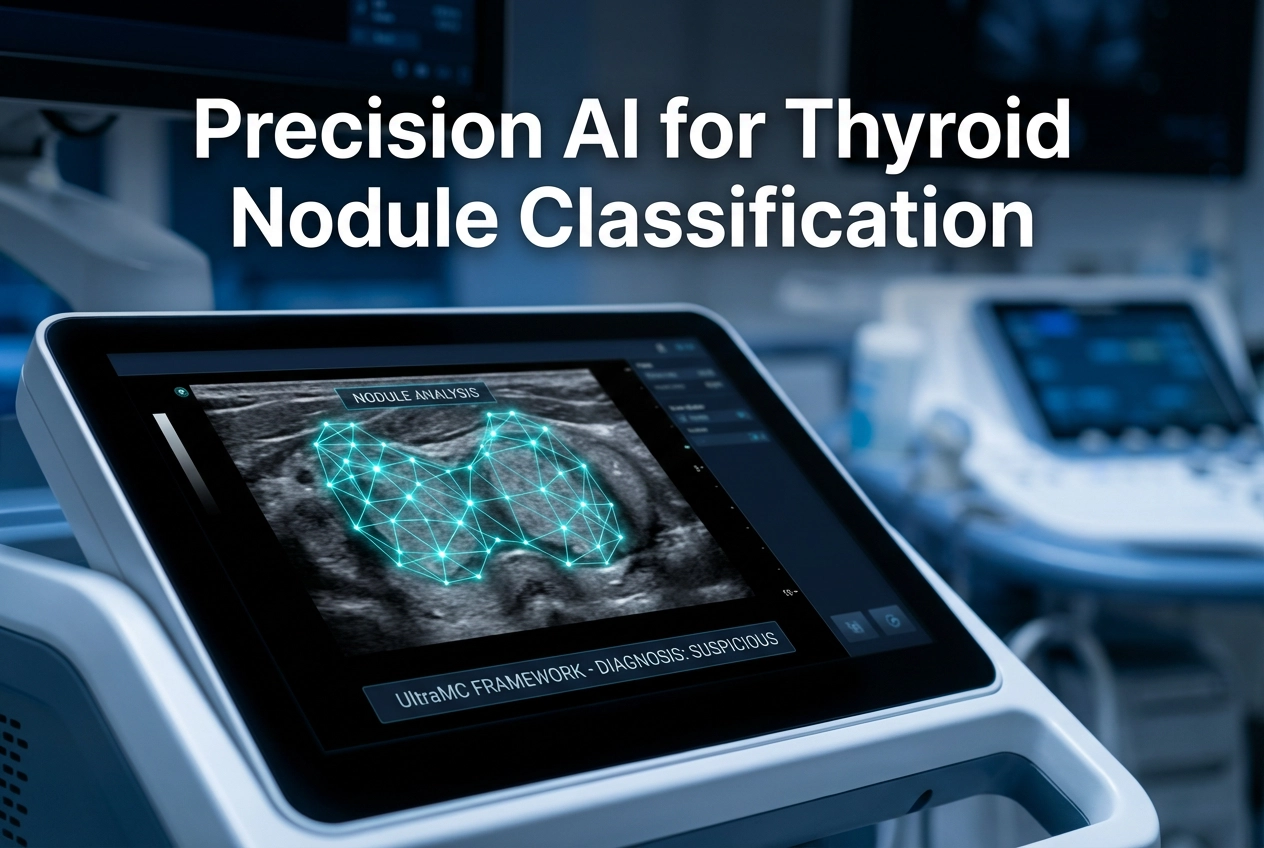
Machine learning thyroid models are rapidly transforming diagnostic imaging. Consequently, a new study presents UltraMC, a two-layer interpretable classification model. This innovative system accurately recognizes complex and conventional thyroid nodules using digitized ultrasound features. The model was developed using a massive retrospective dataset collected from seven Chinese medical centers over ten years (January 2011 to December 2021). The total dataset included 73,826 patients, demonstrating the scale of this research. Furthermore, the clinical relevance of this work is significant for doctors worldwide.
UltraMC: A Novel Two-Layer Machine Learning Thyroid Architecture
The UltraMC model employs a unique two-layer architecture. Specifically, the front-end network is trained to efficiently identify conventional thyroid nodules using four key digitized features. This first layer achieved a high diagnostic accuracy of 92.9% (13718/14765) for detecting these common nodules. Moreover, the back-end network then analyzes nodules that the front-end classified as benign. This secondary analysis aims to clarify the final diagnosis of complex or “mummified thyroid nodules” (MTNs). The complexity of thyroid nodule classification often requires a multi-step approach.
Performance Metrics and Clinical Impact
The back-end network demonstrated strong performance, achieving 88.5% accuracy in classifying mummified thyroid nodules (MTNs). However, the overall diagnostic accuracy of the complete UltraMC system was 91.8% (14228/15502). The areas under the receiver operating characteristic curve (AUCs) were also high. The front-end network’s AUC for identifying conventional thyroid nodules was 0.98. While the overall UltraMC AUC was 0.96. These findings confirm the model’s robust performance. Previous research supports the use of deep learning methods for improved classification accuracy in thyroid nodule diagnosis. Therefore, integrating such a white-box framework with digitized ultrasound features is highly effective for complex nodule classification. This development shows great promise for enhancing diagnostic precision in clinical practice.
Frequently Asked Questions
Q1: What is UltraMC and its primary purpose?
UltraMC is a two-layer interpretable machine learning classification model. Its primary purpose is to accurately recognize both conventional and complex (mummified) thyroid nodules using digitized ultrasound features, thereby supporting efficient diagnosis.
Q2: What was the overall diagnostic accuracy of the UltraMC model?
The UltraMC model achieved an overall diagnostic accuracy of 91.8% in classifying the thyroid nodules. This high accuracy demonstrates the model’s effectiveness across different nodule types.
References
- Li Z et al. Interpretable Machine Learning Model Using Digitized US Features for Classifying Complex Thyroid Nodules. Radiol Artif Intell. 2026 Feb 04. doi: 10.1148/ryai.250383. PMID: 41636619.
- Thyroid Disease Classification using Machine Learning Algorithms. E3S Web of Conferences.
- The Use of Artificial Intelligence in the Diagnosis and Classification of Thyroid Nodules: An Update. PMC.
- Utilizing Machine Learning for Thyroid Disease Classification. Indian Institution of Industrial Engineering.