
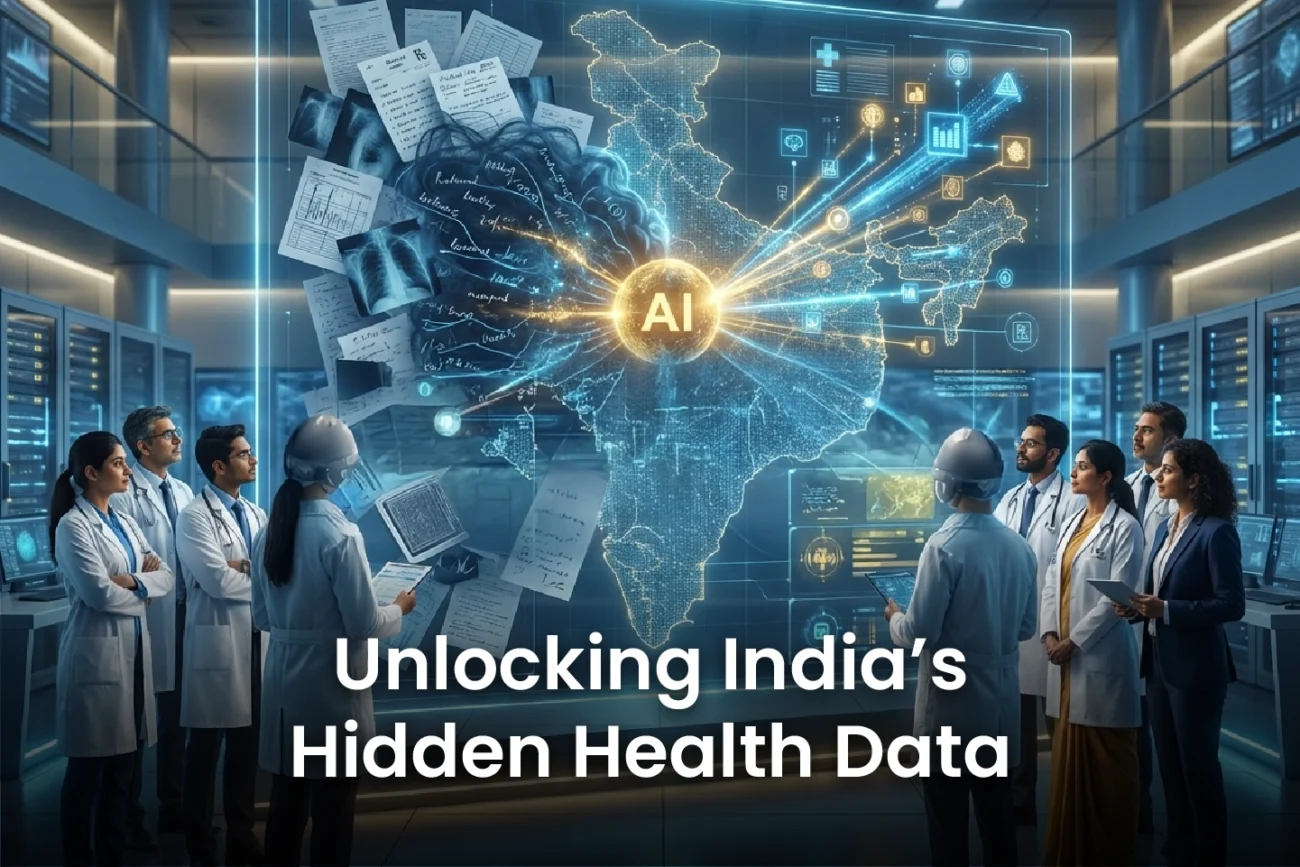
The healthcare industry’s vast pool of unstructured clinical data presents a monumental opportunity for companies developing Artificial Intelligence (AI) solutions. Most patient information remains locked in free-text notes, PDFs, and reports. Consequently, AI firms in the healthcare sector are now moving quickly to unlock and monetize this crucial, untapped data.
Experts and market watchers note that approximately 80% of health data is currently trapped within unstructured formats. This “dark data” contains the most critical clinical information: a doctor’s reasoning, the context of symptoms, and the patient’s full story. For decades, traditional software relying on structured fields like billing codes missed this entire nuance. Furthermore, because this information lacks a predefined format, it has required a manual, time-consuming effort to analyze. The ability to finally make the full clinical narrative of a patient computable and scalable represents healthcare AI’s most valuable opportunity. Therefore, unlocking this hidden information will reshape everything from hospital operations to sophisticated medical research.
Unlocking Unstructured Clinical Data with AI and NLP
Advanced technologies are bridging the gap between raw data and usable insights. Natural Language Processing (NLP), a key branch of AI, allows computers to understand, interpret, and convert the messy, human-generated free-text data at scale. Clinical NLP excels at identifying and extracting specific entities like medical conditions, medications, and procedures from notes. In addition, it facilitates rapid information retrieval and improves data quality by identifying inconsistencies. AI, specifically Large Language Models (LLMs), represents the first technology capable of reading and understanding this unstructured clinical data efficiently. Consequently, LLMs are powering clinical decision support systems (CDSS) that process and interpret patient-specific data for more informed, timely decisions. For instance, researchers are using LLMs to create “digital twins” of patients to accurately predict health trajectories and simulate clinical trial outcomes.
India’s AI Health Market and Global Investment
The Indian healthcare market is experiencing rapid transformation, driven by the integration of AI and advanced tech. Start-ups such as Eka Care, HealthPlix, and Axone Health are actively working to standardize India’s often chaotic medical records. Eka Care, for example, uses generative AI to parse unstructured data like voice notes and prescriptions into structured, interoperable formats. While the number of AI-driven healthcare companies in India remains modest (eight in 2024), the sector is set for significant growth. This momentum is further fueled by robust investments from global corporations. Eli Lilly, Bristol Myers Squibb, Amgen, Sanofi, and Novo Nordisk are all expanding their Global Capability Centers (GCCs) in India, focusing on R&D, digital, AI, and advanced analytics capabilities. Moreover, the integration of AI is redefining drug discovery, development, and supply chain, improving speed and precision across the value chain. India’s intersection of life sciences, data, and digital offers an unparalleled opportunity to leapfrog traditional models and establish leadership in high-value innovation.
Frequently Asked Questions
Q1: What exactly is unstructured clinical data?
Unstructured clinical data is healthcare information that lacks a predefined, organized format. This includes physician’s free-text notes, clinical narratives, medical images, patient correspondence, and scanned lab reports.
Q2: Why is unlocking this data so important for AI in healthcare?
Unstructured data accounts for an estimated 80% of all clinical information, holding the key context of a patient’s full story and a doctor’s reasoning. Unlocking this information with tools like Natural Language Processing (NLP) is necessary to make the patient’s clinical narrative computable, scalable, and usable for AI-driven diagnostics and personalized treatment. Professionals looking to advance their data analysis skills in clinical settings may benefit from an Certification Course In Clinical Imaging.
Q3: How are Large Language Models (LLMs) used to process this data?
LLMs are the first technology that can read and understand the “messy,” human-generated free-text data at scale, converting it into structured data. They are used for automated clinical documentation, aiding diagnostics, and powering clinical decision support systems. Mastering cutting-edge analytical tools is crucial for modern practitioners, especially in areas like Postgraduate Diploma In Clinical Drug Development.
References
- Unstructured clinical data opens fresh market for AI firms – ETHealthworld
- Natural Language Processing in Healthcare – ForeSee Medical
- Large Language Models in Healthcare and Medical Applications: A Review – PMC
- Clinical NLP | State-of-the-art Natural Language Processing to extract Clinical Data – John Snow Labs
- Natural Language Processing in Healthcare Explained – Consensus Cloud Solutions
- Natural Language Processing in Healthcare: A Game-changer for Medical Data Analysis – Veritis
- The Power of Medical Large Language Models (LLMs) in Healthcare – John Snow Labs
- AI Meets Healthcare: How Large Language Models Are Saving Lives and Revolutionizing Medicine – Pacific Data Integrators
- 3 Ways Natural Language Processing (NLP) Can Impact Healthcare – MDClone
- Large Language Models in Healthcare and Medical Domain: A Review – MDPI
- Unstructured clinical data opens fresh market for AI firms – The Economic Times
- AI tool creates ‘digital twins’ of patients to predict their future health – The University of Melbourne
- India’s Healthcare AI Start-ups Grapple with A Broken Data Ecosystem – Outlook Business
- This healthtech startup is using AI to standardise India’s chaotic medical records | YourStory
- Challenges AI is Facing for Advancing Patient Safety in Healthcare, ETHealthworld
Disclaimer: This article was automatically generated from publicly available sources and is provided for informational and educational purposes only. OC Academy does not exercise editorial control or claim authorship over this content. It is not a substitute for professional medical advice, diagnosis, or treatment. Always consult a qualified healthcare provider and refer to current local and national clinical guidelines.