
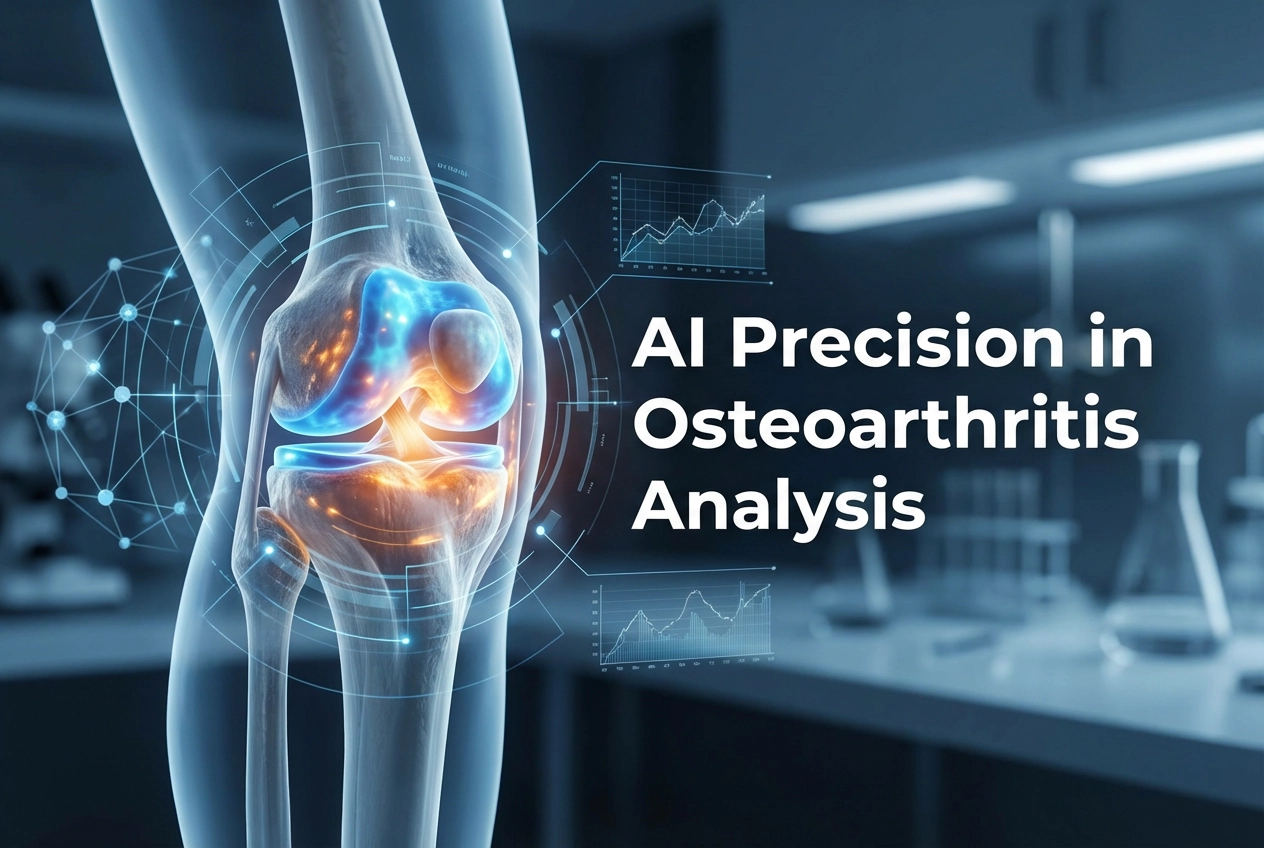
AI cartilage analysis offers a breakthrough for managing knee osteoarthritis in clinical settings. A recent study introduced an automatic framework that transforms MRI scans into high-resolution thickness maps. This system significantly improves how doctors track joint degeneration over time. Consequently, healthcare providers can now identify structural changes years before they appear on standard X-rays.
Advancing Diagnostics with AI Cartilage Analysis
The researchers developed this framework to overcome the limits of manual assessment. Traditionally, evaluating cartilage loss required tedious expert grading, which lacked scalability. However, the new tool uses a 3D-UNet to segment bones and tissues automatically. It processes massive datasets from the Osteoarthritis Initiative with remarkable speed. Furthermore, the system produces a Cartilage Thickness Score (CTh-Score) ranging from 0 to 100. This numerical value provides a clear snapshot of disease severity. Specifically, a score of zero indicates a healthy joint, while 100 represents end-stage disease.
High-Resolution Mapping and Clinical Scaling
Precision remains the core advantage of this digital approach. The study confirmed that the CTh-Score shows excellent reproducibility with an ICC of 0.98. Moreover, the score correlates strongly with expert MOAKS grading. Therefore, clinicians can trust these automated metrics for long-term patient monitoring. Because the software is scalable, it can handle thousands of patients in large-scale clinical trials. This efficiency allows researchers to screen for potential disease progressors more effectively. Consequently, the technology identifies structural changes up to six years before traditional KL grading detects progression on X-rays.
Better Monitoring for Indian Orthopedic Care
In India, the high prevalence of osteoarthritis demands efficient diagnostic tools. Most patients only receive a diagnosis after significant joint damage occurs. However, this framework identifies the early therapeutic window for intervention. Doctors can use these high-resolution maps to evaluate treatment success or failure. Additionally, the open availability of the dataset and project tools encourages global collaboration. This innovation supports better clinical decision-making and personalized patient care.
Frequently Asked Questions
Q1: How does AI cartilage analysis differ from traditional X-rays?
Traditional X-rays only show bone changes and indirect signs of cartilage loss. In contrast, AI analysis of MRI scans provides direct, high-resolution maps of cartilage thickness and detects damage years earlier.
Q2: Is the CTh-Score reliable for long-term monitoring?
Yes, the study demonstrated excellent reproducibility and a strong correlation with expert clinical assessments. It reliably tracks whether cartilage remains stable or degrades over several years.
References
- Margain P et al. Automatic framework for evaluating osteoarthritic cartilage severity: high-resolution cartilage thickness mapping and scoring. Eur Radiol. 2026 Mar 24. doi: 10.1007/s00330-026-12414-w. PMID: 41874622.
- Jo S et al. Artificial Intelligence and Machine Learning for Osteoarthritis and Cartilage Assessment. ResearchGate. 2026.
- Sivakumari et al. Recognition of Knee Osteoarthritis Using Deep Learning: A Review. MDPI. 2026.