
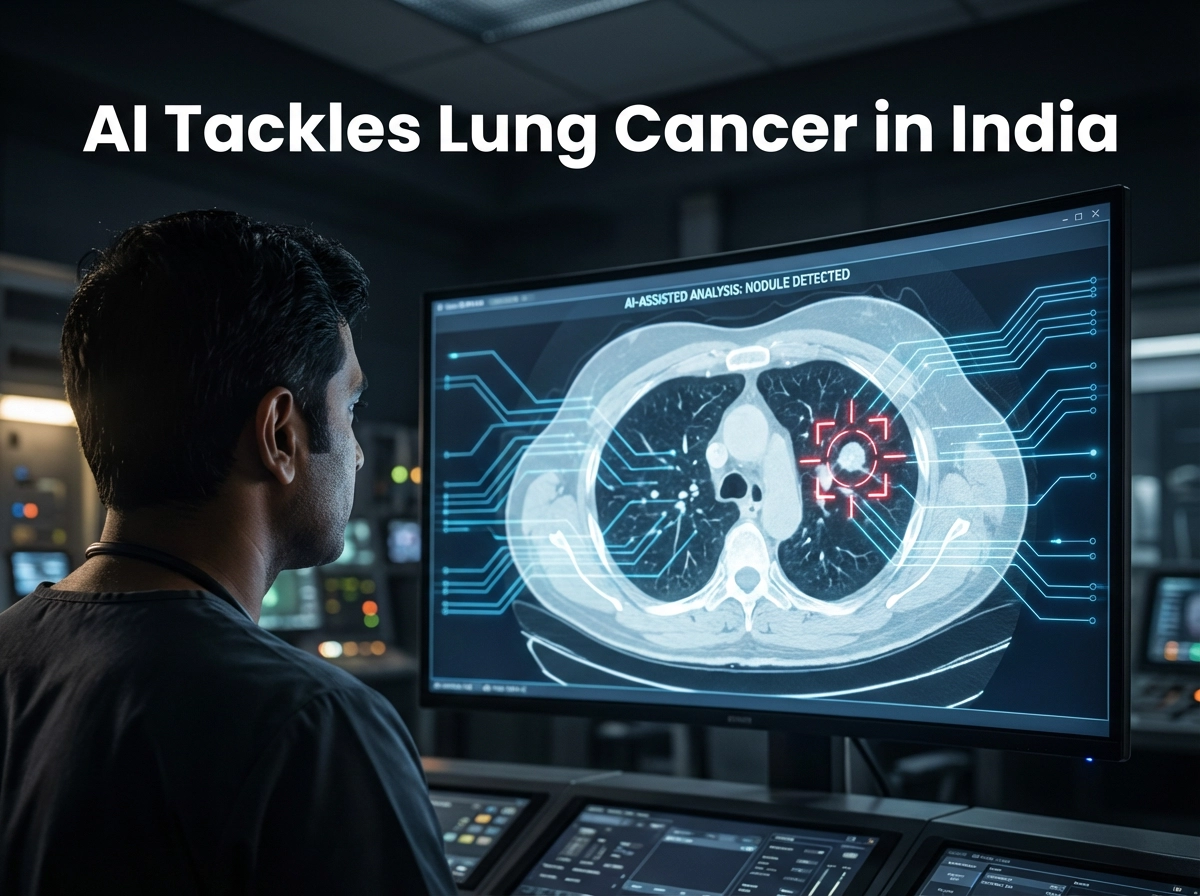
Yashoda Hospital, Hitech City, recently launched an advanced **AI lung nodule detection** clinic in collaboration with Qure.ai and AstraZeneca. This pioneering initiative embeds Artificial Intelligence across the entire imaging-to-care pathway. Since India currently lacks a national lung cancer screening programme, this step is critical. Lung cancer remains the leading cause of cancer-related deaths in India, claiming over one lakh lives annually. Therefore, early intervention is essential. Almost 80% of lung cancer cases in India are detected at advanced stages when curative treatment is unlikely. Experts project that the incidence of lung cancer will rise from approximately 63,700 cases in 2015 to 81,200 cases by 2025, underscoring this public health challenge.
The Mechanism of AI Lung Nodule Detection
The AI-enabled lung nodule clinic provides a structured method for identifying early signs of lung cancer. Significantly, this includes findings in asymptomatic individuals. Pulmonary nodules are small lesions under three centimetres, and they often represent the earliest indicators of lung cancer. These nodules can be easily missed on routine chest X-rays. The integrated AI system at Yashoda Hospitals’ Department of Pulmonology ensures consistent detection, risk stratification, and structured follow-up of these findings. In fact, Qure.ai’s qXR solution, which is FDA-cleared, has shown a high Area Under the Curve (AUC) of 0.99 for nodule detection in validation studies. Furthermore, AI assistance significantly improves a reader’s ability to detect and localize more nodules. The AI system has already analyzed more than 17,000 chest X-rays since deployment. It identified 960 lung nodules, classifying 136 of them as high-risk. Consequently, 77 patients were fast-tracked for CT scans and specialist review.
Advanced Diagnostics and Coordinated Care
Early findings from the clinic confirm lung cancer cases, but they also demonstrate the pathway’s wider clinical value. The AI has identified other major lung diseases, including tuberculosis, sarcoidosis, and lymphoma. The Interventional Pulmonology team supports precise diagnosis. Therefore, they utilise advanced tools like radial endobronchial ultrasound and navigational bronchoscopy. They also use cone-beam CT–guided sampling to biopsy even the smallest lesions. Dr. V. Nagarjuna Maturu, Senior Consultant, Clinical and Interventional Pulmonology, stated the program embeds AI within clinical workflows to manage lung disease earlier. Moreover, this pathway assists patients who fall outside conventional screening criteria. A dedicated nurse-navigator model guides every AI-flagged patient promptly through the next steps. This model also standardises protocols, timelines, and documentation across departments. Ultimately, the AI-augmented pathway transforms incidental findings into actionable clinical outcomes. This marks a significant step toward data-driven respiratory care in India. Professionals looking to enhance their skills in this area can pursue specialized training in lung cancer management or explore broader radiology courses.
Frequently Asked Questions
Q1: What is the primary goal of the new AI-enabled Lung Nodule Clinic?
The primary goal is to strengthen the early detection and timely management of lung cancer and other major lung diseases in India. The clinic uses an AI-powered system to identify early radiologic signs of lung cancer in both symptomatic and asymptomatic individuals, providing a structured care pathway.
Q2: How accurate is the AI system for detecting lung nodules?
The underlying AI technology, qXR by Qure.ai, has shown high accuracy, achieving an Area Under the Curve (AUC) score of up to 0.99 for nodule detection in validation studies. Furthermore, using the AI tool significantly improved the detection and localization of nodules by readers.
Q3: What critical gap does the AI lung nodule pathway address in India?
Since India does not currently have a national lung cancer screening program, this AI-enabled pathway provides a robust, structured mechanism for identifying and managing incidental pulmonary findings, thereby addressing the high rate of late-stage lung cancer diagnosis. Advances in diagnostic imaging are central to improving radiology specialization.
References
- AI-Enabled Lung Nodule Clinic Launched to Boost Early Lung Cancer Detection – ETHealthworld
- India’s lung cancer burden in numbers – India Today
- Lung cancer in India: Current status and promising strategies – PMC – NIH
- Qure’s Chest X-ray AI gets FDA nod for lung nodule detection – Qure.ai
- Yashoda Hospitals-Hitech City launches AI-enabled lung nodule clinic – The Hindu
- AI-Powered Incidental Lung Cancer Detection – Qure.ai
- AI Detects Lung Nodules Leading to Lung Cancer Nearly 3 Years Before Symptoms, Study Shows – digitalhealthnews.com
Disclaimer: This article was automatically generated from publicly available sources and is provided for informational and educational purposes only. OC Academy does not exercise editorial control or claim authorship over this content. It is not a substitute for professional medical advice, diagnosis, or treatment. Always consult a qualified healthcare provider and refer to current local and national clinical guidelines.